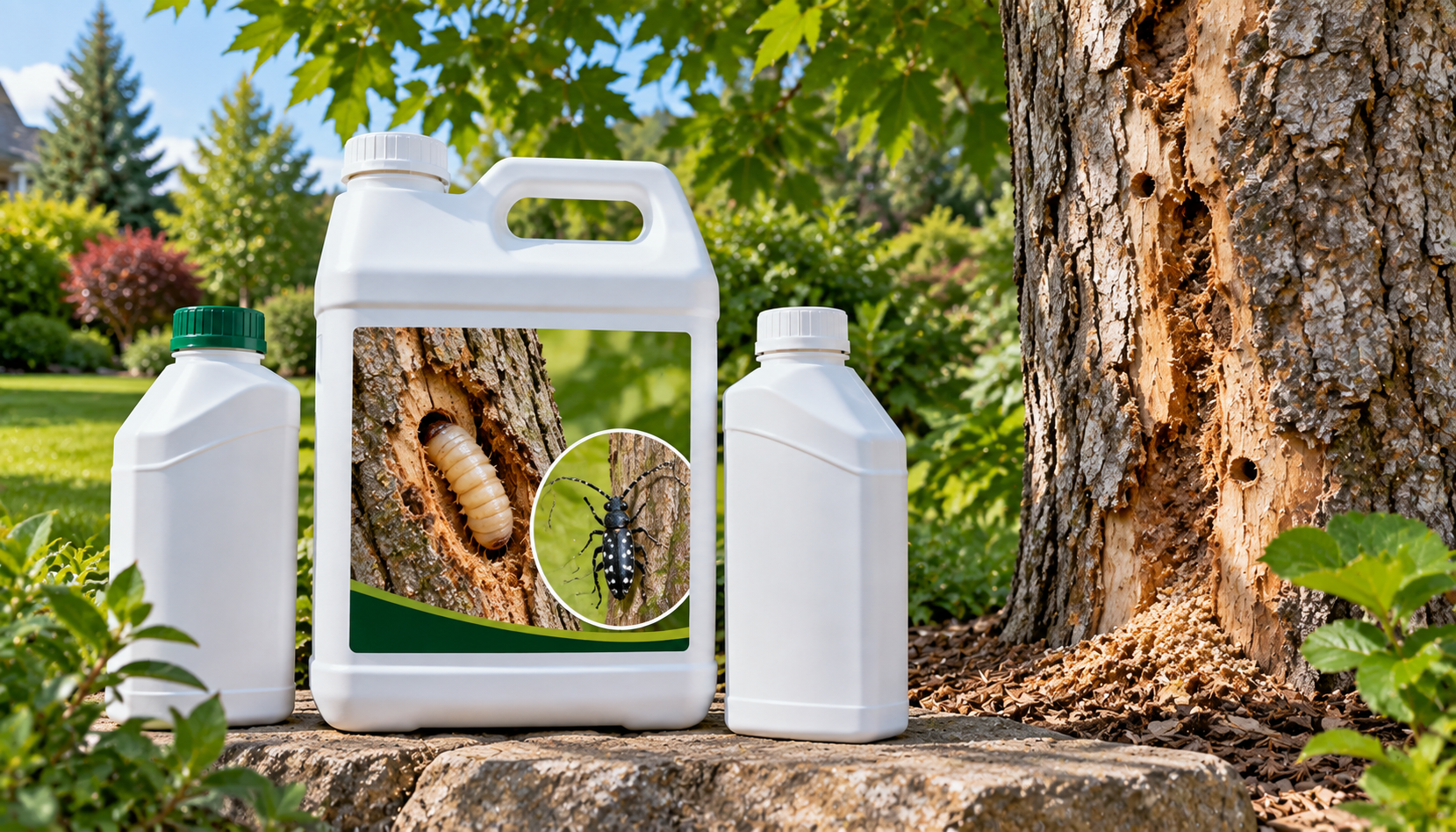
The best insecticide for tree borers can help protect valuable trees when boring insects begin attacking trunks, branches, and other woody tissues. Because larvae often remain concealed beneath bark or inside the wood, successful control depends on identifying the borer, understanding its life cycle, and selecting a treatment that reaches the vulnerable stage.
Tree borer infestations can be difficult to recognize at first because early symptoms may resemble drought stress, disease, or ordinary branch decline. Small holes, sawdust-like frass, cracked bark, dying shoots, and unexplained dieback can provide important clues, particularly when several signs appear on the same tree.
Different tree borer insecticides work in different ways, with contact treatments protecting exposed bark while systemic products move through the tree and can reach certain larvae or adults feeding within plant tissues. The most suitable option depends on the tree species, borer type, infestation stage, tree size, application timing, and whether the product is labeled for the intended use.
In this guide, we examine 10 insecticide and treatment options for tree borers and explain where each one can be most useful. We will also cover application timing, preventive bark protection, treatment limitations, tree health, professional intervention, and answers to common questions about controlling boring insects before they cause serious structural damage.
Best Insecticide For Tree Borers
1. Imidacloprid Systemic Insecticide — Best systemic insecticide for tree borers
Imidacloprid systemic insecticide is used against various sap-feeding and wood-associated insect pests, and certain formulations can be considered for specific tree borer situations when the label permits the application. Because systemic products are absorbed by the tree, they can provide an advantage where direct contact with insects hidden beneath bark is difficult.

- THE TOP PICK FOR GRUB AND INSECT CONTROL: Mineiro 2 F Flex contains 21.4% imidacloprid; the same active ingredient as the Leading Brand, the industry-standard insecticide in preventive grub control for more than 20 years.
- LONG-LASTING PREVENTION: When it comes to grubs, don’t underestimate the power of prevention. Mineiro 2 F Flex delivers lasting power to catch grubs throughout their hatching season – preventing them from growing into feeding, reproducing adult grubs.
However, effectiveness depends heavily on the borer species and feeding behavior because not every larva receives enough active ingredient simply because the tree has absorbed the product. Application timing also matters, particularly when the objective is to affect larvae or adults during a susceptible stage.
Systemic treatment should therefore be viewed as part of a broader management program rather than a guaranteed cure for heavily damaged trees. Improve the tree’s growing conditions, remove severely damaged branches when appropriate, monitor for new emergence holes, and follow the exact product label concerning dosage, application method, and environmental precautions.
Pros:
- Systemic action
- Good canopy distribution
- Longer residual
- Targets sap feeders
- Useful for large trees
- Reduced surface spraying
- Preventive potential
Cons:
- Species dependent
- Pollinator concerns
- Slow response
2. Permethrin Insecticide — Best contact insecticide for tree borers
Permethrin insecticide is a synthetic pyrethroid found in numerous pest-control formulations and can be useful against certain adult or exposed borer stages when the specific product is labeled for the target pest. Contact treatments are especially relevant when insects are active on bark surfaces or before larvae successfully penetrate protected woody tissue.

- Rapid-kill livestock insecticide concentrate
- SAFE: Permethrin is highly toxic to insects but not to animals or humans
Timing is particularly important because spraying after larvae have moved deeply into wood may provide limited benefit. Consequently, monitoring adult activity, emergence holes, bark damage, and known seasonal patterns can help determine when a properly labeled bark treatment is most likely to work.
Permethrin products vary considerably in concentration and approved application sites, so never assume that one formulation can be substituted for another. Follow the current label concerning tree species, target pest, dilution, application frequency, protective equipment, and precautions around beneficial insects and waterways.
Pros:
- Contact action
- Fast knockdown
- Useful bark treatment
- Multiple formulations
- Good adult control
- Widely available
- Useful preventively
Cons:
- Limited deep penetration
- Can harm beneficials
- Timing sensitive
3. Bifenthrin Insecticide — Best residual insecticide for tree borers
Bifenthrin insecticide is another pyrethroid active ingredient used in many landscape and professional pest-control products. Certain formulations provide residual activity on suitable bark or surrounding surfaces, which can make them useful against exposed adult insects when the product is specifically labeled for the target borer.

- Dependable, long-lasting residual control.
- Non-irritating, no-odor formulation dries with no visible residue.
Unlike a systemic treatment, bifenthrin does not simply travel through the tree to find larvae hidden deep inside the wood. Instead, its value generally comes from protecting appropriate surfaces during the period when adult borers or other susceptible stages are exposed.
For that reason, treatment timing should be coordinated with the borer’s life cycle whenever reliable information is available. Keep the application focused on the labeled treatment zone and avoid unnecessary spraying across flowers, water, or areas supporting beneficial insects.
Pros:
- Residual activity
- Contact control
- Useful bark protection
- Multiple formulations
- Longer surface activity
- Suitable for prevention
- Professional use potential
Cons:
- Limited internal control
- Non-target effects
- Timing matters
4. Cypermethrin Insecticide — Best residual treatment for exposed tree borers
Cypermethrin insecticide is a pyrethroid used in a variety of insect-control products and can provide contact or residual activity depending on the formulation. A properly labeled product may be useful for protecting suitable tree surfaces during periods when adult borers are active and exposed.

- Cypermethrin 40%
- Cyper can be used in the following locatons; Commercial and Resdential Structures, Hospitals, Nursing Homes, Non-Food Handling Areas, and Outdoors.
First, confirm the borer species and determine whether the insecticide specifically covers that pest. This step matters because borer species differ in behavior, host preference, emergence period, and susceptibility to particular treatments.
Cypermethrin should not be expected to penetrate deeply enough to solve every established infestation. Nevertheless, appropriately timed surface treatment can help reduce reinfestation pressure when combined with pruning, sanitation, tree-health management, and continued monitoring.
Pros:
- Residual control
- Contact action
- Useful surface treatment
- Multiple pest uses
- Good adult control
- Suitable for targeted use
- Useful preventively
Cons:
- Limited larval reach
- Can affect beneficials
- Label dependent
5. Carbaryl Insecticide — Best broad-spectrum insecticide for tree borers
Carbaryl insecticide is a broad-spectrum product that has been used against numerous insect pests, including certain tree-infesting insects where specific formulations and labels permit. Its broad activity can be useful in some pest-management programs, although it also increases the importance of avoiding unnecessary applications.

- 2.5 gallon jug containing 43.4% Carbaryl
- Wonderful insecticide with many listed problem insects
Because tree borers spend important portions of their life cycle inside wood, the timing of a carbaryl application is more important than simply applying the product after damage becomes visible. Treatment may be more effective when directed toward exposed adults or other vulnerable stages before significant egg laying and larval penetration occur.
Use only the formulation approved for the tree, site, and target pest, and follow all restrictions concerning application rate and environmental exposure. Where a more selective or less disruptive method is available, it may be preferable, especially around flowering trees and areas containing beneficial insects.
Pros:
- Broad-spectrum control
- Multiple pest uses
- Contact activity
- Useful against adults
- Widely recognized
- Landscape applications
- Targeted treatment potential
Cons:
- Broad insect activity
- Can harm predators
- Timing dependent
6. Horticultural Oil — Best oil treatment for tree borer prevention
Horticultural oil is commonly used against insects and mites that remain exposed on plant surfaces, and it can have a role in some preventive tree-pest programs. Its usefulness against tree borers is more limited than that of a treatment specifically designed for exposed adult borers, so the product label and target species must be checked carefully.

- Control insects and diseases in your home garden with All Seasons Horticultural and Dormant Spray Oil Concentrate; use year-round to control listed insects and diseases
- Active ingredient refined mineral oil is approved for organic gardening and the production of organic produce and ornamentals; can be used during the growing season

Oil is generally most useful when the target insect or life stage is accessible on the bark or foliage rather than deeply embedded inside woody tissue. Therefore, it should not be viewed as a way to smother larvae that have already tunneled far beneath the bark.
When used appropriately, horticultural oil can complement broader tree-care practices and may help with other scale or mite problems occurring at the same time. Apply under suitable conditions and follow directions concerning temperature, dilution, tree sensitivity, and coverage to minimize the risk of plant injury.
Pros:
- Contact action
- Useful exposed pests
- Supports IPM
- Multiple pest uses
- Low residue
- Useful maintenance tool
- Simple application
Cons:
- Limited borer reach
- Weather sensitive
- Coverage required
7. Neem Oil — Best botanical treatment for exposed tree pests
Neem oil is a botanical pest-control option that gardeners sometimes use against various insects and mites. Its potential value for tree borers is greatest when the target pest is exposed and the specific product label permits the intended application, rather than after larvae have become deeply established inside wood.

- Protect your oasis with 3 garden products in 1 from Captain Jack’s; Bonide Captain Jack’s Ready-to-Use Neem Oil spray for plants is a multi-purpose fungicide, insecticide and miticide for your lawn & garden
- Clarified Hydrophobic Extract of Neem Oil protects your garden from common fungal diseases including rust, powdery mildew and more; apply to house plants, roses, trees, shrubs, fruits, nuts & vegetables for effective protection against garden diseases
Neem products vary considerably, so the label should be checked for the tree species, pest, and application site before treatment. A botanical formulation should also not be assumed to be harmless to beneficial insects, particularly when sprayed directly onto flowering plants or areas containing active pollinators.
For established borer infestations, neem is better regarded as a supplementary option than a dependable stand-alone cure. Combine any appropriate treatment with pruning, removal of infested wood, improved tree vigor, and monitoring for adult emergence or fresh damage.
Pros:
- Botanical formulation
- Multiple pest uses
- Contact activity
- Supports IPM
- Useful exposed pests
- Easy application
- Low-residue option
Cons:
- Limited deep control
- Variable effectiveness
- Can affect beneficials
8. Spinosad Insecticide — Best biological-derived insecticide for tree pests
Spinosad insecticide is derived from naturally occurring compounds produced by soil microorganisms and is used against a range of insect pests. Depending on the formulation and label, it may be useful against certain exposed insect stages, but its suitability for a particular tree borer must always be confirmed.

- CONTROLS A VARIETY OF INSECTS - Designed to control Adelgids, Ants, Aphids, Armyworms, Beetles including ColoradoPotato Beetle, Borers, Caterpillars, Chinch Bugs, Codling Moth, Earwigs, Fruit Flies, Gypsy Moth, Lace Bugs, Leafhoppers and more. See label for full list.
- DESIGNED FOR OUTDOOR USE - Apply this product to Vegetables, Trees, Shrubs, Flowers, Fruits & Citrus to control listed insects and pests. Great for gardens, lawns, ornamentals and greenhouses.
Spinosad is generally more relevant when the target insect is exposed and actively feeding than when a mature larva is completely protected inside a tree trunk. As a result, identifying the borer’s life cycle can make the difference between a useful application and a disappointing one.
Apply only according to the product label and take particular care around bees and other pollinators because spinosad can be hazardous to them when wet. Targeted application and appropriate timing can reduce unnecessary exposure while improving the likelihood of controlling susceptible pest stages.
Pros:
- Microbial-derived ingredient
- Broad insect activity
- Useful exposed stages
- Supports IPM
- Multiple formulations
- Targeted treatment
- Useful feeding pests
Cons:
- Pollinator risk
- Limited deep reach
- Timing sensitive
9. Insecticide Bark Spray — Best bark treatment for tree borers
Insecticide bark spray refers to properly labeled products designed to protect suitable tree surfaces from insects that contact or land on treated bark. This method can be especially useful as a preventive measure when adult borers are expected to emerge and lay eggs on the tree.

- No chemical exposure to applicator or the environment
- Season-long control of tree pests, up to two seasons in evergreen trees
The treatment does not necessarily reach larvae already protected inside the wood, which is why application timing is so important. Ideally, the product should be applied according to the pest’s known emergence period and the exact directions provided by the manufacturer.
Thorough coverage of the labeled bark area is important, but spraying should never be expanded beyond the permitted application zone. If the tree already has extensive galleries, dead branches, or structural weakening, surface treatment alone may be insufficient and professional assessment is advisable.
Pros:
- Targets bark surfaces
- Useful preventively
- Good adult protection
- Targeted application
- Easy monitoring
- Suitable for timing programs
- Useful landscape method
Cons:
- Limited larval control
- Timing dependent
- Coverage required
10. Professional Tree Borer Treatment — Best treatment for severe tree borer infestations
Professional tree borer treatment is often the safest and most effective option when an infestation has progressed beyond what ordinary homeowner equipment can address. Certified arborists or pest-management professionals can identify the borer, assess the extent of internal damage, and determine whether pruning, systemic treatment, bark protection, removal, or a combination of measures is appropriate.

- Auger Drill Bit Drilling Size,Diameter: 5/16" , Total Length: 16" Please confirm the size before purchasing
- Advantage: The Tri-Flute solid center design of this wood drill bit ensures maximum rigidity while boring, while the screw-point tip aids in accurate positioning and effortless cutting entry
This approach becomes particularly valuable when the tree is mature, structurally important, difficult to reach, or located near buildings and people. Professionals can also distinguish active infestations from old borer damage, which prevents unnecessary pesticide applications to trees that no longer contain a live pest population.
Severely weakened trees may present a greater problem than the insects themselves because extensive galleries can compromise branches and trunks. A qualified professional can therefore evaluate structural safety while developing a pest-management plan, rather than treating the insect problem in isolation.
Pros:
- Expert diagnosis
- Specialist equipment
- Better canopy access
- Customized treatment
- Useful severe cases
- Structural assessment
- Reduced exposure
Cons:
- Higher cost
- Requires scheduling
- Availability varies
Buyer’s Guide
1. Identify The Borer Species
Correct identification is the starting point because different tree borers have different host preferences, life cycles, emergence periods, and treatment vulnerabilities. Look for exit holes, frass, galleries, bark damage, adult insects, and patterns of branch decline before choosing an insecticide.
2. Consider The Larval Location
Some treatments work mainly against insects exposed on bark, while systemic products may reach certain pests feeding within plant tissues. A pesticide that works well against exposed adults may provide little benefit once larvae are deeply protected inside the wood.
3. Pay Attention To Timing
Borer management is often more successful when treatment is synchronized with adult emergence or another vulnerable stage. Check reliable local information about the pest’s life cycle and follow the application timing stated on the product label.
4. Assess Tree Health
Water stress, root damage, poor drainage, compacted soil, and mechanical injuries can make trees more vulnerable to boring insects. Improving growing conditions can help a tree tolerate damage and recover more effectively alongside appropriate pest control.
5. Choose Contact Or Systemic Control
Contact insecticides are generally aimed at exposed insects and treated surfaces, whereas systemic products are absorbed by the plant. Consider the borer’s biology, tree size, infestation stage, flowering status, and product label before deciding which approach is appropriate.
6. Remove Severely Damaged Wood
Pruning can sometimes remove concentrated infestations and reduce sources of reinfestation, particularly when affected branches are already dead or structurally compromised. Dispose of infested wood appropriately rather than storing it beside healthy trees where emerging insects can continue their life cycle.
7. Know When To Call A Professional
Large trees, extensive trunk damage, inaccessible canopies, recurring infestations, or uncertainty about the borer species are good reasons to seek professional help. An arborist or qualified pest-management professional can assess both pest activity and the structural condition of the tree.
FAQs
1. What is the best insecticide for tree borers?
The best insecticide for tree borers depends on the borer species, tree type, pest life stage, and product registration in your area. Systemic insecticides may be useful for certain internal-feeding pests, while properly timed bark treatments can protect against exposed adults and newly arriving insects.
2. What insecticide kills tree borer larvae?
Some systemic insecticides can reach susceptible larvae feeding within living tree tissues, but effectiveness varies substantially between borer species and products. Larvae deeply established inside dead or heavily damaged wood can be much harder to control, making early diagnosis particularly important.
3. Can I spray the trunk to prevent tree borers?
Some insecticides are specifically labeled for bark or trunk applications designed to protect trees from certain adult borers. These treatments can be useful when timed correctly, but they should only be applied to tree species and target pests specifically covered by the product label.
4. Will permethrin kill tree borers?
Permethrin can control certain exposed insect stages when the specific formulation is labeled for the target borer and application site. It is generally less useful against larvae already protected deep inside woody tissue, which is why timing before or during adult activity can be important.
5. How do I know if my tree has borers?
Common warning signs include small exit holes, sawdust-like frass, tunnels beneath bark, cracked or loose bark, dying shoots, branch dieback, and unexplained decline. Because several tree diseases and environmental problems can produce similar symptoms, confirmation of active borer infestation is preferable before treatment.
6. Can a tree recover from borer damage?
A tree can sometimes recover when the infestation is detected early and the remaining vascular and structural tissues are healthy. Recovery becomes less likely when extensive galleries, trunk damage, repeated attacks, severe dieback, or major structural weakening have already occurred.
7. How can I prevent tree borers from returning?
Maintain tree vigor through appropriate watering, suitable soil conditions, correct pruning, and avoidance of unnecessary trunk injuries. Monitoring for adult activity and applying a properly labeled preventive treatment when appropriate can also reduce the chance of successful reinfestation.
Conclusion
In conclusion, the best insecticide for tree borers is the one that matches the borer species, vulnerable life stage, tree condition, and permitted application method. A properly labeled systemic insecticide is the best overall option for certain internal-feeding borers because it can move through living tree tissues where surface sprays may have limited reach.
A well-timed permethrin or bifenthrin bark treatment is the runner-up when the main objective is protecting exposed tree surfaces from adult borers. Gardeners may prefer this approach when the pest’s emergence period is known and the product label specifically supports preventive bark treatment.
Effective borer management also depends on accurate identification, treatment timing, tree vigor, pruning, sanitation, canopy access, and the location of active larvae. Contact insecticides can protect exposed surfaces, systemic products may help with suitable internal feeders, and cultural practices can reduce the stress that makes trees more vulnerable to repeated attack.
The best recommendation is to act before a borer infestation causes extensive structural damage rather than waiting until branches begin dying back. Select a properly labeled treatment, synchronize applications with the pest’s life cycle, maintain the tree’s growing conditions, and seek professional assessment when damage involves a large trunk, major branches, or a difficult-to-treat mature tree.