Herbicides with the longest residual activity are those that stay active in the soil for months or even years after application. Residual herbicides work by persisting in the soil solution or on soil particles, where they continue to control germinating weeds long after the initial spray has dried. The longest-residual products include imazapyr, picloram, bromacil, hexazinone, and indaziflam.
Soil residual activity is determined by the chemical properties of the herbicide, the soil type, and the environmental conditions at the application site. Products with long soil half-lives, low water solubility, and strong adsorption to soil particles tend to persist the longest. Products that break down quickly in sunlight or through microbial activity have short residual activity.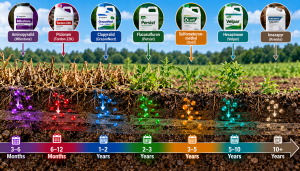
Long-residual herbicides are valuable for total vegetation control on fence rows, rights-of-way, and industrial sites. They reduce the need for repeated applications and lower long-term labor costs. However, they also carry risks, including carryover injury to sensitive crops and groundwater contamination.
In this guide, we review the herbicides with the longest residual activity by examining the products, their uses, and the environmental factors that determine how long they stay active in soil.
Which Herbicides Have The Longest Residual? Top 15 Options
1. Imazapyr 2 Herbicide – Longest Residual For Total Vegetation Control
Imazapyr 2 Herbicide has the longest residual activity for total vegetation control because it can remain active in the soil for one to three years after application. It is absorbed through leaves and roots and translocated throughout the plant. It is highly effective on grasses, broadleaf weeds, vines, and woody trees.

- THE WEED KILLER YOU NEED: This weed and grass killer delivers superior, long-lasting control over 185 types of annual, biennial, and perennial weeds and brush. Ideal for managing tough vegetation, it’s perfect for both pre- and post-emergent weed control
- MASTER OF AQUATIC CONTROL: Our concentrated weed killer controls unwanted aquatic vegetation, including emergent and floating weeds, as well as brush and trees in non-cropland areas. Safe for use around water, including wetlands, riparian zones, and industrial sites
This imazapyr product is labeled for fence rows, rights-of-way, and industrial sites and works best when applied to actively growing vegetation. Its long soil residual prevents new weeds from germinating for months or years after application. It is not selective, so it kills desirable plants on contact.
Because it is a Group 2 herbicide, it should be rotated with products from other groups to slow resistance. Apply according to the label for consistent results and respect buffer zones near water and sensitive plants.
- Longest soil residual activity
- Controls woody plants
- Broad-spectrum control
- Reduces repeat applications
- Works in non-crop areas
- Effective on tough species
- Trusted by land managers
- Long soil residual
- Carryover risk
- Not for use near gardens
2. Picloram Herbicide – Long Residual For Broadleaf And Woody Control
Picloram Herbicide has some of the longest residual activity for broadleaf and woody plant control because it can remain active in the soil for one to three years. It is absorbed through leaves and roots and translocated throughout the plant. It is highly effective on deep-rooted perennials and woody species.


- Effective: Kills cut stumps on fence lines&non-cropland areas. Control unwanted trees by cut surface treatments in forest&non-crop areas such as fence rows, roadsides&rights-of-way
This picloram product is labeled for fence rows, rights-of-way, pastures, and non-crop areas and works best when applied to actively growing vegetation. Its long soil residual prevents new weeds from germinating for months or years. It is not selective for broadleaf plants, so it can damage desirable broadleaf species.
Because it is a Group 4 herbicide, it should be rotated with products from other groups to slow resistance. It is a restricted-use product in some states and must be applied according to label directions.
- Long soil residual
- Controls woody plants
- Safe for established grasses
- Effective on deep-rooted weeds
- Reduces repeat applications
- Trusted by land managers
- Works in non-crop areas
- Long soil residual
- Can affect sensitive plants
- Restricted-use in some areas
3. Bromacil Herbicide – Long Residual For Industrial Vegetation Control
Bromacil Herbicide has long residual activity for industrial vegetation control because it can remain active in the soil for six months to two years. It is absorbed through roots and inhibits photosynthesis in susceptible plants. It is highly effective on grasses, broadleaf weeds, and woody plants.

- ALL-SEASON WEED GUARD: Bromacil weed and grass killer provides consistent suppression of tough annual and perennial grasses and broadleaf weeds for up to 360 days, reducing the need for repeated applications and keeping your site weed-free
- SELECTIVE AND VERSATILE APPLICATION: Formulated for use in various non-crop areas, this pre-emergent weed prevention controls weeds without harming desirable plants, making it ideal for utility sites, railroads, pipelines, and industrial zones
This bromacil product is labeled for fence rows, rights-of-way, and industrial sites and works best when applied to bare soil or actively growing plants. Its long soil residual prevents new weeds from germinating for months or years. It is not suitable for use where sensitive plants will be planted soon after application.
Because it is a Group 5 herbicide, it should be rotated with products from other groups to slow resistance. Apply according to the label for consistent results.
- Long soil residual
- Total vegetation control
- Controls woody plants
- Reduces repeat applications
- Works in industrial sites
- Effective on tough species
- Trusted by land managers
- Long soil residual
- Can affect desirable plants
- Not for use near gardens
4. Hexazinone Herbicide – Long Residual For Total Vegetation Control
Hexazinone Herbicide has long residual activity for total vegetation control because it can remain active in the soil for one to two years. It is absorbed primarily through roots and inhibits photosynthesis in susceptible plants. It is highly effective on tough perennials and woody species.

- Visible Results in One Hour - Spruce dehydrates to kill roots, showing visible results in just 1 hour, dead weeds in 1 day. The hardworking weed sprayer can kill all types of broadleaf and grassy weeds including dandelions, large crabgrass, white clover, dollarweed and morning glory vines.
- Ready to Use Worry-Free Formula - Spruce grass and weed killer is safe to use around people, pets, and bees when used as directed, and one bottle can treat up to 400 weeds. This versatile weed killer spray is made with water, essential oils and surfactant.
This hexazinone product is labeled for fence rows, rights-of-way, and non-crop areas and works best when applied to bare soil around the base of established woody plants. Its long soil residual prevents new weeds from germinating for months or years. It is not suitable for use where sensitive plants will be planted soon after application.
Because it is a Group 5 herbicide, it should be rotated with products from other groups to slow resistance. Apply according to the label for consistent results.
- Long soil residual
- Total vegetation control
- Controls woody plants
- Reduces repeat applications
- Works in non-crop areas
- Effective on tough species
- Trusted by land managers
- Long soil residual
- Can affect desirable plants
- Not for use near gardens
5. Indaziflam Herbicide – Longest Residual Pre-Emergent
Indaziflam Herbicide has the longest residual activity of any pre-emergent herbicide because it can prevent weed germination for up to eight months with a single application. It is absorbed by emerging seedlings and disrupts cellulose formation. It is highly effective on annual grasses and small-seeded broadleaf weeds.

- 🌱 LONG-LASTING PRE-EMERGENCE CONTROL- Rezilon herbicide uses advanced indaziflam chemistry to stop weeds before they emerge, delivering season-long residual control in established bermudagrass and bahiagrass fields.
- 🚜 CONTROLS TOUGH & RESISTANT WEEDS- Effectively targets more than 60 annual grass and broadleaf weeds, including crabgrass, goosegrass, ryegrass, foxtails, and sandbur—even resistant species commonly difficult to manage.
This indaziflam product is labeled for non-crop areas, rights-of-way, and industrial sites and works best when applied to bare soil before weeds germinate. Its long soil residual prevents new weeds from emerging for months after application. It is not selective for all desirable plants, so it can affect sensitive species.
Because it is a Group 29 herbicide, it should be rotated with products from other groups to slow resistance. Apply according to the label for consistent results.
- Longest pre-emergent residual
- Prevents weed germination
- Effective on grasses
- Reduces repeat applications
- Low use rates
- Works in non-crop areas
- Trusted by land managers
- Long soil residual
- Can affect desirable plants
- Not for use near gardens
6. Aminopyralid Herbicide – Long Residual For Pasture And Rangeland
Aminopyralid Herbicide has long residual activity for pasture and rangeland because it can remain active in the soil for six months to two years. It is absorbed through leaves and roots and translocated throughout the plant. It is highly effective on thistles, knapweeds, and other Asteraceae species.

- Target Pests: . See Product label for all listed pests.
- For use In: Rangeland, permanent grass pastures, CRP Acres, non-cropland areas, non-irrigation ditch banks, natural areas, and grazed areas in and around these sites. See Product label for complete list.
This aminopyralid product is labeled for pastures, rangeland, fence rows, and non-crop areas and works best when applied to actively growing weeds. Its long soil residual can affect sensitive broadleaf plants for months or years. It is not suitable for use where legumes will be planted soon after application.
Because it is a Group 4 herbicide, it should be rotated with products from other groups to slow resistance. Apply according to the label for consistent results.
- Long soil residual
- Safe for established grasses
- Labeled for pastures
- Effective on tough weeds
- Reduces repeat applications
- Works in grazing systems
- Trusted by land managers
- Long soil residual
- Can affect sensitive plants
- Grazing and replanting restrictions
7. Clopyralid Herbicide – Long Residual For Thistle Control
Clopyralid Herbicide has long residual activity for thistle control because it can remain active in the soil for three to twelve months. It is absorbed through leaves and roots and translocated throughout the plant. It is highly effective on Canada thistle, musk thistle, and spotted knapweed.

- POST-EMERGENT CONTROL - Thistledown is a full-strength herbicide based on the active ingredient clopyralid and is designed to control actively growing broadleaf weeds and thistle in a range, pasture, and other non-crop areas.
- SELECTIVE WEED KILLER - Weeds controlled by Thistledown include Canada thistle, musk thistle, star thistle, and knapweed. It can also be used to control kudzu, dandelion, and Oxalis.
This clopyralid product is labeled for pastures, rangeland, and non-crop areas and works best when applied to actively growing weeds. Its long soil residual can affect sensitive broadleaf plants for months or years. Compost made from treated grass clippings has caused damage to garden plants in some cases.
Because it is a Group 4 herbicide, it should be rotated with products from other groups to slow resistance. Apply according to the label for consistent results.
- Long soil residual
- Effective on thistles
- Safe for most grasses
- Low use rates
- Reduces repeat applications
- Works in pastures
- Trusted by land managers
- Long soil residual
- Can affect sensitive plants
- Compost contamination risk
8. Atrazine Herbicide – Long Residual For Crop Fields
Atrazine Herbicide has long residual activity for crop fields because it can remain active in the soil for three to twelve months. It is absorbed through roots and leaves and inhibits photosynthesis in susceptible plants. It is highly effective on pigweed, lambsquarters, and foxtail.

- Kills many broadleaf weeds
- Also used in centipede grass
This atrazine product is labeled for corn, sorghum, and some non-crop areas and works best when applied before weed emergence or to small, actively growing weeds. Its long soil residual helps prevent new weeds from germinating for weeks after application. It is a restricted-use product in some states.
Because it is a Group 5 herbicide, it should be rotated with products from other groups to slow resistance. Apply according to the label for consistent results.
- Long soil residual
- Pre and post-emergent activity
- Broad-spectrum control
- Works in corn and sorghum
- Affordable
- Reduces repeat applications
- Trusted by growers
- Restricted-use in some areas
- Groundwater concerns
- Carryover risk
9. Metsulfuron Methyl Herbicide – Long Residual At Low Rates
Metsulfuron Methyl Herbicide has long residual activity at low application rates because it can remain active in the soil for three to twelve months. It is absorbed through leaves and roots and translocated to growing points. It is highly effective on thistles, knapweeds, and brush species.

- BROAD SPECTRUM WEED CONTROL: The MSM herbicide effectively targets over 100 species of broadleaf weeds and brush, giving you comprehensive vegetation management in pastures, rangelands, and industrial sites with precision and reliability
- VERSATILE APPLICATION OPTIONS: Use weed killer concentrate as a post-emergent herbicide for active weeds or apply pre-emergent at dormancy break for early control. This flexibility makes it ideal for diverse settings, from forestry to utility rights-of-way
This metsulfuron methyl product is labeled for pastures, rights-of-way, and non-crop areas and works best when applied to actively growing vegetation. Its long soil residual can affect sensitive broadleaf plants for months. It is not suitable for use where sensitive plants will be planted soon after application.
Because it is a Group 2 herbicide, it should be rotated with products from other groups to slow resistance. Apply according to the label for consistent results.
- Long soil residual
- Low application rates
- Effective on tough weeds
- Safe for most grasses
- Reduces repeat applications
- Works in non-crop areas
- Trusted by land managers
- Long soil residual
- Can affect sensitive plants
- Not for use near gardens
10. Sulfometuron Methyl Herbicide – Long Residual For Non-Crop Areas
Sulfometuron Methyl Herbicide has long residual activity for non-crop areas because it can remain active in the soil for six months to two years. It is absorbed through leaves and roots and translocated to growing points. It is highly effective on broadleaf weeds and grasses.

- BROAD-SPECTRUM WEED CONTROL: SFM Extra pre-emergent weed control delivers effective pre- and post-emergent control of a wide range of annual and perennial grasses and broadleaf weeds, providing comprehensive vegetation management across non-crop sites
- SELECTIVE FORESTRY APPLICATION: Formulated to be selective in forestry settings, this post-emergent crabgrass killer supports site preparation and release of conifers and hardwoods while preserving desirable species, helping maintain a healthy and productive forest ecosystem
This sulfometuron methyl product is labeled for rights-of-way, industrial sites, and non-crop areas and works best when applied to actively growing vegetation. Its long soil residual prevents new weeds from germinating for months. It is not suitable for use where sensitive plants will be planted soon after application.
Because it is a Group 2 herbicide, it should be rotated with products from other groups to slow resistance. Apply according to the label for consistent results.
- Long soil residual
- Low application rates
- Controls broadleaf and grass weeds
- Reduces repeat applications
- Works in non-crop areas
- Effective on tough species
- Trusted by land managers
- Long soil residual
- Can affect sensitive plants
- Not for use near gardens
11. Simazine Herbicide – Long Residual For Non-Crop Areas
Simazine Herbicide has long residual activity for non-crop areas because it can remain active in the soil for six to twelve months. It is absorbed through roots and inhibits photosynthesis in susceptible plants. It is highly effective on annual grasses and broadleaf weeds.

- SIMAZINE 4L herbicide controls a variety of annual broadleaf and grass weeds in Agricultural Crops, Turf and Ornamentals.
- REGISTERED for use in Citrus, Field crops, Tree Fruit and Nut.
This simazine product is labeled for fence rows, rights-of-way, and industrial sites and works best when applied before weed emergence or to small, actively growing vegetation. Its long soil residual helps prevent new weeds from germinating for months. It is not suitable for use where sensitive plants will be planted soon after application.
Because it is a Group 5 herbicide, it should be rotated with products from other groups to slow resistance. Apply according to the label for consistent results.
- Long soil residual
- Pre-emergent activity
- Controls annual weeds
- Reduces repeat applications
- Works in non-crop areas
- Affordable
- Trusted by land managers
- Long soil residual
- Groundwater concerns
- Not for use near gardens
12. Diuron Herbicide – Long Residual For Fence Rows And Rights-Of-Way
Diuron Herbicide has long residual activity for fence rows and rights-of-way because it can remain active in the soil for six months to two years. It is absorbed through roots and inhibits photosynthesis in susceptible plants. It is highly effective on annual weeds and some perennials.

- FULL-CYCLE WEED PROTECTION: Tackle weeds before and after they sprout with Diuron herbicide weed killer’s dual-action formula. It is ideal for long-term control of annual grasses and broadleaf weeds in non-crop areas where consistent results matter most
- BUILT FOR HARSH ENVIRONMENTS: Built for demanding environments like highways, airports, and industrial zones, this weed killer delivers proven weed control where other herbicides fall short, keeping large-scale areas clear and low-maintenance
This diuron product is labeled for fence rows, rights-of-way, and industrial sites and works best when applied to bare soil or small, actively growing vegetation. Its long soil residual prevents new weeds from germinating for months. It is not suitable for use where sensitive plants will be planted soon after application.
Because it is a Group 7 herbicide, it should be rotated with products from other groups to slow resistance. Apply according to the label for consistent results.
- Long soil residual
- Pre and post-emergent activity
- Controls annual weeds
- Reduces repeat applications
- Works in fence rows and rights-of-way
- Affordable
- Trusted by land managers
- Long soil residual
- Can affect desirable plants
- Not for use near gardens
13. Tebuthiuron Herbicide – Long Residual For Rangeland Brush Control
Tebuthiuron Herbicide has long residual activity for rangeland brush control because it can remain active in the soil for one to three years. It is absorbed through roots and inhibits photosynthesis in susceptible plants. It is highly effective on woody plants and deep-rooted perennials.

- YEAR-ROUND BRUSH CONTROL: This brush control herbicide offers extended control of tough brush, woody plants, and weeds for up to one year, reducing repeat treatments and keeping rangelands, pastures, and wildlife clearings free from unwanted vegetation
- VERSATILE WEED DEFENSE: The Tebuthiuron weed and brush killer works both before and after weed emergence, ensuring versatile control of a wide range of grasses and woody plants, providing users with a flexible and reliable vegetation management option
This tebuthiuron product is labeled for rangeland, rights-of-way, and non-crop areas and works best when applied to bare soil around the base of established woody plants. Its long soil residual prevents new weeds from germinating for years. It is not suitable for use where sensitive plants will be planted soon after application.
Because it is a Group 7 herbicide, it should be rotated with products from other groups to slow resistance. Apply according to the label for consistent results.
- Long soil residual
- Controls woody plants
- Effective on deep-rooted species
- Reduces repeat applications
- Works in rangeland
- Multi-season activity
- Trusted by land managers
- Long soil residual
- Can affect desirable plants
- Not for use near gardens
14. Prometon Herbicide – Long Residual For Total Vegetation Control
Prometon Herbicide has long residual activity for total vegetation control because it can remain active in the soil for six months to two years. It is absorbed through roots and leaves and inhibits photosynthesis in susceptible plants. It is highly effective on grasses, broadleaf weeds, and woody plants.

- Pramitol 25% (Prometon Salts)
- Pramitol 25E is for use in commercial areas like storage facilities, fence lines, tank farms, railways, pipelines, and lumber yards. A common use of Pramitol is to control weeds and other vegetation under driveways and parking lots. Pramitol is not recommended for use in residential areas.
This prometon product is labeled for fence rows, rights-of-way, and industrial sites and works best when applied to bare soil or actively growing vegetation. Its long soil residual prevents new weeds from germinating for months. It is not suitable for use where sensitive plants will be planted soon after application.
Because it is a Group 5 herbicide, it should be rotated with products from other groups to slow resistance. Apply according to the label for consistent results.
- Long soil residual
- Total vegetation control
- Controls woody plants
- Reduces repeat applications
- Works in non-crop areas
- Effective on tough species
- Trusted by land managers
- Long soil residual
- Can affect desirable plants
- Not for use near gardens
15. Aminocyclopyrachlor Herbicide – Long Residual For Broadleaf Control
Aminocyclopyrachlor Herbicide has long residual activity for broadleaf control because it can remain active in the soil for one to two years. It is absorbed through leaves and roots and translocated throughout the plant. It is highly effective on tough broadleaf weeds and woody plants.
No products found.
This aminocyclopyrachlor product is labeled for rights-of-way, industrial sites, and non-crop areas and works best when applied to actively growing vegetation. Its long soil residual prevents new weeds from germinating for months or years. It is not suitable for use where sensitive broadleaf plants will be planted soon after application.
Because it is a Group 4 herbicide, it should be rotated with products from other groups to slow resistance. Apply according to the label for consistent results.
- Long soil residual
- Broad-spectrum control
- Controls woody plants
- Low application rates
- Reduces repeat applications
- Works in non-crop areas
- Trusted by land managers
- Long soil residual
- Can affect sensitive plants
- Not for use near gardens
7 Tips For Using Long-Residual Herbicides Safely
- Check the half-life: Herbicide half-life in soil determines how long the product stays active. Products with half-lives over 60 days are considered long-residual and require careful rotation planning.
- Plan crop rotations: Long-residual herbicides can injure sensitive crops for one to three years after application. Check the label for rotation restrictions before planting.
- Match the product to the site: Long-residual herbicides are best for fence rows, rights-of-way, and industrial sites where total vegetation control is acceptable and no desirable plants are nearby.
- Avoid use near gardens: Long-residual products can move through soil and damage sensitive garden plants. Keep buffer zones between treated areas and gardens.
- Respect water restrictions: Some long-residual herbicides carry groundwater concerns and are restricted in certain regions. Check local regulations before use.
- Rotate modes of action: Using the same long-residual herbicide repeatedly selects for resistant weeds. Rotate between Group 2, Group 4, Group 5, Group 7, and Group 29 products.
- Follow the label in full: Long-residual herbicides carry the most restrictions of any product category. Read the label and follow every rate, buffer zone, and application instruction.
Herbicides Have The Longest Residual FAQ’S
1. Which herbicides have the longest residual?
Imazapyr, picloram, bromacil, hexazinone, indaziflam, and tebuthiuron have the longest residual activity, remaining active in soil for six months to three years depending on the rate and site conditions.
2. How long do long-residual herbicides stay in soil?
Long-residual herbicides can stay active for six months to three years. Imazapyr and picloram can persist up to three years. Bromacil and hexazinone typically last one to two years. Indaziflam lasts up to eight months as a pre-emergent.
3. Are long-residual herbicides safe for crop rotation?
Long-residual herbicides can injure sensitive crops for one to three years after application. Check the label for specific rotation restrictions before planting any crop into treated soil.
4. Which long-residual herbicide is best for fence rows?
Imazapyr, bromacil, hexazinone, and diuron are among the best options for fence rows because they provide total vegetation control for months or years and reduce the need for repeat applications.
5. Can long-residual herbicides contaminate groundwater?
Yes, some long-residual herbicides like atrazine and simazine carry groundwater concerns and are restricted in certain regions. Products with high water solubility and low soil adsorption pose the greatest risk.
6. How do I avoid carryover injury from long-residual herbicides?
Plan crop rotations around the herbicides half-life, check the label for rotation restrictions, and consider tillage or irrigation to speed breakdown. Choose short-residual products when sensitive crops will follow.
7. Are long-residual herbicides more effective than short-residual products?
Long-residual herbicides provide extended weed control and reduce the need for repeat applications, but they are not always more effective. Short-residual products break down faster and are safer for rotation, making them better for many crop systems.
Conclusion
Imazapyr 2 Herbicide has the longest residual activity of any herbicide used for total vegetation control, remaining active in the soil for one to three years. Picloram Herbicide, Bromacil Herbicide, Hexazinone Herbicide, and Indaziflam Herbicide follow closely as long-residual options for fence rows, rights-of-way, and industrial sites.
Aminopyralid Herbicide, Clopyralid Herbicide, Atrazine Herbicide, Metsulfuron Methyl Herbicide, and Sulfometuron Methyl Herbicide provide long residual activity at lower rates for pastures, rangeland, and non-crop areas. Simazine Herbicide, Diuron Herbicide, Tebuthiuron Herbicide, Prometon Herbicide, and Aminocyclopyrachlor Herbicide round out the list of options for specific sites and weed spectra.
Long-residual herbicides are valuable for total vegetation control but carry the highest risks of carryover injury and groundwater contamination. Matching the product to the site, planning crop rotations, and following the label carefully are essential for safe use.
Choose the right product for your site and weed spectrum, respect buffer zones, and rotate modes of action to preserve effectiveness. Long-residual herbicides are powerful tools when used responsibly.