The terms herbicide resistance and herbicide tolerance are often used interchangeably, but they describe two different biological situations. Understanding the distinction is important because a weed that is naturally tolerant to an herbicide is fundamentally different from a previously susceptible weed population that has evolved resistance after repeated selection.
In simple terms, tolerance is an inherent ability to survive a herbicide, while resistance is an inherited ability that develops within a population of plants that were previously susceptible. Herbicide Resistance Action Committee (HRAC) defines herbicide resistance as the ability of a weed biotype to survive an herbicide application that would normally control the susceptible population, whereas tolerance refers to the inherent ability of a plant species to survive and reproduce following treatment.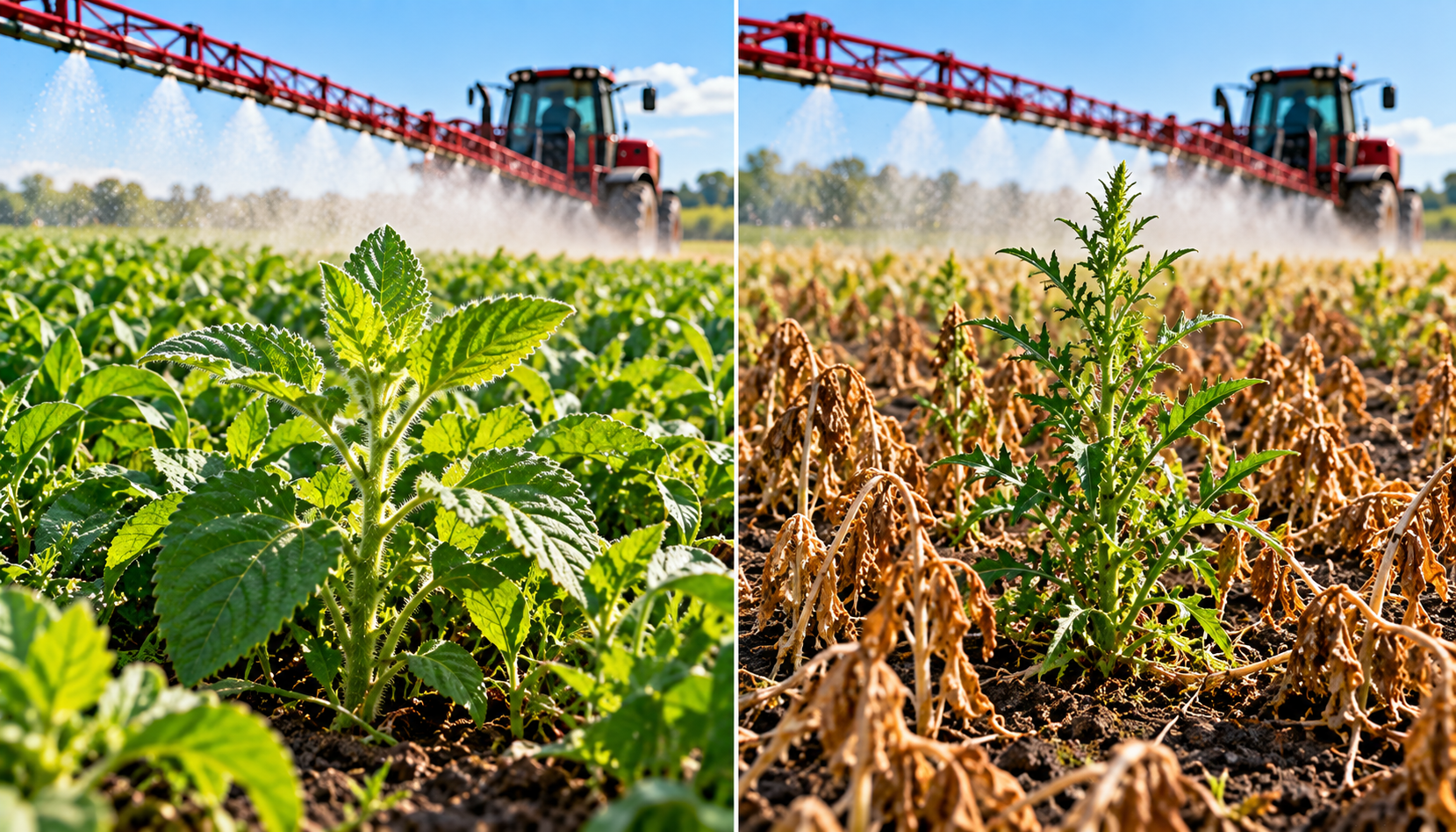
This difference matters greatly in practical weed management. If a weed species is naturally tolerant to a herbicide, increasing the rate beyond the label recommendation is generally not the solution, while a confirmed resistance problem requires a broader resistance-management strategy involving alternative herbicide modes of action and non-chemical control practices.
This guide explains what is the difference between herbicide resistance and herbicide tolerance, how each develops, how to distinguish them in the field, why repeated herbicide use can select resistant weeds, and what farmers and agronomists can do when herbicide control begins to fail.
What Is The Difference Between Herbicide Resistance And Herbicide Tolerance?
What Is Herbicide Tolerance?
Herbicide tolerance is the inherent ability of a plant species to survive and reproduce after exposure to a particular herbicide. The important word is inherent, meaning the plant species naturally possesses characteristics that allow it to survive treatment rather than having evolved resistance because of repeated exposure.
For example, a herbicide may effectively control one weed species while having little or no effect on another species when both are treated correctly. The second species may be naturally tolerant to that herbicide because of physiological or biochemical characteristics that prevent sufficient herbicide injury.
HRAC specifically distinguishes tolerance from resistance by describing tolerance as the inherent ability of a plant species to survive and reproduce after treatment.
How Does Herbicide Tolerance Occur?
Natural tolerance can result from several plant characteristics, including differences in:
- Herbicide absorption
- Herbicide translocation
- Herbicide metabolism
- Herbicide activation or deactivation
- Target-site characteristics
- Plant morphology
- Growth characteristics
- Physiological sensitivity
A tolerant species may therefore survive a herbicide without ever having been previously susceptible to it.
This is why it is important not to assume that every weed surviving a herbicide application is resistant.
What Is Herbicide Resistance?
Herbicide resistance is the inherited ability of a plant or weed biotype to survive and reproduce after exposure to a herbicide dose that would normally kill the susceptible type. WSSA and HRAC definitions emphasize that resistance is heritable and represents a change within a plant population rather than simply the normal response of a naturally tolerant species.
A useful way to understand resistance is to imagine a field containing thousands of plants of the same weed species. Most plants may initially be susceptible to a particular herbicide, but a small number may possess naturally occurring genetic characteristics that allow them to survive.
When the herbicide is repeatedly used, susceptible plants are controlled while the survivors remain alive and reproduce. Over successive generations, the proportion of resistant plants can increase until the herbicide no longer provides acceptable control.
HRAC describes this process as selection: susceptible plants are removed by the herbicide while resistant individuals survive and contribute seed to subsequent generations.
Herbicide Resistance vs. Herbicide Tolerance
The easiest way to remember the difference is:
| Herbicide tolerance | Herbicide resistance |
|---|---|
| Natural or inherent characteristic | Evolved inherited characteristic within a population |
| Usually associated with a plant species | Usually associated with a resistant biotype or population |
| The species was not necessarily previously susceptible | The population was previously susceptible |
| Not necessarily caused by repeated herbicide use | Often selected by repeated herbicide exposure |
| Normal response of the species | Change in frequency of resistant individuals |
| Increasing the rate is not automatically the answer | Requires resistance-management strategies |
| May be expected based on the herbicide spectrum | Often appears as a control failure in a previously controlled weed |
The distinction is particularly important when diagnosing herbicide failures because poor weed control does not automatically prove resistance.
The Biggest Difference: Natural Tolerance vs. Evolutionary Resistance
The central difference between the two terms is the history of susceptibility.
Suppose a herbicide has never effectively controlled a particular weed species. If the weed survives a properly applied treatment, that survival may simply represent natural tolerance.
Now consider a different situation. A herbicide has provided excellent control of a particular weed species for several seasons. Suddenly, plants of that same species survive the recommended treatment and produce seed, while nearby plants remain susceptible.
That situation raises a much stronger possibility of herbicide resistance.
HRAC notes that confirmation of resistance requires evidence such as historical susceptibility, appropriate testing, heritability, practical field impact, and elimination of other explanations for poor control.
How Herbicide Resistance Develops
Herbicide resistance is an evolutionary process.
Natural weed populations contain genetic variation. Some individual plants may possess characteristics that make them less susceptible to a particular herbicide, even when those plants represent only a very small proportion of the population.
When the same herbicide or herbicides with the same site of action are repeatedly used, susceptible plants are controlled while resistant individuals survive.
The surviving plants can mature and produce seed. If their offspring inherit the resistance trait and are exposed to the same selection pressure in subsequent seasons, resistant plants can become increasingly common.
HRAC explains that repeated use of a single herbicide mode or site of action can accelerate the selection process because resistant plants survive and reproduce while susceptible plants are removed.
Herbicides Do Not Simply “Teach” Weeds to Resist Them
A common misconception is that repeated spraying directly teaches individual weeds how to resist herbicides.
That is not the best way to describe resistance evolution.
Instead, genetic variation exists within weed populations. Herbicide applications act as a selection pressure that favors plants already possessing traits that allow them to survive.
The survivors reproduce, increasing the frequency of resistance-associated traits in later generations. The University of Minnesota Extension similarly explains that herbicides are not known to directly cause the genetic change responsible for resistance; rather, pre-existing variation can be selected through herbicide use.
What Is a Herbicide-Resistant Biotype?
A biotype is a group of plants within a species that possesses a particular biological trait that is not necessarily common throughout the entire species.
In herbicide resistance, a resistant biotype may contain an inherited characteristic that allows it to survive a herbicide that normally controls susceptible plants.
This distinction is important because saying that an entire weed species is “resistant” can sometimes be misleading.
For example, a species may contain:
- Susceptible plants
- Tolerant populations
- Resistant biotypes
- Multiple resistant biotypes
Therefore, resistance is generally discussed in relation to a particular weed population or biotype and herbicide or herbicide group.
Why Does Repeated Herbicide Use Increase Resistance Risk?
Repeated use increases selection pressure.
Imagine a field containing 10,000 weeds. If 9,990 plants are susceptible and 10 possess resistance-associated traits, an effective herbicide application may kill the 9,990 susceptible plants while leaving the 10 survivors.
If those survivors produce seed and the same herbicide continues to be used, their offspring receive a significant reproductive advantage.
Over time, the proportion of resistant plants can increase dramatically.
HRAC identifies repeated use of herbicides with the same site of action as an important factor in resistance selection and recommends diversification of chemical and non-chemical weed-management practices.
What Is Target-Site Herbicide Resistance?
Target-site resistance (TSR) occurs when a change at the herbicide’s target reduces the herbicide’s ability to interfere with the plant’s normal biochemical process.
The target may be an enzyme or another specific biological component required for plant growth.
A resistant plant may have:
- A modified target protein
- Reduced herbicide binding
- Increased expression of the target protein
- Additional copies of a target gene
HRAC identifies altered target sites, increased target-protein expression, and target-gene amplification among mechanisms associated with target-site resistance.
The result is that the herbicide may reach the plant but fail to interfere effectively with its intended target.
What Is Non-Target-Site Herbicide Resistance?
Non-target-site resistance (NTSR) occurs when the plant reduces the amount of active herbicide that reaches its target or otherwise prevents the herbicide from exerting its normal effect.
Mechanisms can include:
- Reduced herbicide absorption
- Reduced translocation
- Enhanced herbicide metabolism
- Detoxification
- Herbicide sequestration
- Reduced retention
HRAC identifies reduced retention, absorption or translocation, enhanced metabolism, and subcellular sequestration among mechanisms associated with non-target-site resistance.
NTSR can be especially challenging because the mechanism may affect herbicides with different sites of action.
What Is Cross-Resistance?
Cross-resistance occurs when one resistance mechanism allows a weed to survive two or more herbicides.
For example, a resistant weed may survive multiple herbicides because the same resistance mechanism affects how those herbicides interact with the plant.
Cross-resistance does not necessarily mean that the herbicides have identical chemical structures. A single resistance mechanism can sometimes affect herbicides from different chemical classes or with different sites of action.
This is one reason why simply switching from one herbicide product to another may not solve a resistance problem.
What Is Multiple Herbicide Resistance?
Multiple resistance occurs when a weed population has more than one resistance mechanism that allows it to survive herbicides with different modes or sites of action.
This can develop through separate selection events.
For example, a weed population could first develop resistance to herbicide A. If herbicide B is then repeatedly used and another resistance mechanism develops, the population may eventually possess resistance to both herbicides through different mechanisms.
HRAC distinguishes multiple resistance from cross-resistance because multiple resistance involves more than one resistance mechanism or separate resistance-selection processes.
Can Herbicide Tolerance Become Herbicide Resistance?
Not necessarily.
Natural tolerance and evolved resistance are different concepts. A naturally tolerant species does not automatically become resistant simply because it survives a herbicide.
However, any weed population containing genetic variation can potentially be subjected to selection pressure, and repeated use of herbicides can favor traits that provide greater survival.
The important point is that tolerance should not be casually relabeled as resistance. Scientific confirmation requires appropriate testing and evidence of heritable resistance.
How Can You Tell If a Weed Is Resistant?
A single surviving weed is not enough to confirm herbicide resistance.
Poor herbicide performance can have many causes, including:
- Incorrect herbicide rate
- Incorrect application timing
- Poor spray coverage
- Adverse weather
- Rain shortly after application
- Incorrect weed identification
- Weed growth stage
- Poor water quality
- Herbicide degradation
- Antagonism
- Application equipment problems
- Naturally tolerant species
- Herbicide resistance
HRAC recommends scientific confirmation rather than assuming resistance based solely on field survival. Confirmation generally involves controlled testing with susceptible and suspect populations and examination of heritability and practical field impact.
Why Application Errors Can Look Like Resistance
One of the biggest mistakes in resistance diagnosis is assuming that every control failure represents resistance.
Suppose a farmer applies a post-emergence herbicide to weeds that are already too large. The weeds may survive because the application was made outside the optimal treatment window.
That does not necessarily mean the weeds are resistant.
Similarly, insufficient spray coverage, incorrect mixing, environmental stress, or an inappropriate application rate can reduce control.
Before declaring resistance, the entire application history should be reviewed.
Why Weed Identification Matters
Correct species identification is essential.
Different weed species can naturally respond very differently to the same herbicide. A product that provides excellent control of one species may provide little control of another because of the herbicide’s labeled spectrum.
HRAC’s criteria for confirming resistance specifically require identification of the weed to species level.
This means that a farmer should identify the surviving weed rather than simply describing it as “grass,” “broadleaf,” or “weed.”
Accurate identification allows the agronomist to determine whether the observed response is consistent with natural tolerance, application failure, or possible resistance.
Why Herbicide Mode of Action Matters
A herbicide’s mode of action describes how it interferes with essential biological processes in a plant.
The HRAC classification system groups herbicides according to their modes or sites of action, helping growers understand which products have similar biochemical targets. HRAC’s current 2026 classification includes updated groupings and active ingredients relevant to modern resistance-management planning.
Repeatedly using products with the same mode or site of action can increase selection pressure for resistant weeds.
Therefore, resistance management should not simply focus on changing brand names.
Two products with different brand names may still have the same relevant mode or site of action.
Does Rotating Herbicides Prevent Resistance?
Herbicide rotation can contribute to resistance management, but simply alternating products without considering their modes of action is not necessarily sufficient.
For example, rotating two commercial products that contain herbicides from the same resistance group may provide little diversification of selection pressure.
Effective programs should consider:
- Herbicide mode of action
- Weed species
- Herbicide efficacy
- Application timing
- Crop rotation
- Cultural practices
- Mechanical control
- Cover crops
- Crop competition
- Weed seedbank management
HRAC recommends integrating chemical and non-chemical practices rather than relying exclusively on herbicide rotation.
Can Tank Mixing Help Manage Herbicide Resistance?
Tank mixing herbicides with different effective sites of action can be useful in resistance management when the mixture is appropriate, legally permitted, and each active ingredient provides effective control of the target weed.
HRAC recommends that mixtures contain active ingredients that provide high levels of control of the target weed and come from different sites of action.
However, tank mixing should not be treated as a universal solution.
The products must be compatible, labeled for the intended crop and weed, applied at appropriate rates, and used according to local regulations and product instructions.
What Should You Do If You Suspect Herbicide Resistance?
If a previously controlled weed suddenly survives a properly applied herbicide, investigate before repeating the same treatment.
Step 1: Identify the weed
Determine the exact weed species.
Step 2: Review the herbicide
Record the active ingredient, formulation, rate, mode-of-action group, and application history.
Step 3: Check application conditions
Review:
- Weed growth stage
- Weather
- Spray coverage
- Water volume
- Application equipment
- Mixing procedure
- Herbicide rate
- Timing
- Rainfall after application
Step 4: Examine the field pattern
Look at where survivors occur.
Patchy survival can provide useful clues, although field patterns alone cannot confirm resistance.
Step 5: Preserve evidence
If resistance is suspected, document the affected area and collect appropriate plant or seed samples according to local diagnostic procedures.
Step 6: Seek confirmation
Resistance should be confirmed through appropriate testing rather than assumed from field observations. HRAC recommends dose-response testing and other procedures to establish whether resistance is heritable and has practical field significance.
How to Manage Confirmed Herbicide Resistance
Once resistance has been confirmed, continuing to rely on the herbicide responsible for the selection problem is generally a poor strategy.
Management should aim to prevent further seed production and reduce the spread of resistant plants.
Useful approaches may include:
- Using an effective herbicide from a different site of action
- Using appropriately designed herbicide mixtures
- Rotating modes of action
- Mechanical weed control
- Crop rotation
- Competitive crop stands
- Cover crops
- Timely cultivation where appropriate
- Preventing resistant weeds from producing seed
- Cleaning equipment before moving between fields
- Monitoring resistant patches
HRAC emphasizes that mitigation focuses on preventing further development and spread because complete eradication of established resistant populations is generally difficult, particularly where persistent weed seedbanks are involved.
Herbicide Tolerance in Crops
The term herbicide tolerance is also commonly used when discussing crops.
Some crop varieties are intentionally developed or selected to tolerate particular herbicides. This allows growers to use a herbicide that controls susceptible weeds while the tolerant crop survives.
HRAC notes that crop herbicide tolerance can be introduced through techniques such as genetic engineering or selection of variants produced through tissue culture or mutagenesis.
This is different from a weed population naturally developing resistance through selection.
Therefore, when discussing a crop, “herbicide tolerance” may refer to a deliberately introduced agronomic characteristic, while “herbicide resistance” generally describes an inherited ability that allows a plant to survive an otherwise lethal herbicide exposure.
Simple Example of Tolerance
Imagine Herbicide X effectively controls:
- Palmer amaranth
- Lambsquarters
- Pigweed
But it does not effectively control a particular naturally tolerant weed species.
If that weed species has always survived Herbicide X at the recommended rate, its response is better described as tolerance rather than newly evolved resistance.
The key point is that the weed was not necessarily susceptible to Herbicide X in the first place.
Simple Example of Resistance
Now imagine Herbicide Y has provided excellent control of a particular weed species for many years.
A few plants survive a correctly timed application at the recommended rate.
Those plants produce seed.
The following season, many of their offspring survive the same herbicide.
After appropriate testing, the population is shown to have an inherited ability to survive the treatment.
That is a classic example of herbicide resistance.
Herbicide Resistance and Tolerance: A Practical Rule
For practical field diagnosis, remember this rule:
If the species has always survived the herbicide, think tolerance. If a previously susceptible population evolves an inherited ability to survive the herbicide, think resistance.
That distinction is simple, but confirming resistance requires more than observing survivors.
A scientific diagnosis should account for application quality, weed identification, environmental conditions, historical susceptibility, field impact, and heritability.
Frequently Asked Questions
1. What is the main difference between herbicide resistance and tolerance?
Herbicide tolerance is the inherent ability of a plant species to survive and reproduce after herbicide treatment, while herbicide resistance is an inherited ability that develops within a previously susceptible population and allows plants to survive a normally effective herbicide treatment.
2. Is herbicide tolerance genetic?
Tolerance can be associated with inherent biological characteristics of a species and can also be deliberately introduced into crops through breeding, genetic engineering, tissue culture, or mutagenesis.
3. Does repeated herbicide use cause resistance?
Repeated use creates selection pressure that favors resistant individuals already present within a genetically variable weed population. Over generations, those survivors can reproduce and increase the frequency of resistance in the population.
4. Can a herbicide-tolerant weed be controlled by using more herbicide?
Not necessarily, and increasing the rate beyond the product label is not an appropriate general response. First determine whether the problem is natural tolerance, application failure, or confirmed resistance, and always follow the registered product label.
5. How is herbicide resistance confirmed?
Confirmation normally involves appropriate controlled testing, comparison with susceptible plants, evidence of practical field impact, and demonstration that the resistance is heritable. HRAC recommends scientifically established testing procedures rather than relying solely on field observations.
6. What are the two major types of herbicide resistance mechanisms?
The two broad categories are target-site resistance and non-target-site resistance. Target-site resistance changes how the herbicide interacts with its target, while non-target-site resistance reduces the amount of active herbicide reaching or affecting the target through mechanisms such as enhanced metabolism, reduced translocation, or sequestration.
7. Why is herbicide resistance a problem for farmers?
Resistance can cause previously effective herbicides to provide inadequate weed control, increasing production costs and making weed management more complicated. Resistant populations can also spread through seed and other mechanisms, requiring integrated management rather than reliance on one herbicide.
Conclusion
The difference between herbicide resistance and herbicide tolerance is fundamentally a difference between inherent survival ability and evolved inherited resistance within a previously susceptible population. Tolerance describes a plant species’ natural ability to withstand a herbicide, whereas resistance describes a heritable ability that allows a weed biotype to survive a herbicide treatment that would normally control it.
Recognizing this distinction is essential when investigating herbicide control failures. A weed that naturally survives a herbicide should not automatically be labeled resistant, because poor control can also result from incorrect identification, application timing, weather, spray coverage, weed size, product performance, or other agronomic factors.
Herbicide resistance develops through selection, particularly when susceptible weeds are repeatedly exposed to the same herbicide or herbicides with the same site of action. Effective resistance management therefore depends on diversifying weed-control practices, using appropriate herbicide modes of action, preventing resistant weeds from producing seed, and integrating chemical, cultural, mechanical, and other management approaches.
The simplest rule to remember is that tolerance is generally inherent, while resistance is an inherited change in a population that allows previously susceptible weeds to survive an otherwise effective herbicide. Correctly identifying which situation exists is the foundation for making sound weed-management decisions and avoiding unnecessary changes in herbicide programs.