Herbicide adsorption is the process by which herbicide molecules bind to soil particles, removing them from soil solution and reducing their movement and availability. It is one of the most important processes determining how long an herbicide stays active, how far it moves, and whether it reaches groundwater or target weeds.
Adsorption differs from absorption. Adsorption means the herbicide sticks to the surface of soil particles. Absorption means the herbicide is taken up into the plant or into a soil organism. Both processes matter in weed management, but adsorption is the one that controls how much herbicide remains available in the soil solution.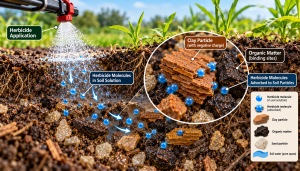
Understanding adsorption helps applicators choose the right product for their soil type, predict how long an herbicide will remain effective, and avoid off-target movement. Sandy soils and organic soils behave very differently, and soil pH changes how strongly some herbicides bind.
In this guide, we break down what herbicide adsorption is by examining the factors that control it, how it affects herbicide behavior, and why it matters for effective and responsible use.
What Is Herbicide Adsorption? 10 Key Facts To Know
1. Definition Of Herbicide Adsorption
Herbicide adsorption is the binding of herbicide molecules to the surfaces of soil particles such as clay, organic matter, and iron or aluminum oxides. When a herbicide adsorbs, it leaves the soil solution and attaches to solid surfaces, which reduces its availability to plants and its ability to move with water.
Adsorption is a physical and chemical process driven by attraction between the herbicide molecule and charged or reactive sites on soil particles. It is usually reversible, meaning adsorbed herbicide can be released back into soil solution under certain conditions. This release is called desorption.
The balance between adsorption and desorption determines how much herbicide remains in the soil solution where it can be taken up by weeds, leached downward, or broken down by soil microbes. Understanding this balance is central to herbicide behavior in soil.
2. Adsorption Versus Absorption
Adsorption and absorption are often confused, but they describe different processes. Adsorption is the binding of herbicide molecules to the surface of soil particles. Absorption is the uptake of herbicide into the interior of a plant, a soil organism, or another material.
In soil science, adsorption refers specifically to surface binding. Herbicide molecules stick to clay and organic matter through weak forces such as van der Waals attraction, hydrogen bonding, or ion exchange. Absorption in plants refers to the movement of herbicide into root cells or leaf tissues.
Both processes matter for weed control, but they operate differently. A herbicide that adsorbs strongly to soil may not reach the weed roots and will fail. A herbicide that absorbs into plant tissue is doing the job it was applied for. Keeping the terms straight helps with product selection and diagnosis of control problems.
3. Soil Organic Matter And Clay Content
Soil organic matter and clay content are the two most important factors controlling herbicide adsorption. Both materials have large surface areas and charged sites that attract and hold herbicide molecules. Soils with high organic matter and high clay content adsorb more herbicide than sandy soils.
Organic matter has a high cation exchange capacity and many reactive functional groups that bind both cationic and nonionic herbicides. Clay minerals have negatively charged surfaces that attract cationic herbicides and polar molecules. Together, they determine how much herbicide stays in the soil solution.
The practical implication is that higher rates of soil-applied herbicide are often needed on high-organic-matter or high-clay soils to achieve the same level of weed control. Sandy soils with low organic matter require lower rates because less herbicide is bound and more remains available.
4. Cation Exchange Capacity And Soil Charge
Cation exchange capacity, or CEC, is the total capacity of a soil to hold exchangeable cations. Soils with high CEC adsorb more cationic herbicides and have more buffering capacity against changes in soil solution concentration.
Herbicides that carry a positive charge, such as paraquat and diquat, bind strongly to negatively charged clay and organic matter surfaces. This binding makes them unavailable for plant uptake and prevents them from leaching. Anionic and nonionic herbicides bind differently and depend more on other adsorption mechanisms.
High CEC soils include those with high organic matter, smectite clays, and vermiculite. Low CEC soils include sandy soils and kaolinite clays. Knowing the CEC of a soil helps predict how strongly a given herbicide will bind.
5. Herbicide Chemical Properties
Herbicide chemical properties determine how strongly a molecule adsorbs to soil. Water solubility, polarity, molecular charge, and molecular size all play a role. In general, herbicides with low water solubility and high lipophilicity adsorb more strongly to organic matter.
Weak acid herbicides like 2,4-D, dicamba, and glyphosate bind differently depending on soil pH. At low pH, they are uncharged and adsorb more strongly to organic matter. At high pH, they are negatively charged and adsorb less, which increases leaching risk.
Weak base herbicides like atrazine and simazine are positively charged at low pH and adsorb strongly to clay and organic matter. At high pH, they are uncharged and adsorb less. This is why soil pH management matters for both herbicide performance and environmental risk.
6. Soil pH And Adsorption
Soil pH affects herbicide adsorption by changing the charge of both the herbicide molecule and the soil particle surfaces. For weak acid and weak base herbicides, pH can change adsorption by a factor of ten or more across the normal soil pH range.
Weak acid herbicides like 2,4-D and glyphosate adsorb more strongly at low pH because the molecules lose their negative charge and can bind to positively charged soil sites. At high pH, they remain negatively charged and repel the negatively charged clay surfaces, staying in soil solution.
Weak base herbicides like atrazine and simazine behave in the opposite way. They adsorb more strongly at low pH because they become positively charged and bind to negatively charged clay surfaces. At high pH, they are uncharged and remain in solution, which increases leaching risk.
7. The Soil Adsorption Coefficient And Koc
The soil adsorption coefficient, often written as Kd or Koc, is a numeric value that describes how strongly a herbicide binds to soil. Kd is the ratio of herbicide concentration on the soil to the concentration in soil solution at equilibrium.
Koc is the organic carbon normalized adsorption coefficient, which allows comparison across soils with different organic matter content. A high Koc means the herbicide binds strongly to organic matter and is unlikely to leach. A low Koc means the herbicide stays in solution and can move with water.
Herbicides with Koc values below 50 are considered mobile and pose a leaching risk. Herbicides with Koc values above 1000 are considered strongly bound and stay near the application site. Koc values guide product selection for different soil types and environmental conditions.
8. Factors That Reduce Adsorption
Several factors reduce herbicide adsorption, increasing the amount of herbicide in the soil solution and the potential for leaching or plant uptake. High soil pH reduces adsorption of weak acid herbicides. Low organic matter reduces adsorption across all herbicide classes.
High soil moisture competes with herbicide molecules for binding sites on soil particles, reducing adsorption. High soil temperature can increase desorption and increase the amount of herbicide in solution. Certain fertilizer cations, especially calcium and magnesium, can also displace cationic herbicides from soil surfaces.
Understanding these factors helps applicators predict when a product is more likely to leach or move off-site. Avoiding application before heavy rain on low-organic-matter soils reduces environmental risk.
9. Adsorption And Herbicide Persistence
Adsorption and herbicide persistence are closely linked. Herbicides that bind strongly to soil are less available for microbial breakdown and photodegradation, which can increase their persistence in the soil. However, strong binding also reduces their availability to weeds.
Herbicides with low adsorption and high solubility break down more quickly because they remain in the soil solution where microbes and sunlight can act on them. The trade-off is that they are also more likely to leach or move off-site before they break down.
Balancing persistence, adsorption, and leaching risk is one of the main challenges of soil-applied herbicide programs. Choosing the right product and rate for the soil type is essential for both performance and environmental safety.
10. Practical Implications For Applicators
Practical implications of herbicide adsorption affect product choice, application rate, and timing. On high-organic-matter or high-clay soils, higher rates may be needed to overcome adsorption and deliver effective weed control. On sandy, low-organic-matter soils, lower rates are usually sufficient but the risk of leaching is higher.
Soil pH should be checked before using pH-sensitive herbicides. Adjusting pH into the recommended range improves both performance and reduces environmental risk. Rotating modes of action prevents resistance and reduces reliance on any single product.
Reading the label for soil-specific use rates and restrictions is essential. Labels often list different rates for different soil textures and organic matter levels. Following those instructions protects the crop, the environment, and the long-term effectiveness of the herbicide.
Why Herbicide Adsorption Matters
- Weed control performance: Herbicides that adsorb too strongly to soil may not reach weed roots in sufficient concentration to control the target species.
- Leaching and groundwater risk: Herbicides with low adsorption move easily with water and can contaminate groundwater. Koc values help predict this risk.
- Application rate selection: Soil texture, organic matter, and pH determine how much herbicide is needed for effective control. The label lists specific rates for different soils.
- Carryover and rotation restrictions: Herbicides that persist in soil due to strong adsorption can injure sensitive crops planted the following season.
- Environmental fate: Adsorption is one of the key processes regulators evaluate when assessing an herbicide for registration. Strong adsorption reduces environmental risk.
- Soil pH management: Adjusting soil pH into the recommended range for a given herbicide improves performance and reduces off-target movement.
- Product selection: Matching the herbicide to the soil type is one of the most important decisions in a soil-applied weed program.
What Is Herbicide Adsorption FAQ’S
1. What is herbicide adsorption?
Herbicide adsorption is the binding of herbicide molecules to the surfaces of soil particles such as clay and organic matter. Adsorbed herbicide leaves the soil solution and becomes less available to plants and less likely to move with water.
2. What is the difference between adsorption and absorption?
Adsorption means the herbicide binds to the surface of soil particles. Absorption means the herbicide is taken up into the interior of a plant, soil organism, or other material. Both processes matter for weed control, but they operate differently.
3. What factors affect herbicide adsorption?
Soil organic matter, clay content, cation exchange capacity, soil pH, herbicide chemical properties, and soil moisture all affect adsorption. High organic matter and clay increase adsorption. High pH reduces adsorption of weak acid herbicides.
4. What is Koc and how does it relate to adsorption?
Koc is the organic carbon normalized adsorption coefficient. It describes how strongly an herbicide binds to organic matter in soil. High Koc means strong binding and low leaching risk. Low Koc means weak binding and high leaching risk.
5. Does soil pH affect herbicide adsorption?
Yes, soil pH affects adsorption of weak acid and weak base herbicides. Weak acid herbicides adsorb more strongly at low pH. Weak base herbicides adsorb more strongly at low pH as well, but their behavior varies with the specific molecule.
6. Why does adsorption matter for leaching?
Herbicides that adsorb weakly stay in the soil solution and move downward with rain and irrigation. This increases the risk of groundwater contamination. Strongly adsorbed herbicides stay near the surface and pose less leaching risk.
7. How does adsorption affect herbicide persistence?
Strongly adsorbed herbicides are less available for microbial breakdown and photodegradation, which can increase persistence in soil. Weakly adsorbed herbicides break down faster but are more likely to leach or move off-site.
Conclusion
Herbicide adsorption is the binding of herbicide molecules to soil particles, which removes them from soil solution and affects their availability, movement, and persistence. It is controlled by soil organic matter, clay content, cation exchange capacity, soil pH, and the chemical properties of the herbicide itself.
The soil adsorption coefficient, Koc, is the primary numeric tool for predicting how strongly an herbicide binds and whether it is likely to leach. High Koc values indicate strong binding and low leaching risk. Low Koc values indicate weak binding and high leaching risk.
Adsorption has practical consequences for applicators. It determines application rates for different soil types, affects weed control performance, influences carryover risk, and drives environmental regulations. Soil pH and organic matter management are key tools for optimizing herbicide performance.
Understanding adsorption helps applicators choose the right product, apply the correct rate, and protect water quality. Read the label, check your soil properties, and manage pH where needed. Herbicide adsorption is one of the most important processes in soil-applied weed management.