Herbicide solubility is determined by the chemical structure of the active ingredient, the polarity of the molecule, the temperature and pH of the solvent, and the presence of adjuvants or co-solvents in the spray mixture. Water solubility is one of the most important properties of an herbicide because it determines how the product behaves in soil, in water, and inside the plant.
Solubility is measured in parts per million or milligrams per liter at a standard temperature, usually 20 or 25 degrees Celsius. A product with high water solubility dissolves easily and moves readily with water through soil and plant tissue. A product with low water solubility stays where it is applied and requires organic solvents or adjuvants to stay in solution.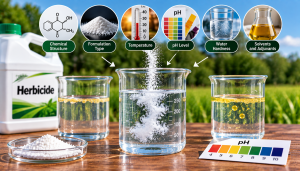
Understanding solubility helps applicators predict leaching risk, runoff potential, and how quickly a product will be taken up by roots or foliage. It also determines whether an herbicide can be applied in water, mixed with liquid fertilizer, or used in granular form. Every formulation decision starts with solubility.
In this guide, we break down what determines herbicide solubility by examining the chemical, physical, and environmental factors that control how herbicides dissolve and move.
What Determines Herbicide Solubility? 10 Key Factors
1. Molecular Polarity – The Primary Driver Of Water Solubility
Molecular polarity is the primary driver of water solubility because water is a polar solvent and dissolves polar molecules most easily. Polar herbicides have charged or partially charged regions that form hydrogen bonds with water molecules. Nonpolar herbicides do not interact with water and require organic solvents instead.
Polarity is determined by the arrangement of atoms and functional groups within the molecule. Groups like hydroxyl, carboxyl, and amine increase polarity and water solubility. Groups like long carbon chains and aromatic rings decrease polarity and water solubility.
The general rule is that like dissolves like. Polar herbicides dissolve in polar solvents like water. Nonpolar herbicides dissolve in nonpolar solvents like oil, xylene, or diesel. This rule explains why some herbicides mix easily with water and others do not.
2. Functional Groups And Chemical Structure
Functional groups and chemical structure determine how polar or nonpolar an herbicide molecule is, which in turn determines its solubility. The type, number, and position of functional groups on the molecule all affect how it interacts with water and organic solvents.
Salt forms of herbicides are usually more water-soluble than ester forms because salts are ionic and interact strongly with water. For example, 2,4-D amine salt is highly water-soluble, while 2,4-D ester is oil-soluble and requires an emulsifier to mix with water.
Acidic and basic herbicides change solubility with pH. Weak acid herbicides are more soluble in basic water, while weak base herbicides are more soluble in acidic water. This pH dependence is important for formulation and application.
3. Temperature – Higher Temperature Increases Solubility
Temperature affects herbicide solubility because warmer water molecules move faster and can more easily surround and separate solute molecules. Most herbicides become more soluble as temperature rises, though the effect varies by product.
For example, atrazine has a water solubility of about 33 parts per million at 20 degrees Celsius and about 70 parts per million at 30 degrees Celsius. This doubling of solubility with a ten-degree temperature increase is typical for many herbicides.
Temperature matters in the spray tank because cold water can limit how much product dissolves. In cold weather, some products may not fully dissolve at the labeled rate, leading to clogged nozzles and uneven application. Always mix with water at moderate temperatures when possible.
4. pH Of The Solvent – Critical For Weak Acid And Base Herbicides
The pH of the solvent is critical for weak acid and weak base herbicides because it determines whether the molecule is charged or uncharged. Charged molecules are more water-soluble than uncharged ones because they interact more strongly with water.
Weak acid herbicides like 2,4-D, dicamba, and glyphosate are more soluble in basic water because the acidic groups lose protons and become negatively charged. Weak base herbicides like atrazine and simazine are more soluble in acidic water because the basic groups gain protons and become positively charged.
pH also affects how herbicides behave in soil and inside the plant. Soil pH influences whether a product stays in solution and moves with water or binds to soil particles. Spray water pH can affect how quickly a product breaks down in the tank.
5. Adjuvants And Co-Solvents – Improving Formulation Performance
Adjuvants and co-solvents improve herbicide solubility and performance by helping products dissolve, spread, or penetrate. Surfactants reduce surface tension, emulsifiers help oil-soluble products mix with water, and co-solvents increase the amount of active ingredient that can be dissolved.
Emulsifiable concentrates are oil-soluble herbicides mixed with emulsifiers that allow them to form an emulsion in water. Soluble liquids are water-soluble salts that dissolve readily in water. Suspension concentrates are solid particles suspended in liquid with the help of dispersants.
Adjuvants also affect how herbicides behave after application. Surfactants improve leaf coverage, penetrants help products move through the waxy cuticle, and drift control agents reduce off-target movement. The right adjuvant can mean the difference between control and failure.
6. Formulation Type – How The Product Is Made
Formulation type determines how an herbicide is packaged and how it behaves in the spray tank. Common formulations include emulsifiable concentrates, soluble liquids, suspension concentrates, wettable powders, dry flowables, and granules.
Emulsifiable concentrates contain the active ingredient dissolved in an organic solvent plus an emulsifier. When added to water, they form a milky emulsion. Soluble liquids contain the active ingredient as a water-soluble salt that dissolves completely. Suspension concentrates contain solid particles suspended in liquid and require agitation.
Wettable powders and dry flowables are solid formulations that mix with water to form a suspension. Granules are solid formulations applied dry without mixing. Each formulation type has different solubility, handling, and application requirements.
7. Soil Organic Matter And Clay Content
Soil organic matter and clay content affect how herbicides behave once applied, which is closely tied to their solubility. Highly soluble herbicides move more easily with water and are more likely to leach through the soil profile. Less soluble herbicides bind more tightly to soil particles.
Organic matter and clay have charged surfaces that attract and hold herbicide molecules. Cationic herbicides bind strongly to clay and organic matter. Anionic and nonionic herbicides vary in how tightly they bind depending on their solubility and charge.
The soil adsorption coefficient, or Koc, describes how strongly an herbicide binds to soil. Low Koc values indicate weak binding and high leaching potential. High Koc values indicate strong binding and low leaching potential. Solubility and Koc together predict how a product moves in soil.
8. Leaching Potential – Solubility In Soil Water
Leaching potential is directly related to herbicide solubility because products that dissolve easily in soil water move downward with rain and irrigation. Highly soluble herbicides with low soil binding are the most likely to reach groundwater.
Herbicides like metribuzin, atrazine, and hexazinone have moderate to high solubility and have been detected in groundwater in some regions. Products with low solubility and high soil binding, like pendimethalin and trifluralin, stay near the surface and do not leach easily.
Leaching potential also depends on soil type, rainfall, and irrigation practices. Sandy soils with low organic matter leach more than clay soils with high organic matter. Managing leaching risk starts with understanding solubility.
9. Volatility – Solubility In Air And Water
Volatility is a separate property from water solubility but is related to how easily an herbicide moves into the air. Volatile herbicides like dicamba, 2,4-D ester, and certain thiocarbamates can vaporize after application and drift to sensitive crops.
Volatility increases with temperature and decreases with higher humidity. Ester formulations are generally more volatile than amine or salt formulations. Low-volatility formulations reduce drift risk and are preferred in areas with sensitive crops nearby.
Solubility in water does not directly predict volatility, but the two properties together determine how an herbicide behaves in the environment. Products that are both water-soluble and volatile are especially difficult to manage because they can move in both water and air.
10. Environmental And Regulatory Implications
Environmental and regulatory implications of herbicide solubility include restrictions on application sites, buffer zones, and use rates. Products with high water solubility and leaching potential face stricter regulations because they are more likely to contaminate water.
Atrazine is a well-known example. Its moderate solubility and detection in groundwater have led to restrictions in several countries. Imazapyr and picloram face similar scrutiny because of their long soil residual activity and movement potential.
Regulatory agencies evaluate solubility along with persistence, toxicity, and leaching potential when registering herbicides. Products that pose high environmental risk require more stringent label restrictions. Understanding these factors helps applicators use products responsibly.
Why Herbicide Solubility Matters In Practice
- Spray tank mixing: Products with low water solubility may require special adjuvants or co-solvents to dissolve properly in the spray tank. Failing to follow label instructions leads to clogged nozzles and poor application.
- Soil behavior: Highly soluble herbicides move more easily with water, increasing leaching risk. Low-solubility products stay near the surface and provide longer residual control at the application site.
- Plant uptake: Water-soluble herbicides are more easily taken up by roots. Oil-soluble herbicides are better absorbed through waxy leaf surfaces when formulated with the right adjuvants.
- Rainfastness: Products that dissolve slowly in water may be more rainfast because they are absorbed into the leaf before rain can wash them off. Products that stay on the surface longer are more vulnerable to wash-off.
- Environmental risk: Solubility is one of the key properties regulators evaluate when assessing groundwater contamination potential. Highly soluble products with low soil binding pose the greatest risk.
- Application timing: Solubility affects how quickly a product acts and how long it remains effective. Fast-dissolving products act quickly. Slow-dissolving products provide residual control over longer periods.
- Formulation choice: Manufacturers choose formulation types based on solubility. Water-soluble active ingredients become soluble liquids. Oil-soluble active ingredients become emulsifiable concentrates or suspension concentrates.
What Determines Herbicide Solubility Frequently Asked Questions
1. What determines herbicide solubility?
Herbicide solubility is determined by molecular polarity, functional groups, temperature, pH, adjuvants, formulation type, and the chemical structure of the active ingredient. Polar molecules dissolve in water, while nonpolar molecules require organic solvents.
2. Why are some herbicides more soluble in water than others?
Herbicides with polar functional groups like hydroxyl, carboxyl, and amine dissolve easily in water. Herbicides with long carbon chains and aromatic rings are nonpolar and do not dissolve in water without an emulsifier.
3. Does temperature affect herbicide solubility?
Yes, warmer water dissolves more herbicide than cold water. For example, atrazine solubility roughly doubles when water temperature increases from 20 to 30 degrees Celsius. Mix with moderate-temperature water when possible.
4. How does pH affect herbicide solubility?
pH affects weak acid and weak base herbicides by changing their charge. Weak acid herbicides dissolve better in basic water, while weak base herbicides dissolve better in acidic water. The charge determines how strongly the molecule interacts with water.
5. What is the difference between soluble liquids and emulsifiable concentrates?
Soluble liquids contain the active ingredient as a water-soluble salt that dissolves completely in water. Emulsifiable concentrates contain the active ingredient dissolved in an organic solvent plus an emulsifier that forms a milky emulsion in water.
6. Why does solubility matter for leaching?
Highly soluble herbicides dissolve easily in soil water and move downward with rain and irrigation. This increases the risk of groundwater contamination. Low-solubility herbicides bind to soil particles and stay near the surface.
7. Can I change herbicide solubility by adding adjuvants?
Adjuvants do not change the intrinsic solubility of the active ingredient, but they help products dissolve, mix, spread, or penetrate more effectively. Emulsifiers allow oil-soluble products to mix with water, and co-solvents increase how much product can be dissolved.
Conclusion
Herbicide solubility is determined by molecular polarity, functional groups, temperature, pH, adjuvants, and formulation type. Polar molecules dissolve easily in water, while nonpolar molecules require organic solvents or emulsifiers. Understanding these properties helps applicators predict how products behave in the tank, in soil, and inside the plant.
Solubility affects leaching potential, rainfastness, plant uptake, and environmental risk. Highly soluble herbicides with low soil binding are more likely to reach groundwater, while low-solubility herbicides stay near the surface and provide longer residual control.
Formulation choices reflect solubility. Water-soluble active ingredients become soluble liquids. Oil-soluble active ingredients become emulsifiable concentrates or suspension concentrates. Granules are dry formulations applied without mixing.
Applicators who understand solubility make better decisions about product selection, mixing, timing, and environmental stewardship. Read the label, follow the directions, and use the right adjuvant for the job. Solubility is one of the most important properties of any herbicide.