Invasive bush honeysuckle identification starts with recognizing the shrubs that dominate forest understories across much of North America. Several non-native Lonicera species, including Amur, Morrow’s, Tatarian, and Bell’s honeysuckle, escaped cultivation and now form dense thickets that crowd out native plants and reduce wildlife habitat.
These shrubs share a similar appearance, which makes identification challenging for landowners unfamiliar with the group. They leaf out earlier in spring and hold leaves later in fall than most native shrubs, giving them a longer growing season and a competitive advantage. Their red or orange berries are spread by birds.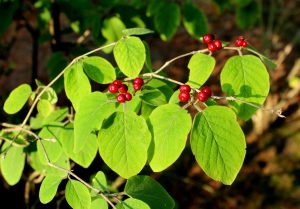
Distinguishing invasive bush honeysuckle from native species requires attention to leaf arrangement, stem structure, flower shape, and fruit characteristics. Native honeysuckles are usually vines with twining stems, while invasive types are upright shrubs with hollow or solid stems. These differences make accurate identification possible.
In this guide, we break down invasive bush honeysuckle identification by examining the key features, seasonal clues, and habitat signs that separate these shrubs from native lookalikes.
10 Key Signs For Invasive Bush Honeysuckle Identification
1. Leaf Arrangement – Most Reliable Identification Feature
Leaf arrangement is the most reliable feature for invasive bush honeysuckle identification because the leaves grow in opposite pairs along the stem. This arrangement differs from many native shrubs, which have alternate leaves. Opposite leaves attach at the same point on the stem, creating a distinctive pattern that is easy to recognize once you know what to look for.
Invasive bush honeysuckle leaves are oval to oblong with smooth or slightly hairy edges, unlike the serrated leaves of many native shrubs. They range from 1 to 3 inches long and are typically medium green on top with a lighter underside. The leaf surface may be slightly hairy, especially on Morrow’s honeysuckle.
Confirming opposite leaf arrangement eliminates many lookalikes and narrows identification quickly. Combining this feature with stem and flower characteristics provides reliable identification in most cases, even when the plant is not in bloom.
2. Hollow Stems – Best Winter Identification Clue
Hollow stems are the best winter identification clue for invasive bush honeysuckle because native shrubs typically have solid or chambered pith. Cutting a stem lengthwise reveals a hollow or brown-centered interior in invasive species. This feature is especially useful when leaves and flowers are absent during the dormant season.
Amur and Morrow’s honeysuckle have hollow stems with a brownish pith, while Tatarian honeysuckle has a solid but brown-centered stem. Native honeysuckles usually have solid white pith. Testing several stems confirms the pattern and prevents misidentification.
Hollow stems also explain why these shrubs resprout vigorously after cutting or burning. The hollow structure allows rapid regrowth from root crowns and cut stumps, which is why repeated treatment is necessary for effective control.
3. Early Leaf-Out And Late Leaf-Drop – Seasonal Advantage
Early leaf-out and late leaf-drop is one of the most visible signs of invasive bush honeysuckle because these shrubs green up weeks before native species in spring. They also hold leaves well into fall after most native shrubs have dropped theirs. This extended growing season gives them a significant competitive advantage.
The longer growing season allows invasive honeysuckles to capture more sunlight, water, and nutrients than native plants, suppressing their growth and reproduction. In forest understories, this advantage leads to dense monocultures that exclude wildflowers, tree seedlings, and native shrubs.
Walking a woodlot in early spring or late fall makes identification easier because invasive honeysuckles stand out as green shrubs among dormant vegetation. This seasonal clue is one of the simplest ways to locate infestations before they spread further.
4. Tubular Flowers In Pairs – Best Blooming Season Clue
Tubular flowers in pairs is the best blooming season clue for invasive bush honeysuckle identification because native honeysuckles typically produce flowers in different arrangements. Invasive species produce fragrant, tubular flowers in pairs at the leaf axils, with colors ranging from white to yellow to pink depending on the species.
Amur honeysuckle produces white flowers that turn yellow as they age, while Tatarian honeysuckle produces pink or white flowers. Morrow’s honeysuckle produces white flowers that fade to yellow. Native honeysuckle vines produce similar flowers but grow as twining vines rather than upright shrubs.
Blooming occurs in late spring to early summer and lasts several weeks, providing a reliable window for identification. Photographing flowers and noting their arrangement helps confirm identification and distinguishes invasive species from native relatives.
5. Red Or Orange Berries – Most Visible Fall Feature
Red or orange berries are the most visible fall feature of invasive bush honeysuckle and a key identification clue. The berries ripen in late summer to early fall and persist on the shrub into winter, providing food for birds that spread the seeds. Berry color varies from bright red to orange depending on the species.
Amur and Morrow’s honeysuckle produce bright red berries, while Tatarian honeysuckle produces red to orange fruit. Native honeysuckles also produce red berries, but they grow on vines rather than upright shrubs. Checking the growth habit along with berry color confirms identification.
Because birds disperse the seeds widely, berries are often the first sign of a new infestation. Removing shrubs before berries ripen prevents further spread and reduces the seedbank in the soil.
6. Upright Shrub Growth Habit – Key Distinction From Native Vines
Upright shrub growth habit is the key distinction between invasive bush honeysuckle and native honeysuckle vines. Invasive species grow as multi-stemmed shrubs reaching 6 to 15 feet tall, while native honeysuckles are twining vines that climb trees and fences. This difference is obvious once you know what to look for.
Invasive bush honeysuckles form dense thickets through root suckers and spreading root systems, creating impenetrable stands in forest understories. Their upright form allows them to capture light more effectively than native shrubs and vines, contributing to their competitive success.
Checking growth habit first eliminates confusion with native vines and focuses identification on the shrub species. Combining growth habit with leaf arrangement, stem structure, and fruit characteristics provides reliable identification in any season.
7. Bark Texture And Color – Useful Year-Round Clue
Bark texture and color provide a useful year-round clue for invasive bush honeysuckle identification when leaves and flowers are absent. Invasive species typically have gray-brown bark that becomes shaggy or peeling on older stems. The bark often has a slightly ridged or striped appearance that helps distinguish it from native shrubs.
Amur honeysuckle bark is gray-brown and develops shallow vertical fissures as the shrub ages. Morrow’s honeysuckle bark is similar but slightly lighter in color. Tatarian honeysuckle bark is gray and relatively smooth on young stems, becoming rough with age.
Bark alone is rarely sufficient for identification, but combining it with stem pith, growth habit, and habitat clues provides reliable results. Winter identification is possible by examining bark and cutting stems to check pith structure.
8. Habitat And Spread Patterns – Where To Look
Habitat and spread patterns help narrow identification because invasive bush honeysuckles thrive in specific environments. They are most common in forest edges, disturbed woodlands, old fields, roadsides, and riparian areas. They tolerate a wide range of soil conditions but prefer moist, fertile sites with partial to full sun.
Invasive honeysuckles spread from landscape plantings into natural areas, forming dense thickets that expand outward from the original source. Birds disperse seeds along fence lines, power line corridors, and watercourses, creating new infestations far from parent plants.
Knowing where to look improves identification efficiency and helps landowners prioritize removal efforts. Scouting forest edges and disturbed areas in early spring or late fall reveals infestations before native vegetation obscures them.
9. Comparing Invasive And Native Honeysuckles – Side-By-Side Clues
Comparing invasive and native honeysuckles side by side is the fastest way to confirm identification once you know the key differences. Invasive species are upright shrubs with opposite leaves, hollow or brown-centered stems, and paired tubular flowers. Native species are twining vines with opposite leaves, solid white pith, and similar flowers.
Native honeysuckles include coral honeysuckle, hairy honeysuckle, and grape honeysuckle, all of which grow as vines rather than shrubs. Their flowers are typically more colorful and tubular, and their berries are red but smaller than those of invasive species.
Learning the native species in your region prevents unnecessary removal of beneficial plants and focuses control efforts on the actual invaders. Consulting a local extension guide or botanist confirms identification when uncertainty remains.
10. Seasonal Identification Calendar – Best Time To Confirm
A seasonal identification calendar is the best way to confirm invasive bush honeysuckle identification throughout the year. Each season offers different clues: early leaf-out in spring, paired flowers in late spring, red berries in late summer, and hollow stems and persistent berries in winter. Combining multiple seasonal observations provides the most reliable identification.
Spring is ideal for locating infestations because invasive honeysuckles green up before native vegetation. Summer provides flowers and fruit for confirmation. Fall offers berry color and late leaf retention as key clues. Winter allows stem and bark examination when the shrub is dormant.
Recording observations across seasons helps landowners track infestations and plan treatment timing. Because invasive honeysuckles resprout after cutting, identifying them accurately before treatment prevents wasted effort and ensures the right control methods are used.
7 Tips For Identifying Invasive Bush Honeysuckle Accurately
- Check leaf arrangement first: Opposite leaves in pairs along the stem are the most reliable starting point for identification and eliminate many lookalikes immediately.
- Cut a stem to check pith: Invasive bush honeysuckles have hollow or brown-centered stems, while native honeysuckles have solid white pith. This test works year-round.
- Look for early leaf-out: Invasive honeysuckles green up weeks before native shrubs in spring, making them easy to spot in dormant woodlands and forest edges.
- Examine flowers in late spring: Paired tubular flowers at the leaf axils confirm identification during bloom. Note color and arrangement to distinguish species.
- Check berries in late summer: Red or orange berries that persist into winter are a strong indicator of invasive bush honeysuckle, especially when paired with upright shrub growth.
- Confirm growth habit: Invasive species grow as upright shrubs, while native honeysuckles are twining vines. This difference is obvious once you know what to look for.
- Consult local resources: Extension guides, field manuals, and botanists help confirm identification when uncertainty remains, preventing unnecessary removal of native plants.
Frequently Asked Questions (FAQs)
1. How do I identify invasive bush honeysuckle?
Identify invasive bush honeysuckle by its opposite leaves, hollow or brown-centered stems, upright shrub growth habit, paired tubular flowers in late spring, and red or orange berries in late summer. Early leaf-out and late leaf-drop are additional seasonal clues.
2. What is the difference between invasive and native honeysuckle?
Invasive bush honeysuckles grow as upright shrubs with hollow or brown-centered stems, while native honeysuckles are twining vines with solid white pith. Both have opposite leaves and paired flowers, but growth habit is the clearest distinction.
3. When is the best time to identify invasive bush honeysuckle?
Early spring and late fall are the best times to identify invasive bush honeysuckle because they leaf out earlier and hold leaves later than native shrubs. Late spring and late summer also work well when flowers and berries are present.
4. Are invasive bush honeysuckle berries toxic?
Invasive bush honeysuckle berries are mildly toxic to humans and pets if consumed in quantity. Birds can eat them without harm and are the primary dispersal agents. People should avoid eating berries from plants they cannot positively identify.
5. How do I remove invasive bush honeysuckle?
Control typically involves cutting the shrub and treating the stump with concentrated herbicide to prevent resprouting. Foliar herbicide applications work on smaller plants, while basal bark treatment is effective on larger specimens. Repeated monitoring over several seasons is essential.
6. Why is invasive bush honeysuckle a problem?
Invasive bush honeysuckle forms dense thickets that crowd out native plants, reduces wildlife habitat quality, and alters forest structure. Its early leaf-out and late leaf-drop give it a competitive advantage that suppresses native vegetation.
7. What should I plant instead of invasive bush honeysuckle?
Plant native shrubs like red chokeberry, winterberry, native viburnums, and dogwoods, or native honeysuckle vines like coral honeysuckle. These plants provide food and habitat for wildlife without spreading into natural areas.
Conclusion
Opposite leaf arrangement is the most reliable starting point for invasive bush honeysuckle identification, and hollow or brown-centered stems confirm the diagnosis year-round. Early leaf-out in spring and late leaf-drop in fall make these shrubs stand out among native vegetation.
Paired tubular flowers in late spring and red or orange berries in late summer provide additional confirmation, while upright shrub growth habit distinguishes invasive species from native honeysuckle vines. Combining these features ensures accurate identification in any season.
Confirming identification before treatment prevents wasted effort and protects native plants that might otherwise be removed by mistake. Accurate identification also helps landowners prioritize the most aggressive infestations for control before they spread further.
Start scouting your property this season, note the seasonal clues, and consult local resources when uncertainty remains. Consistent monitoring and accurate identification are the foundation of effective invasive bush honeysuckle management.