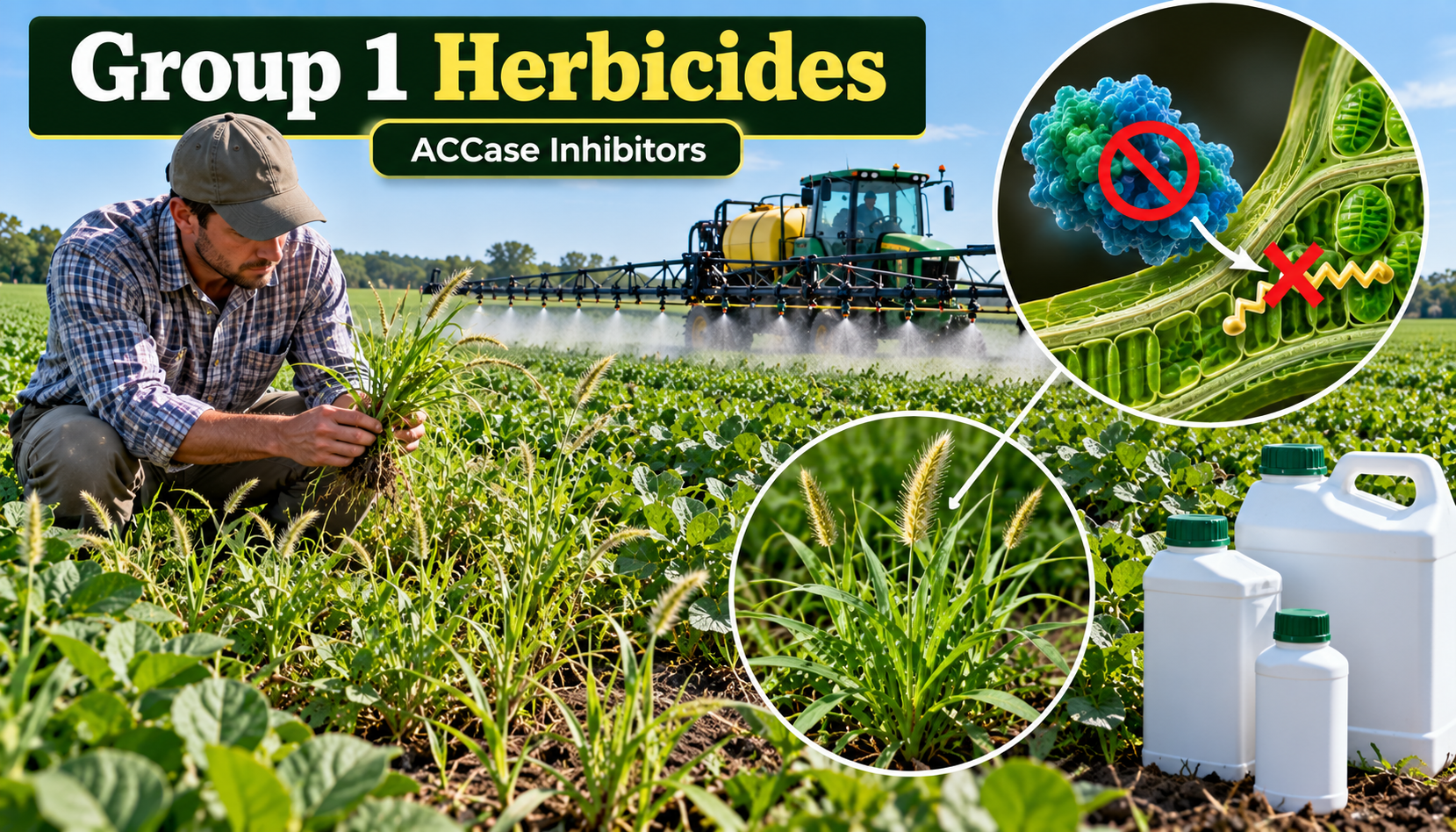
Group 1 herbicides are ACCase inhibitors used primarily for post-emergence control of susceptible grass weeds. They inhibit acetyl-CoA carboxylase (ACCase), an enzyme involved in fatty-acid biosynthesis, disrupting the growth of susceptible grasses and making this herbicide group an important tool in many weed-management programs.
The Group 1 designation comes from the HRAC/WSSA herbicide site-of-action classification system. In the legacy HRAC classification, the same mode of action was designated Group A, so both Group 1 and Group A may appear in herbicide labels, technical literature, and resistance-management resources.
Group 1 contains several chemically different herbicide families, including aryloxyphenoxypropionates (FOPs), cyclohexanediones (DIMs), and the phenylpyrazoline family represented by pinoxaden. Although these compounds differ chemically, they are classified together because they inhibit the same primary herbicide target, ACCase.
In this guide, we explain what Group 1 herbicides are, how ACCase inhibition affects susceptible grasses, which weeds they can control, the major active ingredients in the group, five commonly used Group 1 products, application considerations, crop safety, resistance mechanisms, and practical resistance-management strategies.
Group 1 Herbicides Explained: ACCase Inhibitors, Uses, Best Products, and Resistance Management
Group 1 Herbicides: An Overview
Group 1 herbicides are defined by their inhibition of acetyl-CoA carboxylase, commonly abbreviated as ACCase. ACCase is an important enzyme involved in fatty-acid biosynthesis, a process required for the development and maintenance of growing plant tissues.
When a susceptible grass absorbs an effective Group 1 herbicide, ACCase activity is inhibited. This interferes with essential biochemical processes in actively growing tissues and eventually causes the susceptible grass to stop developing and die.
HRAC/WSSA classifies ACCase inhibition as Group 1, while the legacy HRAC system identifies the same mode of action as Group A. These designations should not be interpreted as different modes of action; they describe the same ACCase-inhibiting group.
The group contains several chemical families. FOPs include active ingredients such as fluazifop, quizalofop, fenoxaprop, diclofop, clodinafop, cyhalofop, and haloxyfop. DIMs include active ingredients such as clethodim and sethoxydim, while pinoxaden belongs to the phenylpyrazoline family.
How Group 1 Herbicides Work
Most Group 1 herbicides are applied to foliage after grass weeds have emerged. The herbicide is absorbed by treated plant tissue and moves within the plant toward metabolically active areas, including growing points.
ACCase inhibition disrupts fatty-acid biosynthesis in susceptible grasses. Because developing tissues have a high requirement for new cellular components, disruption of this pathway eventually causes growth to stop and susceptible plants to deteriorate.
Symptoms are generally not instantaneous. Depending on the active ingredient, weed species, growth stage, environmental conditions, and application rate, treated grasses may first show reduced growth before more obvious symptoms develop in the growing point and other tissues.
The time required for visible injury and plant death therefore varies. Slow symptom development should not automatically be interpreted as treatment failure, particularly when the herbicide has been applied under conditions specified on the product label.
What Weeds Do Group 1 Herbicides Control?
Group 1 herbicides are primarily used against susceptible annual and perennial grass weeds. Their effectiveness depends on the specific active ingredient, product formulation, weed species, growth stage, application rate, crop, and label directions.
Examples of grass weeds that may be targeted by individual Group 1 products include foxtails, wild oats, barnyardgrass, crabgrass, volunteer cereals, Johnsongrass, quackgrass, and other susceptible grasses. However, no single Group 1 herbicide should be assumed to control every grass species.
Product labels provide the most reliable information about the weeds controlled by a particular formulation. Differences in weed susceptibility are important because a herbicide can be highly effective on one grass species while providing inadequate control of another.
Group 1 herbicides are primarily grass herbicides rather than broad-spectrum weed killers. Broadleaf weeds and sedges generally require other herbicide modes of action or non-chemical management practices.
Common Group 1 Active Ingredients
Group 1 contains numerous active ingredients used in different crops and production systems. Common examples include clethodim, sethoxydim, quizalofop-ethyl, fluazifop-butyl, fenoxaprop-ethyl, diclofop-methyl, clodinafop-propargyl, cyhalofop-butyl, haloxyfop-methyl, and pinoxaden.
Clethodim and sethoxydim are members of the cyclohexanedione (DIM) family. Active ingredients such as fluazifop, quizalofop, fenoxaprop, diclofop, clodinafop, cyhalofop, and haloxyfop belong to the aryloxyphenoxypropionate (FOP) family.
Pinoxaden is chemically distinct from both FOPs and DIMs and belongs to the phenylpyrazoline family. Despite those chemical differences, these active ingredients are classified together because they inhibit ACCase.
This distinction is important for resistance management. Changing from one Group 1 active ingredient to another Group 1 active ingredient does not constitute a true herbicide mode-of-action rotation.
5 Best Group 1 Herbicides
Choosing a Group 1 herbicide depends on the target grass, crop, weed growth stage, product label, application conditions, and local resistance situation. The products below represent established ACCase-inhibiting formulations, but they should not be treated as interchangeable because their labeled crops, weed spectra, rates, and restrictions differ.
1. Select Max Herbicide
Best for: Clethodim-based post-emergence control of susceptible grass weeds in labeled crops.
Select Max contains clethodim, a Group 1 ACCase inhibitor belonging to the cyclohexanedione family. It is used for post-emergence grass control in various labeled crops, with the specific weeds and application requirements determined by the current product label.

Clethodim provides systemic activity against susceptible grasses after foliar application. Its usefulness depends on correct weed identification, appropriate weed growth stage, adequate spray coverage, and compliance with crop-specific label directions.
- Clethodim active
- Post-emergence control
- Grass-focused activity
- Broad crop uses
- Systemic activity
- Established formulation
- Multiple labeled uses
- Group 1 resistance
- Label restrictions
- Crop-specific uses
2. Poast Herbicide
Best for: Sethoxydim-based selective post-emergence grass control in labeled crops.
Poast contains sethoxydim, another Group 1 ACCase inhibitor in the cyclohexanedione family. It is intended for selective post-emergence control of susceptible grasses in crops and situations listed on the product label.

- This selective post-emergent herbicide targets and kills grass growth.
- The product can be applied to around vegetables, gardens, trees, shrubs and ornamentals safely.
Sethoxydim is chemically different from clethodim, but both remain within Group 1 because they inhibit ACCase. Consequently, moving from clethodim to sethoxydim should not be regarded as a genuine mode-of-action rotation for resistance management.
- Sethoxydim active
- Selective control
- Post-emergence use
- Annual grass activity
- Perennial grass activity
- Established product
- Known chemistry
- Group 1 resistance
- Label limitations
- Grass-focused activity
3. Assure II Herbicide
Best for: Quizalofop-based control of susceptible grass weeds in labeled crops.
Assure II contains quizalofop, an ACCase-inhibiting Group 1 herbicide in the aryloxyphenoxypropionate family. It is designed for selective post-emergence grass control in the crops and use situations specified on its label.

- BROAD-SPECTRUM WEED ACTION: Fusilade herbicide weed killer targets perennial and annual grass weeds in various settings. Safe for landscapes, nurseries, and sports fields, it controls weeds without harming ornamentals, ensuring a clean appearance
- POWERFUL BROAD-SPECTRUM CONTROL: Applied at 1.29-1.95 oz./acre, Recognition selectively controls sedges (including yellow and puple nutsedge), kyllingas, grasses and broadleaf weeds (dollarweed / lawn pennywort, spotted spurge, wild garlic, carpetweed)
Quizalofop demonstrates the chemical diversity within Group 1. Although it belongs to the FOP family rather than the DIM family, its primary herbicidal target remains ACCase, meaning resistance-management considerations still apply across the group.
- Quizalofop active
- FOP chemistry
- Selective control
- Post-emergence activity
- Systemic activity
- Established formulation
- Grass-focused action
- Group 1 resistance
- Label limitations
- Crop restrictions
4. Fusilade DX Herbicide
Best for: Fluazifop-P-butyl-based post-emergence control of susceptible grasses in labeled crops.
Fusilade DX contains fluazifop-P-butyl, an ACCase-inhibiting Group 1 herbicide in the FOP family. It is used for selective post-emergence management of susceptible annual and perennial grass weeds in crops listed on its label.

- Group 1 Herbicide
- Postemergence Herbicide Control of Perennial and Annual Grass Weeds
Fusilade DX illustrates why the product label is more important than the Group 1 classification alone when choosing a herbicide. Crop approvals, target weeds, rates, adjuvants, tank-mix partners, and application restrictions must all be considered before treatment.
- Fluazifop active
- FOP chemistry
- Systemic activity
- Annual grass control
- Perennial grass control
- Established product
- Selective applications
- Crop-specific label
- Resistance concerns
- Grass-focused activity
5. Select 2 EC Herbicide
Best for: Clethodim-based post-emergence grass control where the formulation is labeled.
Select 2 EC is a clethodim formulation and therefore belongs to Group 1. Clethodim products are used for selective post-emergence management of susceptible annual and perennial grasses in various labeled broadleaf crops.

- USE SITES: For use on both cool and warm season grasses
- EFFECTIVE AGAINST: Dandelion, clover, plantain, and many other listed broadleaf weeds
Select 2 EC is chemically related to Select Max because both contain clethodim. The choice between formulations should therefore be based on the current label, crop, target weed, formulation requirements, availability, application conditions, and resistance-management program rather than treating them as different modes of action.
- Clethodim active
- Post-emergence use
- Selective grass control
- Broadleaf crop uses
- Annual grass activity
- Perennial grass activity
- Established chemistry
- Group 1 resistance
- Label-dependent uses
- Adjuvant requirements
How to Apply Group 1 Herbicides
Group 1 herbicides are commonly used as post-emergence foliar treatments against actively growing grass weeds. The appropriate application stage depends on the individual product and target weed, so the registered label should always determine the permitted timing and rate.
Young, actively growing grass weeds are generally more responsive to post-emergence treatments than large or severely stressed plants. Delaying treatment can make control more difficult, particularly when weeds approach or exceed the size specified on the product label.
Spray coverage is important for foliar-applied herbicides. Nozzle selection, carrier volume, spray quality, weed density, crop canopy, and application technique can influence how much herbicide reaches the target foliage.
Adjuvant requirements vary among Group 1 products. Some formulations require or recommend crop oil concentrate, methylated seed oil, non-ionic surfactant, or another specified adjuvant, while other products have different requirements. The product label should determine the appropriate adjuvant and rate.
Weather and Weed Growth Conditions
Environmental conditions can influence herbicide absorption, movement, and plant response. Group 1 herbicides generally perform more predictably when susceptible grass weeds are actively growing and are not under severe environmental stress.
Drought, frost, extreme temperatures, prolonged cloudy conditions, or other forms of plant stress can affect herbicide performance. Stressed weeds may absorb or translocate herbicides differently from actively growing plants.
Rainfall after application can also affect some foliar herbicides. The appropriate rainfast interval varies by product and formulation, so a universal rainfast period should not be applied to every Group 1 herbicide.
Always follow the individual product label for application timing, temperature restrictions, rainfast requirements, adjuvant use, spray volume, and other environmental limitations.
Crop Safety and Selectivity
Group 1 herbicides are widely used where selective control of grass weeds is required in crops that tolerate the particular product. Selectivity depends on the crop, active ingredient, formulation, rate, application timing, and other label-specific conditions.
The fact that a product is selective in one crop does not mean it is safe for every crop. Grass crops can be particularly sensitive to ACCase inhibitors intended for use against grass weeds in broadleaf crops.
Crop injury can also result from drift, incorrect rates, application outside the registered crop, contaminated spray equipment, or failure to follow label restrictions. Sprayer cleanout should therefore be performed according to the product label before moving between crops.
Crop safety information should always come from the specific product label rather than from the herbicide group classification alone. Group 1 identifies the mode of action, not a universal crop-safety profile.
Group 1 Herbicide Resistance
Resistance to ACCase-inhibiting herbicides has developed in numerous grass weed species around the world. Resistant populations have been documented in species including blackgrass, wild oat, goosegrass, ryegrass, and other important grass weeds.
Resistance develops through natural genetic variation followed by selection. When an effective herbicide is repeatedly used against a weed population, susceptible plants are controlled while individuals carrying resistance mechanisms may survive and contribute seed to subsequent generations.
Repeated use of the same herbicide mode of action can therefore increase selection pressure. Resistance is a population-level evolutionary process rather than an individual plant simply becoming accustomed to a herbicide during its lifetime.
ACCase resistance can involve different mechanisms. Target-site resistance can reduce the sensitivity of ACCase to the herbicide, while non-target-site mechanisms can reduce the amount of active herbicide reaching or remaining at the target site.
Poor control should not automatically be classified as resistance. Incorrect weed identification, inadequate application rate, poor spray coverage, environmental stress, unsuitable timing, antagonistic tank mixtures, or other application problems can also cause inadequate control.
Cross-Resistance Within Group 1
Cross-resistance is an important consideration when managing ACCase-resistant weeds. A weed population with a resistance mechanism affecting ACCase inhibitors may show resistance to more than one Group 1 active ingredient.
This means that replacing one Group 1 product with another Group 1 product may not restore effective control. The outcome depends on the resistance mechanism and the susceptibility of the particular weed population.
Changing from an FOP product to a DIM product, for example, should not automatically be considered a resistance-management solution because both remain within Group 1.
Where resistance is suspected or confirmed, herbicide selection should be based on documented susceptibility, the target weed, crop, and locally approved recommendations rather than simply changing commercial brands.
Herbicide Rotation and Tank-Mix Strategies
Herbicide rotation is one component of resistance management, but effective rotation means changing selection pressure rather than simply changing product names. Moving between herbicides that share the same site of action does not provide the same benefit as using an effective herbicide with a different mode of action.
Tank mixtures can contribute to resistance management when they contain effective partners with different modes of action. However, simply mixing two herbicides does not automatically prevent resistance.
For a mixture to provide meaningful resistance-management value, the components should be effective against the target weed at the application timing and should be used at their labeled rates and according to applicable restrictions.
Resistance-management programs should therefore be designed around the target weed, crop, known resistance status, available herbicide groups, and local label requirements.
Integrated Weed Management
Long-term weed management should not depend entirely on repeated herbicide applications. Integrated weed management combines chemical control with cultural, mechanical, and other appropriate practices to reduce weed populations and selection pressure.
Crop rotation can diversify weed-management programs by changing crop competition, planting dates, herbicide options, and opportunities for mechanical or cultural control. Cover crops and competitive crop stands can also suppress some weeds when properly established and managed.
Mechanical control, including cultivation, can provide another management tool where soil conditions, crop stage, weed size, and production systems make it practical. Preventing surviving weeds from producing seed is particularly important where herbicide resistance is suspected or confirmed.
Integrated management is especially important for Group 1 because resistance has been documented in numerous grass species. Combining different management practices can reduce dependence on repeated ACCase inhibition.
Tips for Using Group 1 Herbicides Effectively
- Identify the weed: Confirm the grass species before selecting a Group 1 product.
- Treat actively growing weeds: Avoid applying under severe plant stress unless the label permits it.
- Follow the label: Use the approved crop, rate, timing, adjuvant, and application method.
- Use effective alternatives: Select different modes of action when appropriate and effective.
- Avoid repeated Group 1 use: FOPs, DIMs, and pinoxaden remain within Group 1.
- Investigate control failures: Check application conditions before assuming resistance.
- Prevent seed production: Control surviving weeds before they replenish the soil seedbank.
Group 1 Herbicides Explained Frequently Asked Questions
1. What are Group 1 herbicides?
Group 1 herbicides are ACCase inhibitors classified under the HRAC/WSSA numerical system. They are primarily used to control susceptible grass weeds, while the same mode of action is identified as legacy HRAC Group A.
2. What is the mode of action of Group 1 herbicides?
Group 1 herbicides inhibit acetyl-CoA carboxylase (ACCase), an enzyme involved in fatty-acid biosynthesis. In susceptible grasses, ACCase inhibition disrupts processes required for continued growth and development.
3. Which active ingredients belong to Group 1?
Examples include clethodim, sethoxydim, quizalofop, fluazifop, fenoxaprop, diclofop, clodinafop, cyhalofop, haloxyfop, and pinoxaden. The current HRAC/WSSA classification should be checked for the active ingredient being considered.
4. What weeds do Group 1 herbicides control?
Group 1 herbicides primarily control susceptible annual and perennial grasses. The exact spectrum varies by active ingredient, formulation, weed species, crop, application rate, and growth stage.
5. Are FOPs and DIMs both Group 1 herbicides?
Yes. FOPs and DIMs are chemically different families, but both inhibit ACCase and are classified under HRAC/WSSA Group 1. Pinoxaden is also classified in Group 1 but belongs to the phenylpyrazoline family.
6. Does switching between Group 1 herbicides prevent resistance?
No. Switching between different Group 1 active ingredients does not represent a true change in herbicide mode of action because they share ACCase inhibition. Resistance-management programs should consider effective herbicides with different modes of action where appropriate.
7. What should I do if a Group 1 herbicide fails?
Check weed identification, product rate, application timing, weed growth stage, weather conditions, spray coverage, adjuvant requirements, and other possible causes of poor control. If resistance is suspected, avoid repeatedly applying the same Group 1 treatment and seek appropriate local resistance-management guidance.
Conclusion
Group 1 herbicides are ACCase inhibitors that provide an important post-emergence tool for controlling susceptible grass weeds. The group contains chemically different families, including FOPs, DIMs, and pinoxaden, but all are classified together because they inhibit acetyl-CoA carboxylase.
Successful use depends on choosing a product that is labeled for the crop and target weed and applying it according to the product-specific directions. Weed size, growth conditions, spray coverage, adjuvant requirements, application rate, and environmental conditions can all influence control.
Resistance is one of the most important limitations associated with repeated reliance on Group 1 herbicides. Because FOPs, DIMs, and pinoxaden share the same primary mode of action, moving between these products does not provide the same resistance-management benefit as using an effective herbicide with a different mode of action.
The most durable approach combines appropriate herbicide use with crop rotation, cultural practices, mechanical control where suitable, and prevention of seed production by surviving weeds. Integrated weed management can reduce dependence on repeated ACCase inhibition and help preserve useful herbicide options for future seasons.