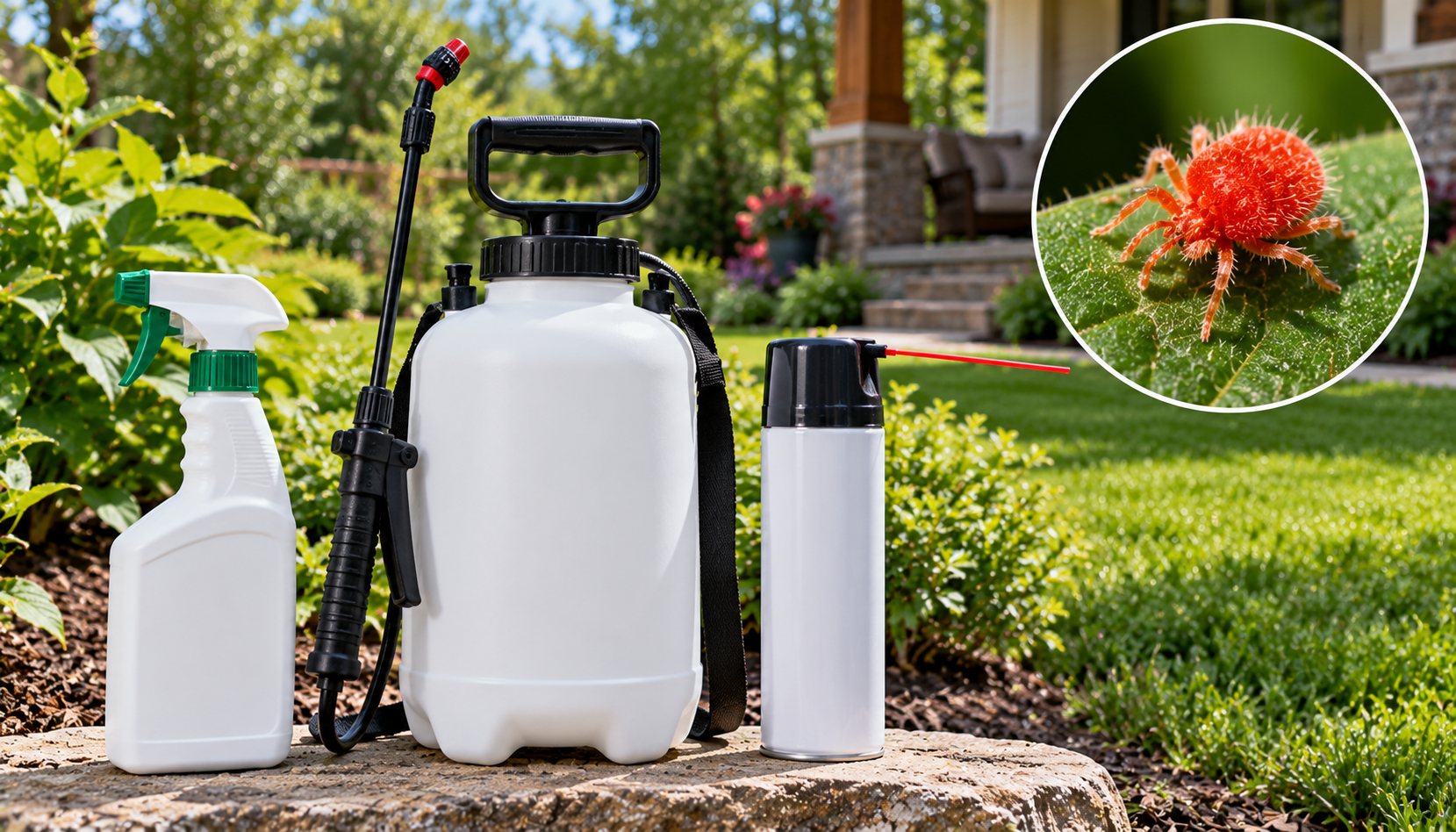
The best insecticide for chiggers can help reduce troublesome mite populations in lawns, gardens, wooded edges, and other outdoor areas where people spend time. Because chiggers are extremely small and often remain hidden in vegetation and soil-level debris, effective control depends on treating likely habitat rather than simply spraying areas where bites have already occurred.
A successful treatment program starts with identifying damp, overgrown, or shaded locations where chiggers are most likely to thrive. Mowing, trimming vegetation, removing unnecessary leaf litter, improving airflow, and reducing dense groundcover can make the environment less favorable before an insecticide is considered.
When chemical control is necessary, the active ingredient, formulation, application site, residual performance, and label directions all deserve careful attention. Products containing ingredients such as bifenthrin, permethrin, cyfluthrin, or related pyrethroids may be labeled for certain mite or chigger control uses, but registration and permitted applications vary by product and location.
In this guide, we examine 15 insecticide and control options that can be useful when managing chiggers around outdoor living areas. We also cover application considerations, lawn preparation, prevention, safety precautions, and answers to common questions about reducing chigger populations without treating every part of the property unnecessarily.
Best Insecticide For Chiggers
1. Bifenthrin Insecticide
Bifenthrin is a synthetic pyrethroid found in numerous residential and professional pest-control products and is often considered when managing mites and other crawling pests. Depending on the formulation, it can provide residual activity on suitable outdoor surfaces, making it useful for treating areas where chiggers may move through vegetation.
The important distinction is between the active ingredient and the individual product. A bottle containing bifenthrin should not automatically be assumed to be suitable for chiggers, lawns, gardens, or every outdoor surface, so the current label must specifically support the intended use.
For yard management, concentrate attention on likely chigger habitat rather than treating an entire property indiscriminately. Follow the label concerning dilution, application rate, protective equipment, re-entry, weather conditions, and restrictions around water and edible plants.

- Dependable, long-lasting residual control.
- Non-irritating, no-odor formulation dries with no visible residue.
Pros:
- Widely used synthetic pyrethroid active ingredient.
- Can provide residual control where labeled.
- Useful against various crawling pests.
- Available in several formulations.
- Suitable for targeted outdoor applications when permitted.
- Can complement habitat management.
- Useful for persistent pest-pressure areas.
Cons:
- Not every bifenthrin product is labeled for chiggers.
- Can affect non-target insects.
- Application requires careful label compliance.
2. Permethrin Insecticide
Permethrin is another widely used pyrethroid found in numerous insect-control products. Certain formulations may be labeled for mites or chiggers in particular outdoor settings, giving gardeners and property owners another potential option when environmental management alone does not provide adequate relief.
Its effectiveness depends heavily on where the product is applied and whether the target pest is actually included on the label. A product designed for clothing, for example, should not be used on lawns, while a lawn treatment should not be applied to clothing or skin unless its label specifically permits such use.
When a suitable outdoor formulation is selected, treat the areas where people are most likely to encounter chiggers rather than applying pesticide without a clear target. Pay particular attention to tall grass, brushy margins, dense vegetation, and other areas identified through monitoring.

- Rapid-kill livestock insecticide concentrate
- SAFE: Permethrin is highly toxic to insects but not to animals or humans
Pros:
- Commonly available pyrethroid ingredient.
- Found in multiple pest-control formulations.
- Can provide residual activity.
- Useful for certain outdoor pest applications.
- Can complement mowing and vegetation management.
- Suitable for targeted treatment where labeled.
- Useful against several crawling pests.
Cons:
- Different formulations have different uses.
- Can harm beneficial insects.
- Must not be used on an unapproved surface.
3. Cyfluthrin Insecticide
Cyfluthrin is a pyrethroid insecticide used in various residential pest-control products. Depending on the formulation and registration, it may provide residual control against certain outdoor pests and can be considered when a product specifically identifies the intended chigger or mite application.
Outdoor pest management works best when the treatment area has already been prepared. Cutting excessively tall vegetation and clearing dense debris can improve access to the habitat while also reducing the protected conditions that allow chiggers and other nuisance arthropods to persist.
Do not select a cyfluthrin product solely because the active ingredient has a broad reputation for insect control. Read the complete label and verify the target pest, application site, dilution, frequency, and environmental precautions before using it.

- POWERFUL BROAD-SPECTRUM CONTROL: Tirade 1% Dust contains cyfluthrin, the same active ingredient as the leading brand, to control flying, crawling, and wood-infesting insect pests.
- READY TO USE + EASY TO APPLY: Control insects without the hassle of measuring and mixing. Our convenient dust formulation comes ready to use and is easy to apply in hard-to-reach areas. See product label for complete application directions.
Pros:
- Provides pyrethroid-based pest control.
- Available in outdoor pest-control formulations.
- Can provide residual activity where labeled.
- Useful for targeted habitat treatment.
- Can complement physical yard management.
- May control several labeled crawling pests.
- Suitable for integrated pest management.
Cons:
- Product labels vary considerably.
- Can affect non-target arthropods.
- Requires careful application.
4. Lambda-Cyhalothrin Insecticide
Lambda-cyhalothrin is a synthetic pyrethroid used in numerous pest-management products. Certain registered formulations can provide residual control on appropriate outdoor surfaces, making the ingredient relevant to broader nuisance-pest programs where chigger control is specifically listed.
Its usefulness depends on reaching the habitat where chiggers are active. Treating only open lawn while ignoring overgrown borders, brush, and shaded vegetation may produce disappointing results because untreated refuges can continue supporting the population.
Apply only according to the specific product label and avoid unnecessary applications around flowering plants and aquatic environments. A targeted treatment combined with vegetation reduction generally makes more sense than repeated blanket applications across a property.

- FORMULATED FOR FAST + LASTING INSECT CONTROL: Devito with EnduraCap Technology contains 9.7% lambda-cyhalothrin. Our EnduraCap Technology adds time-released defense to a proven active for extended insect control.
- CONTROL THAT GOES WHERE YOU NEED IT: Devito with EnduraCap Technology is labeled for insect control in many settings. Devito works inside and out in residential and business settings including landscapes, building perimeters, and kitchens. See the label for complete use site listing.
Pros:
- Common synthetic pyrethroid ingredient.
- Some formulations provide residual activity.
- Useful for certain outdoor pest programs.
- Can complement habitat reduction.
- Suitable for targeted applications when labeled.
- Can address multiple approved pests.
- Useful for recurring pest-pressure areas.
Cons:
- Not every product is suitable for chiggers.
- May affect beneficial arthropods.
- Weather can influence residual performance.
5. Deltamethrin Insecticide
Deltamethrin is another pyrethroid active ingredient used in residential and professional pest-control products. Depending on the formulation, it can provide contact and residual activity against a range of pests, although chigger use must be confirmed on the specific label.
For property-wide chigger management, identify the areas where people repeatedly encounter bites before deciding where to apply a treatment. Dense vegetation around paths, recreation areas, lawn margins, and neglected corners can deserve greater attention than regularly maintained open lawn.
Because deltamethrin products differ in concentration and approved application sites, following the label is particularly important. Keep treated areas clear for the required period and take precautions around children, pets, pollinators, waterways, and edible crops.

- POWERFUL INSECT KILL, FLEXIBLE USE OFFERING: Adjourn SC contains 4.75% deltamethrin; the same active ingredient as the leading brand. Deltamethrin is the active professionals trust for proven insect control in nearly every setting – including bedbugs, lice, and fleas in mattresses, furniture, and carpets.
- FROM THE FRONT LAWN TO THE BACK ROOM, WE HAVE YOU COVERED. With its wide-use label, Adjourn SC controls insects inside and out in residential and business settings. Use everywhere from outdoor landscapes and perimeter treatments to interior applications including kitchens and upholstered furniture. See the label for complete use site listing.
Pros:
- Widely used pyrethroid insecticide.
- Available in different formulations.
- Can provide residual activity where permitted.
- Useful for targeted outdoor pest control.
- Can complement environmental management.
- Suitable for several labeled pest species.
- Useful when persistent pest activity occurs.
Cons:
- Chigger use depends on the specific label.
- Can affect beneficial insects.
- Requires careful environmental precautions.
6. Carbaryl Insecticide
Carbaryl is a broad-spectrum insecticide that has historically been used for controlling a wide variety of garden and landscape pests. Its broad activity can make it relevant to some pest-management situations, but that same characteristic means it should not be selected casually where less disruptive approaches could work.
Before using a carbaryl product for chiggers, verify that the exact formulation is registered for the target pest and intended site. Agricultural, ornamental, turf, and residential products can have substantially different directions, so the product name alone is not enough to establish suitability.
When the label permits the intended treatment, apply only at the specified rate and avoid unnecessary coverage of flowering plants or areas frequented by beneficial insects. Physical habitat reduction should remain part of the strategy rather than relying entirely on chemical control.

- 2.5 gallon jug containing 43.4% Carbaryl
- Wonderful insecticide with many listed problem insects
Pros:
- Broad-spectrum pest-control activity.
- Available in several formulations.
- Can control numerous labeled pests.
- Useful in certain landscape pest programs.
- Can complement habitat modification.
- Suitable for targeted treatment when registered.
- Longstanding use in pest management.
Cons:
- Broad activity can affect beneficial organisms.
- Product restrictions vary.
- Requires careful handling and application.
7. Insecticidal Soap
Insecticidal soap is generally better known for soft-bodied insects than for chiggers, so it should not be treated as a universal solution. Its relevance depends entirely on the pest species, product formulation, and whether the label specifically supports the intended use.
For homeowners seeking a comparatively simple first response to minor arthropod problems, a properly labeled soap product can sometimes form part of a broader management program. It is most useful when the target organisms are exposed to direct contact rather than protected within dense vegetation or soil.
Do not increase the concentration in an attempt to make the product stronger because concentrated soap solutions can injure plants. Test applications according to label directions and use the product only on approved plants and surfaces.

- Captain Jack's Insecticidal Super Soap controls species of adelgid, ant, aphid, borer, caterpillar, spider mite, cricket, chinch bug, weevil, fly, thrip, and more
- Designed for outdoor residential use in home gardens, lawns, ornamentals, and greenhouses; use on artichoke, cabbage, onions, berries, basil, lavender, mint, sage, pistachios, almonds, apples, plums, cilantro, lawns, turf and more

Pros:
- Useful for several soft-bodied pests.
- Simple spray formulation.
- Can complement broader pest management.
- Generally suited to targeted applications.
- Useful when direct contact is possible.
- Can reduce reliance on broad-spectrum products.
- Available for many gardening applications.
Cons:
- Not a universal chigger treatment.
- Requires direct contact with susceptible pests.
- Can damage sensitive plants if misused.
8. Horticultural Oil
Horticultural oil is primarily used against various insects and mites and can be useful in targeted pest-management programs when the product label includes the intended pest. It works mainly through direct contact, so coverage and timing are important considerations.
Chiggers spend much of their life in soil-level vegetation and organic material, which limits the usefulness of a foliage-focused treatment. Consequently, horticultural oil should only be considered where its label and the biology of the target pest make sense for the particular situation.
Never assume that a horticultural oil product is interchangeable with every other oil formulation. Follow instructions concerning temperature, plant sensitivity, mixing, and application frequency to avoid foliage injury.

- Control insects and diseases in your home garden with All Seasons Horticultural and Dormant Spray Oil Concentrate; use year-round to control listed insects and diseases
- Active ingredient refined mineral oil is approved for organic gardening and the production of organic produce and ornamentals; can be used during the growing season
Pros:
- Useful against several insect and mite pests.
- Provides contact-based control.
- Can complement integrated pest management.
- Useful for selected landscape applications.
- Can reduce dependence on some conventional insecticides.
- Suitable for targeted treatments when labeled.
- Helpful for certain exposed pest stages.
Cons:
- Not generally a stand-alone chigger solution.
- Requires thorough contact.
- Improper timing can injure plants.
9. Granular Lawn Insecticide
Granular lawn insecticides can be convenient when chigger activity is concentrated across turf and surrounding landscape areas. Granules can be distributed over larger areas than spot sprays, although the exact application method depends on the product and whether it is labeled for chiggers or mites.
Coverage should be based on observed activity rather than treating every square metre of the property. Focus on places where people regularly walk or sit and where vegetation remains dense enough to provide suitable habitat.
Some granular products require watering after application, while others have different activation instructions. Follow the package directions exactly and keep people and pets away from treated areas for the specified period.

- LONG-LASTING PROTECTION: This lawn insect and ant killer provides up to 6 months of ant control (excludes pharaoh, carpenter and harvester ants) and 3 months residual protection against other listed pests
- FAST-ACTING BUG BARRIER: This pest control product starts to work in minutes (except against fire ants) to protect your lawn, ornamental plants, home perimeter, flower beds, and listed vegetable plants
Pros:
- Convenient for treating larger lawn areas.
- Can provide relatively even distribution.
- Useful for suitable turf applications.
- Reduces the need for repeated spot spraying.
- Can complement mowing and vegetation management.
- Practical for recurring outdoor pest problems.
- Available in ready-to-apply formulations.
Cons:
- Requires suitable spreader technique for some products.
- Can be over-applied if coverage is not measured.
- Not every lawn insecticide is labeled for chiggers.
10. Ready-To-Spray Lawn Insecticide
Ready-to-spray lawn insecticides are designed to simplify outdoor pest treatment by reducing or eliminating the need for manual mixing. They can be convenient for homeowners dealing with localized chigger activity when the product label specifically permits treatment of the affected lawn or landscape.
Convenience should not replace careful application. Walk the property first and determine where chiggers are most likely to occur, then direct the treatment toward those areas rather than spraying indiscriminately.
Keep the spray away from ponds, streams, vegetable gardens, flowering plants, and other sensitive areas unless the label explicitly allows such use. Observe the required drying or re-entry period before allowing children or pets back into the treated area.

- FAST-ACTING FORMULA: Protects lawns, vegetables, fruit and nut trees, roses, flowers, trees and shrubs
- KILLS 260+ INSECTS BY CONTACT: Above and below ground, including grubs, most ants, fleas, deer ticks, Japanese beetles and more
Pros:
- Convenient application method.
- Reduces manual measuring for some formulations.
- Useful for localized lawn treatment.
- Practical for routine property maintenance.
- Can provide broad area coverage.
- Easy to use when conditions are suitable.
- Can complement physical habitat reduction.
Cons:
- Coverage can be inconsistent without careful application.
- Spray drift can affect nearby areas.
- Must be specifically labeled for the intended use.
11. Professional Mite And Chigger Treatment
Professional pest management can be the most practical choice when chigger activity remains severe despite sensible yard maintenance and properly labeled homeowner treatments. A professional can assess vegetation, property boundaries, likely habitat, and the pattern of human exposure before recommending targeted control.
This approach is particularly useful when the affected property includes extensive woodland, unmanaged vegetation, large recreational areas, or complicated landscape features. Professionals may also be better positioned to determine whether the nuisance is actually caused by chiggers rather than another biting arthropod.
When choosing a pest-control service, ask what pest has been identified, which areas will be treated, which products will be used, and what precautions apply afterward. A good treatment should be targeted rather than presented as an excuse to apply pesticide indiscriminately across the entire property.

- Compatible With: the aluminum access tool for opening termi-te bait station trap lids opens termi-te bait station trap lids easily and in large quantities, making inspections easier and faster. compatibility: compatible with some termi-te bait station traps
- Wide Range of Applications: the termi-te bait station trap service tool has two metal protrusions on the inside of the tool. you need to place the tool on the workstation cover and turn it counterclockwise until the two locking pads release from the locking ring. it will help you cover the lid and you don't even have to touch it if you don't want to
Pros:
- Provides specialist assessment.
- Useful for extensive infestations.
- Can identify likely chigger habitat.
- Reduces the need for risky DIY applications.
- Useful for complicated properties.
- Can develop a targeted treatment plan.
- Helpful when previous measures have failed.
Cons:
- Costs more than many DIY options.
- Requires arranging a professional visit.
- Availability varies by location.
12. Diatomaceous Earth For Outdoor Pest Areas
Diatomaceous earth is a physical pest-control material rather than a conventional insecticide. It can damage the protective outer layer of susceptible arthropods, but its performance outdoors can be inconsistent when moisture, rain, or irrigation reduces the material’s effectiveness.
It should not be considered a guaranteed solution for chiggers, particularly across damp lawns or dense vegetation. If a product is used, choose one specifically labeled for the intended pest and application and avoid creating airborne dust that could be inhaled.
Environmental conditions strongly influence how long a dry dust remains effective. For that reason, habitat modification and careful monitoring should remain the primary components of a long-term chigger-management plan.

- 100% Chemical-Free: Made from 8oz of food-grade freshwater diatomaceous earth with no additives or fillers. Safe for use around children, pets and farm animals when used as directed.
- OMRI Listed for Organic Use: Certified by the Organic Materials Review Institute, making it suitable for use in organic farming and gardening practices.
Pros:
- Provides a non-conventional physical control approach.
- Does not rely on a conventional pyrethroid active ingredient.
- Useful for certain dry pest environments.
- Can complement broader pest management.
- Simple material to store.
- Useful for localized applications when properly labeled.
- Can reduce reliance on repeated liquid sprays.
Cons:
- Moisture greatly reduces effectiveness.
- Not a dependable stand-alone chigger treatment.
- Dust should not be inhaled.
13. Mite Control Concentrate
Mite-control concentrates can be useful when the target pest has been accurately identified and the formulation is specifically registered for the intended outdoor application. Concentrates may be economical for treating larger areas, but they require accurate measuring and appropriate application equipment.
Do not assume that a product labeled for ornamental mites will automatically control chiggers in turf or around recreational areas. The crop, surface, pest, concentration, and application method must all correspond with the label.
For homeowners unfamiliar with pesticide concentrates, a ready-to-use product may be easier to apply correctly. Whichever formulation is selected, avoid increasing the dose beyond the labeled rate because stronger is not necessarily more effective and can increase environmental exposure.

- 3-IN-1 PLANT CARE: 3-in-1 formula provides insect control, disease control, and mite control in one solution; Delivers protection for up to 14 days
- INSECT KILLER: Controls aphids, adult Japanese beetles, whiteflies, and other listed pests; Use on roses, flowers, trees, shrubs, and other listed ornamentals
Pros:
- Useful for appropriate mite-control applications.
- Concentrates can cover larger areas economically.
- Suitable for targeted treatment plans.
- Can complement vegetation management.
- Available in several formulations.
- Useful for recurring pest pressure.
- Can provide residual control depending on the active ingredient.
Cons:
- Requires accurate measuring.
- Not every mite product controls chiggers.
- Incorrect dilution can cause problems.
14. Chigger Repellent And Barrier Treatment
Repellents and barrier treatments are useful complements to property-wide management because reducing contact with chiggers is often just as important as reducing their numbers. Products intended for clothing or personal protection should be used only as directed and should never be substituted for a lawn pesticide.
For outdoor living areas, physical barriers such as maintained paths, trimmed vegetation, and clear separation between lawns and dense brush can reduce the number of places where people encounter chiggers. Wearing appropriate clothing and avoiding direct contact with overgrown vegetation can further reduce exposure.
A combined approach is particularly useful on properties bordering woodland or unmanaged land where complete eradication is unrealistic. Rather than trying to eliminate every mite from the landscape, focus on reducing populations and limiting contact in areas used frequently.

- WHERE TO USE INSECT SPRAY: Use this pest control spray indoors in kitchens and bathrooms or around doors and windows, and outdoors to the perimeter of foundations, patios, decks, garages or wherever insects are a recurring problem
- LONG-LASTING PROTECTION: This outdoor perimeter and indoor bug spray for homes creates a bug barrier that provides up to 12 month protection against ants, roaches and spiders when applied indoors on non-porous surfaces
Pros:
- Reduces human exposure to biting arthropods.
- Can complement yard treatment.
- Useful when complete landscape control is unrealistic.
- Supports an integrated management approach.
- Practical for outdoor activities.
- Can reduce reliance on property-wide pesticide use.
- Useful around woodland edges.
Cons:
- Does not eliminate chiggers from the landscape.
- Protection varies by product.
- Must be applied according to its specific directions.
15. Integrated Chigger Yard Treatment
An integrated chigger-control program combines several measures instead of relying on a single pesticide. Regular mowing, trimming, leaf-litter removal, vegetation management, targeted insecticide applications, and personal protection can work together to reduce both habitat and human exposure.
This approach is particularly valuable because chiggers can occur in natural areas that are difficult or undesirable to treat chemically. Maintaining a clean transition between frequently used lawn and unmanaged vegetation can create a practical buffer without attempting to treat the entire ecosystem.
Monitor the property after treatment and determine whether biting incidents decline before deciding that additional pesticide is necessary. If activity continues in a particular location, investigate the habitat and treatment coverage rather than automatically increasing the pesticide rate or frequency.

- KILLS MULTIPLE MITE SPECIES — ALL LIFE STAGES: — Eliminates mites on contact with 95%+ proven efficacy. Kills dust mites, scabies, bird mites, red spiders, two-spotted spider mites, rodent mites, chiggers, and more—across all life stages: eggs, larvae, adults.
- PLANT-POWERED FORMULA: Powered by botanicals and enhanced with molecular technology, this mite spray is free of toxins and synthetic pesticides. It provides a natural solution that is safe to use around plants, pets, and your home.
Pros:
- Combines chemical and nonchemical methods.
- Reduces dependence on one control method.
- Addresses chigger habitat as well as pest numbers.
- Useful for long-term management.
- Can reduce pesticide use through targeted treatment.
- Suitable for properties beside natural vegetation.
- Encourages regular monitoring.
Cons:
- Requires continued property maintenance.
- Results may take time to evaluate.
- Complete eradication is unlikely in natural areas.
Best Insecticide For Chiggers Buyer’s Guide
1. Confirm That Chiggers Are The Problem
Many tiny outdoor organisms can cause irritation, and bite-like symptoms alone do not prove that chiggers are responsible. Look at where exposure occurs, inspect the habitat, and consider professional identification when the problem is persistent or unusually severe.
2. Choose The Right Active Ingredient
Look beyond the product name and examine the active ingredient and its concentration. Ingredients such as bifenthrin, permethrin, cyfluthrin, deltamethrin, and related compounds occur in many pest-control products, but the specific formulation must be labeled for the intended chigger application.
3. Treat Chigger Habitat Rather Than Every Surface
Chiggers are most relevant in areas with suitable vegetation, moisture, organic debris, and limited disturbance. Targeting these locations can make treatment more efficient while reducing unnecessary pesticide exposure across maintained portions of the property.
4. Consider Granules Or Liquid Sprays
Granular products can be convenient for larger lawn areas, while ready-to-spray and concentrate formulations may offer greater flexibility. Choose the format that allows you to achieve accurate coverage without exceeding the labeled application rate.
5. Improve The Yard Before Applying Insecticide
Mow tall grass, trim dense vegetation, remove excessive leaf litter, and keep frequently used areas maintained. These measures can make the habitat less favorable and may improve the effectiveness of targeted chemical treatment.
6. Protect People, Pets, And Beneficial Organisms
Keep children and pets away from treated areas for the period specified on the product label. Avoid spraying flowering plants, ponds, streams, vegetable gardens, and other sensitive areas unless the label explicitly permits the application.
7. Know When Professional Treatment Makes More Sense
Extensive woodland, persistent exposure, large properties, uncertain pest identification, or repeated treatment failures are good reasons to seek professional advice. A qualified technician can determine whether pesticide treatment is justified and where it should be concentrated.
Best Insecticide For Chiggers FAQs
1. What is the best insecticide for chiggers?
The best insecticide for chiggers depends on the product label, target habitat, and local registration requirements. Outdoor formulations containing pyrethroid ingredients such as bifenthrin, permethrin, cyfluthrin, or related compounds may be suitable when the specific product is labeled for chigger or mite control.
2. What kills chiggers in the yard?
Targeted landscape insecticides can reduce chigger populations when applied to suitable habitat and used according to the product label. Mowing, trimming vegetation, removing excessive leaf litter, and reducing dense groundcover are also important because they make the environment less favorable for these pests.
3. Does bifenthrin kill chiggers?
Bifenthrin can affect various mites and other arthropods, but whether it can legally and effectively be used for chiggers depends on the specific formulation. Check the product label for chiggers or the appropriate mite designation and confirm that the intended lawn or landscape application is permitted.
4. How often should I spray my yard for chiggers?
There is no universal spraying schedule because treatment frequency depends on the pesticide, weather, habitat, pest pressure, and product label. Reapply only when the label permits it and when monitoring indicates that additional treatment is justified rather than following an arbitrary calendar schedule.
5. Does mowing get rid of chiggers?
Mowing can reduce suitable habitat and make frequently used areas less favorable for chiggers, but it does not guarantee complete elimination. Keeping grass short, trimming brush, clearing excessive debris, and maintaining a clean boundary between lawn and dense vegetation can significantly improve overall management.
6. Can I spray insecticide on my skin to prevent chigger bites?
No, a lawn or landscape insecticide should never be applied to human skin unless the product is specifically registered and labeled for personal use. Use a properly labeled personal insect repellent or clothing treatment when protection from chiggers is needed, and follow its directions carefully.
7. How can I prevent chiggers from coming back?
Long-term prevention involves maintaining the yard, reducing dense vegetation, removing unnecessary leaf litter, limiting contact with brushy areas, and monitoring locations where previous exposure occurred. On properties bordering woodland, maintaining a well-kept buffer between frequently used lawn areas and unmanaged vegetation can also reduce encounters.
Conclusion
In conclusion, the best insecticide for chiggers is a product specifically labeled for the pest and intended outdoor application rather than simply the strongest pesticide available. Bifenthrin-based products are among the more useful options to investigate because the active ingredient is widely used for crawling pests and can provide residual control in appropriate formulations, but the exact label must always determine whether a particular product is suitable for chiggers.
Permethrin-based products are an excellent alternative when the specific formulation is registered for chigger control in the intended landscape. They can work particularly well as part of a broader program that combines targeted treatment with mowing, vegetation reduction, leaf-litter management, and personal protection.
Effective chigger control depends on more than choosing an insecticide because these pests are closely associated with habitat and human exposure. Dense grass, brush, shaded vegetation, organic debris, moisture, property boundaries, application coverage, weather, and the protection of beneficial organisms all influence the outcome, while repeated blanket spraying can create unnecessary environmental exposure without addressing untreated refuges.
The most practical recommendation is to identify the areas where chiggers are actually causing problems and concentrate management there. Maintain the landscape, use only properly labeled products, follow application and re-entry instructions precisely, protect people and pets from treated areas, and seek professional assistance when persistent activity or extensive natural habitat makes DIY control ineffective.