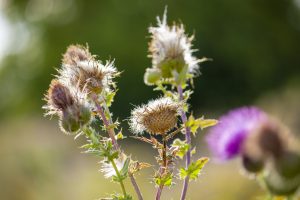
Knowing weeds that poke you is important when working in gardens, lawns, farms, pastures, roadsides, and other areas where unwanted plants can grow. Some weeds have sharp spines, prickly leaves, hooked burrs, thorny stems, or irritating hairs that can cause painful contact during routine outdoor work.
Not all painful weeds use the same type of defense. Thistles generally rely on sharp spines, puncturevine produces exceptionally hard seed burrs, sandburs develop prickly fruiting structures, and nettles use specialized hairs that inject irritating substances into the skin when touched.
The timing and method of control also vary considerably between species. Annual weeds may be easiest to manage before they produce seed, while perennial weeds with extensive roots or rhizomes can require repeated control because removing the visible foliage does not necessarily eliminate the underground plant.
In this guide , we cover 30 weeds that poke, prick, sting, scratch, or attach themselves to people and animals, including thistles, puncturevine, sandbur, cocklebur, burdock, spiny amaranth, horse nettle, stinging nettle, multiflora rose, greenbrier, and other troublesome weeds.
30 Weeds That Poke You With Spines, Burrs and Stinging Hairs
1. Canada Thistle – Weed With Sharp Spiny Leaves
Canada thistle is one of the most recognizable weeds that poke you with sharp spiny leaves. Cirsium arvense produces narrow, deeply lobed leaves with sharp spines along their margins, making the plant uncomfortable to handle without protective gloves.
Unlike many annual prickly weeds, Canada thistle is a perennial that spreads through an extensive creeping root system. New shoots can develop from the roots, allowing established patches to persist even after the above-ground stems have been cut.
How to Control Canada Thistle
Control is most effective when the plant is prevented from producing seed and its underground root system is repeatedly weakened. Hand removal, cultivation where appropriate, mowing before seed production, and properly selected herbicides can all have roles depending on the site and infestation. Repeated management is generally more important than a single cutting because perennial roots can regenerate new shoots.
Why It Is Problematic
- Sharp leaf spines
- Extensive root system
- Persistent perennial
- Spreads aggressively
- Difficult manual removal
- Produces many seeds
- Invades agricultural areas
Control Challenges
- Regrows from roots
- Requires repeated control
- Mature plants are difficult to handle
2. Bull Thistle – Weed With Sharp Spines on Leaves and Stems
Bull thistle is a weed with sharp spines on its leaves and stems that can make manual removal particularly unpleasant. Cirsium vulgare forms a large rosette before developing an upright flowering stem covered with heavily armed foliage.
The leaves are deeply lobed and densely covered with stiff spines, while the flower heads are surrounded by spiny bracts. This gives mature plants an obvious defensive appearance and makes direct contact hazardous to bare hands and exposed skin.
How to Control Bull Thistle
Bull thistle is a biennial, so preventing seed production is an important part of management. Small plants can often be dug out before they establish large roots, while mowing or cutting mature plants before seed production can reduce reproduction; herbicides may be appropriate in larger infestations when the product is labeled for the site.
Why It Is Problematic
- Numerous sharp spines
- Large mature plants
- Produces abundant seed
- Difficult hand removal
- Invades pastures
- Unpalatable to livestock
- Spreads in disturbed areas
Control Challenges
- Spines complicate removal
- Mature plants produce seed
- Repeated monitoring is needed
3. Puncturevine – Weed With Burrs That Poke Your Feet
Puncturevine is one of the most notorious weeds that poke your feet because its mature seedpods contain extremely hard, sharp spines. Tribulus terrestris is a low-growing summer annual that can form dense mats across bare soil, lawns, orchards, roadsides, and other disturbed areas.
The sharp burrs are the plant’s most troublesome feature. They can injure bare feet and animal hooves and can even puncture bicycle tires, making established infestations particularly problematic around paths, recreational areas, and livestock environments.
How to Control Puncturevine
The most important control objective is to prevent seed production. UC IPM recommends removing plants before or around flowering, continuing control over several years, and collecting burrs that have already fallen to the ground; hand removal and hoeing are effective in home landscapes, while shallow cultivation can be useful in larger areas. Mowing is ineffective because puncturevine grows close to the ground.
Why It Is Problematic
- Extremely sharp burrs
- Injures bare feet
- Punctures tires
- Spreads by seed
- Forms dense mats
- Troublesome around animals
- Persistent seedbank
Control Challenges
- Seeds remain in soil
- Burrs fall before removal
- Mowing is ineffective
4. Sandbur – Grass Weed With Sharp Burrs
Sandbur is a grass weed with sharp burrs that stick to clothing, skin, animal fur, and footwear. Several Cenchrus species are known as sandburs, and their mature seed structures develop stiff projections that make established plants uncomfortable to walk through or handle.
Sandbur commonly becomes a problem in lawns, pastures, fields, and disturbed areas. The burrs are especially troublesome after seedheads mature because they readily attach to passing people and animals.
How to Control Sandbur
Preventing plants from reaching the seed-producing stage is important because the burrs are responsible for much of the weed’s persistence and spread. Maintaining a dense, competitive turf or desirable ground cover can reduce opportunities for sandbur establishment, while appropriately labeled preemergence or postemergence herbicides may be used in some turf and agricultural situations. Product selection must match the turf species or crop because sandbur is a grass.
Why It Is Problematic
- Sharp seed burrs
- Attaches to clothing
- Troublesome in lawns
- Can injure animals
- Produces persistent seed
- Difficult after seed set
- Spreads through disturbed soil
Control Challenges
- Grass herbicide selection is limited
- Mature burrs remain troublesome
- Seed prevention is important
5. Musk Thistle – Weed With Spiny Leaves and Flower Heads
Musk thistle is a weed with spiny leaves and heavily protected flower heads. Its deeply divided foliage carries numerous sharp spines, making the plant difficult to grasp safely during manual removal.
Mature plants can develop a large rosette followed by a tall flowering stem. The combination of size and numerous spines means that established plants can become substantial obstacles in pastures, roadsides, and unmanaged areas.
How to Control Musk Thistle
Preventing flowering and seed production is a key management objective. Small plants can be removed mechanically when the soil permits, while mowing before viable seed develops can reduce reproduction; selective herbicides may also be appropriate depending on the site and label.
Why It Is Problematic
- Sharp foliage
- Spiny flower heads
- Large mature plants
- Produces seed
- Difficult to handle
- Invades pastures
- Competes with vegetation
Control Challenges
- Spines hinder removal
- Large plants require effort
- Seed production must be prevented
6. Plumeless Thistle – Weed With Sharp Prickly Leaves
Plumeless thistle is a weed with sharp prickly leaves that can puncture skin during removal. The plant forms a dense rosette of deeply divided leaves armed with numerous spines.
The sharp foliage extends around much of the plant, so grabbing the leaves without gloves can result in painful contact. Mature plants become increasingly difficult to handle as the flowering stem develops.
How to Control Plumeless Thistle
Mechanical removal is most effective when plants are young and before seed production. Cutting or digging can reduce individual plants, while appropriately labeled herbicides can be incorporated into larger-scale management programs.
Why It Is Problematic
- Numerous leaf spines
- Difficult hand removal
- Produces seed
- Forms dense rosettes
- Competes with desirable plants
- Persists in disturbed areas
- Difficult after maturity
Control Challenges
- Spines complicate digging
- Mature plants are harder to handle
- Follow-up control may be needed
7. Prickly Lettuce – Weed With Prickly Leaves
Prickly lettuce is a weed with prickly leaves that can scratch or poke the hands and arms. Lactuca serriola has distinctive leaves with prickles, particularly along the midrib and margins.
It can grow as an upright annual or biennial weed in disturbed areas, fields, roadsides, gardens, and other open sites. Although its prickles are less intimidating than those of a large thistle, mature plants can still make hand pulling unpleasant.
How to Control Prickly Lettuce
Young plants are generally easier to remove mechanically before they become established and produce seed. Hand pulling, hoeing, cultivation, mowing before seed production, and appropriately labeled herbicides can be used according to the site and growth stage.
Why It Is Problematic
- Prickly leaf margins
- Scratchy foliage
- Produces seed
- Grows rapidly
- Invades disturbed soil
- Difficult to handle bare-handed
- Can spread in fields
Control Challenges
- Small plants resemble other lettuce weeds
- Seed production increases spread
- Herbicide options depend on crop
8. Spiny Sowthistle – Weed With Spine-Tipped Leaves
Spiny sowthistle is a weed with spine-tipped leaves that can poke your hands. Unlike many thistles, it produces yellow flowers, making flower color useful when distinguishing it from purple-flowered species.
The leaves clasp the stem and have sharp projections along their margins. These structures can make manual removal uncomfortable, especially when mature plants are growing densely.
How to Control Spiny Sowthistle
Remove plants while they are young and before they produce mature seed. Hoeing, hand pulling, cultivation, mowing before seed dispersal, and crop-specific herbicides can all contribute to management depending on where the weed is growing.
Why It Is Problematic
- Sharp leaf margins
- Rapid establishment
- Produces numerous seeds
- Common in disturbed soil
- Difficult bare-handed removal
- Competes with crops
- Can survive repeated disturbance
Control Challenges
- Similar to other sowthistles
- Seed production increases populations
- Crop restrictions affect herbicide choice
9. Spiny Amaranth – Weed With Spines Near Leaf Bases
Spiny amaranth is a weed that pokes you with sharp spines near its leaf bases. The paired spines are easy to overlook because the leaves themselves do not have the dramatic spiny appearance associated with thistles.
The plant can grow rapidly in cultivated ground, pastures, gardens, and disturbed sites. Contact becomes particularly uncomfortable when reaching through dense growth or pulling plants by hand.
How to Control Spiny Amaranth
Young plants are easier to remove before they flower and produce seed. Hoeing, hand removal, cultivation, competitive crop growth, and properly selected herbicides can be used depending on the production system.
Why It Is Problematic
- Sharp stem spines
- Fast-growing weed
- Produces many seeds
- Invades cultivated ground
- Difficult to handle
- Competes with crops
- Can form dense stands
Control Challenges
- Spines are easy to overlook
- Mature plants produce abundant seed
- Herbicide tolerance varies
10. Common Cocklebur – Weed With Prickly Burrs
Common cocklebur is a weed with prickly burrs that attach to clothing and animal fur. The mature fruits develop hooked projections that allow them to travel with passing animals and people.
The burrs become particularly troublesome toward the end of the growing season. They can attach firmly to clothing and fur, making them difficult to remove and potentially helping the plant disperse its seeds.
How to Control Common Cocklebur
Remove young plants before they produce mature burrs whenever practical. Cultivation and hand removal can be useful in appropriate sites, while maintaining competitive vegetation can reduce establishment; chemical control should be based on the crop, site, and current label.
Why It Is Problematic
- Hooked burrs
- Attaches to clothing
- Spreads through animals
- Produces persistent seed
- Difficult after fruiting
- Invades agricultural land
- Troublesome around livestock
Control Challenges
- Burrs spread easily
- Mature plants are difficult to handle
- Seed prevention is critical
11. Burdock – Weed With Hooked Burrs
Burdock is a weed with hooked burrs that cling to clothing and animal fur. The mature flower heads develop numerous hooks that readily attach to anything passing close to the plant.
The large leaves can make the plant easy to recognize, but the burrs become the most obvious problem once flowering has finished. They can become firmly embedded in fabrics and animal coats.
How to Control Burdock
Removing plants before they flower and produce mature burrs is an effective management objective. Digging can be useful for individual plants, but the root must be removed sufficiently to prevent regrowth; repeated cutting before seed production can also reduce reproduction.
Why It Is Problematic
- Hooked seed heads
- Attaches to animals
- Difficult to remove from clothing
- Large plants
- Produces persistent seeds
- Invades disturbed sites
- Spreads through animals
Control Challenges
- Deep roots
- Burrs spread seed
- Mature plants require careful handling
12. Catchweed Bedstraw – Weed With Hooked Hairs
Catchweed bedstraw is a weed that catches and pokes because of its tiny hooked hairs. Unlike thistles, it does not depend on large visible spines; instead, numerous small hooks cover parts of the plant.
The stems can cling strongly to clothing and animal fur. Dense patches can also become tangled with neighboring plants, making physical removal more difficult.
How to Control Catchweed Bedstraw
Small infestations can often be removed by hand or hoeing before the plant produces mature seed. Maintaining dense desirable vegetation and reducing opportunities for establishment can help suppress it, while herbicides may be used where the site label permits.
Why It Is Problematic
- Hooked hairs
- Clings to clothing
- Tangled growth
- Produces seeds
- Invades gardens
- Difficult dense patches
- Spreads readily
Control Challenges
- Small hooks are difficult to see
- Stems tangle with vegetation
- Seeds complicate long-term control
13. Horse Nettle – Weed With Sharp Stem Spines
Horse nettle is a weed with sharp spines on its stems and foliage. Solanum carolinense belongs to the nightshade family and can be unpleasant to handle because of its numerous prickly structures.
The plant is a perennial and can spread through underground structures as well as seeds. This makes it more persistent than many annual weeds that disappear after one growing season.
How to Control Horse Nettle
Young plants should be controlled before they become established and produce seed. Repeated mechanical removal can weaken small infestations, while suitable systemic herbicides may be useful for larger perennial populations when labeled for the site.
Why It Is Problematic
- Sharp stem spines
- Perennial growth
- Underground persistence
- Produces seeds
- Difficult hand removal
- Competes with vegetation
- Unpleasant to handle
Control Challenges
- Perennial roots
- Regrowth after cutting
- Spines complicate digging
14. Jimsonweed – Weed With Spiny Seed Pods
Jimsonweed is a weed with spiny seed pods that can poke you. Datura stramonium produces distinctive capsules covered with stiff projections as the fruit matures.
The spiny fruit is particularly noticeable after flowering. Jimsonweed should also be handled cautiously because Datura species contain toxic compounds, making identification and safe handling important beyond the physical hazard posed by the spiny capsule.
How to Control Jimsonweed
Preventing seed production is a major control objective. Young plants can be removed mechanically while wearing gloves, while cultivation and appropriately labeled herbicides can be used in agricultural settings where necessary.
Why It Is Problematic
- Spiny seed capsules
- Toxic plant
- Produces many seeds
- Rapid growth
- Difficult mature removal
- Invades disturbed soil
- Potential livestock concern
Control Challenges
- Toxicity requires caution
- Mature seedpods spread seed
- Identification is important
15. Prickly Sida – Weed With Small Sharp Spines
Prickly sida is a weed that pokes you with small spines around the leaf-base region. Its defensive structures are less obvious than those of thistles but can still cause painful contact during hand removal.
The weed can grow in disturbed ground, pastures, crop fields, and other warm environments. Because the spines are relatively small, gardeners can easily grab the plant without noticing them.
How to Control Prickly Sida
Remove young plants before they become established and produce seed. Hoeing and cultivation can be useful where appropriate, while maintaining competitive vegetation can reduce opportunities for establishment.
Why It Is Problematic
- Small sharp spines
- Easy to overlook
- Produces seed
- Invades disturbed areas
- Difficult bare-handed removal
- Competes with crops
- Warm-season growth
Control Challenges
- Spines are inconspicuous
- Seed production increases spread
- Identification can be difficult
16. Wild Cucumber – Vine With Spiny Fruit
Wild cucumber is a vine with spiny fruits that can poke you when handled. Its climbing growth allows it to move through shrubs, fences, and other vegetation.
The fruit develops numerous stiff projections, giving it a distinctly prickly appearance. The vines can also become tangled, increasing the difficulty of removing them without contacting the spiny fruit.
How to Control Wild Cucumber
Small vines can usually be removed manually before fruit production. Cutting or pulling the vines before seed maturity can reduce reproduction, while repeated monitoring is useful where plants have already established.
Why It Is Problematic
- Spiny fruit
- Climbing growth
- Tangled vines
- Produces seed
- Difficult to remove from shrubs
- Spreads in disturbed areas
- Can obstruct paths
Control Challenges
- Vines become tangled
- Fruit creates sharp contact
- Seed production complicates control
17. Common Teasel – Weed With Sharp Flower Heads
Common teasel is a weed with stiff spines around its distinctive flower heads. The tall stems terminate in elongated flower structures surrounded by rigid bracts that can be surprisingly sharp.
Mature plants can remain upright after flowering, allowing the spiny structures to persist in fields and unmanaged areas. The tall growth also makes teasel difficult to overlook once established.
How to Control Common Teasel
Preventing seed production is important because mature plants can contribute to future infestations. Digging individual plants before seed set and cutting flowering stems before seeds mature can reduce reproduction, while larger infestations may require additional control methods.
Why It Is Problematic
- Sharp flower heads
- Tall mature plants
- Produces seed
- Difficult to handle
- Persists after flowering
- Invades disturbed land
- Spreads in unmanaged areas
Control Challenges
- Mature plants are difficult to handle
- Seed prevention is time-sensitive
- Large infestations require repeated monitoring
18. Mile-a-Minute Weed – Thorny Climbing Weed
Mile-a-minute weed is a thorny climbing weed that can poke and scratch exposed skin. Its stems and other structures contain sharp prickles that make the plant unpleasant to handle.
The climbing habit allows it to move through existing vegetation rather than remaining as a simple upright plant. This can make removal more difficult because the prickly stems become intertwined with desirable plants.
How to Control Mile-a-Minute Weed
Early removal is preferable because young plants are easier to separate from surrounding vegetation. Cutting or pulling before seed production can reduce reproduction, while larger infestations may require repeated management.
Why It Is Problematic
- Thorny stems
- Climbing growth
- Dense infestations
- Produces seed
- Difficult manual removal
- Scratches skin
- Entangles vegetation
Control Challenges
- Vines become intertwined
- Spines complicate handling
- Early detection is important
19. Multiflora Rose – Thorny Weed With Sharp Prickles
Multiflora rose is a thorny weed with sharp prickles along its woody stems. Dense plants can form tangled thickets that are difficult to enter or remove without protective clothing.
Unlike true thorns, rose prickles arise from the outer stem tissue, but they serve a similar practical purpose by making the plant difficult to handle. Dense growth can also obstruct paths, fences, and field margins.
How to Control Multiflora Rose
Small plants can sometimes be dug out when the soil is workable, but established plants may require repeated cutting or appropriately labeled systemic herbicides. Preventing seed production and monitoring regrowth are important because mature plants can persist for years.
Why It Is Problematic
- Sharp woody prickles
- Dense thickets
- Difficult hand removal
- Produces fruit
- Invades field margins
- Blocks access
- Persistent perennial growth
Control Challenges
- Woody stems
- Extensive root system
- Regrowth after cutting
20. Greenbrier – Prickly Vine That Hooks Clothing
Greenbrier is a prickly vine that can poke and hook clothing while moving through vegetation. Species of Smilax can develop sharp prickles along their stems, creating a difficult barrier in unmanaged areas.
The vines climb through shrubs and trees and can become tightly intertwined with surrounding vegetation. Pulling them without adequate protection can result in scratches, punctures, and snagged clothing.
How to Control Greenbrier
Cutting the vines can provide immediate access, but persistent plants may regrow from underground structures. Repeated cutting or carefully targeted herbicide treatments may be necessary for established infestations, depending on the species and site.
Why It Is Problematic
- Sharp vine prickles
- Dense climbing growth
- Hooks clothing
- Difficult to pull
- Persistent roots
- Invades woodland edges
- Blocks access
Control Challenges
- Underground structures persist
- Vines tangle with desirable plants
- Repeated treatment may be needed
21. Stinging Nettle – Weed That Stings When Touched
Stinging nettle is one of the most distinctive weeds that sting rather than simply poke. Urtica dioica has specialized hairs on its leaves and stems that can penetrate skin and inject irritating substances, producing burning, itching, and redness.
Stinging nettle is a perennial and can form colonies through underground rhizomes. It commonly occurs in moist uncultivated areas, along riverbanks, roadsides, fence rows, and other locations with suitable moisture.
How to Control Stinging Nettle
Wear gloves and protective clothing when removing plants. Mechanical removal must address the underground rhizomes because leaving them in the soil can allow regrowth; repeated cultivation can be effective in suitable situations, while mowing can prevent fruit development.
Why It Is Problematic
- Causes skin irritation
- Stinging hairs
- Forms colonies
- Perennial growth
- Spreads through rhizomes
- Troublesome along paths
- Difficult bare-handed removal
Control Challenges
- Rhizomes regenerate
- Direct contact causes irritation
- Cultivation can spread rhizomes
22. Burning Nettle – Small Weed With Stinging Hairs
Burning nettle is a small weed with stinging hairs that can irritate skin when touched. Unlike tall perennial stinging nettle, burning nettle is an annual species that can occur in gardens and disturbed areas.
The leaves and stems contain both stinging and nonstinging hairs. Contact can produce reddish patches accompanied by itching, burning, and prolonged tingling sensations.
How to Control Burning Nettle
Hand removal can be effective for small infestations, but gloves should always be worn to protect the skin. Maintaining good garden management and removing plants before seed production can reduce future populations.
Why It Is Problematic
- Stinging hairs
- Causes skin irritation
- Grows in gardens
- Produces seed quickly
- Difficult bare-handed removal
- Can occur in colonies
- Troublesome around pathways
Control Challenges
- Contact causes immediate irritation
- Seeds maintain populations
- Gloves are necessary
23. Prickly Pear – Weed With Spines and Glochids
Prickly pear can become a weed that pokes you with sharp spines and tiny glochids where it establishes outside managed cultivation. The flattened pads contain defensive structures that can penetrate skin.
The larger spines are easy to see, but the tiny glochids can be particularly troublesome because they are fine and can detach from the plant. Handling pads without appropriate protection can therefore cause repeated skin contact.
How to Control Prickly Pear
Physical removal should be performed carefully with appropriate tools and protective equipment. Small plants can sometimes be dug out, while established patches may require repeated removal or site-specific herbicide management.
Why It Is Problematic
- Sharp spines
- Tiny glochids
- Difficult handling
- Forms dense patches
- Can spread vegetatively
- Injures people
- Difficult physical removal
Control Challenges
- Glochids are difficult to see
- Pads can regenerate
- Protective equipment is essential
24. Yellow Starthistle – Weed With Extremely Sharp Flower Spines
Yellow starthistle is a weed with extremely sharp spines surrounding its yellow flower heads. The rigid structures become particularly noticeable when the plant reaches the flowering stage.
It can establish in pastures, roadsides, open landscapes, and disturbed areas. The sharp flower structures can make established stands difficult to walk through and unpleasant to handle.
How to Control Yellow Starthistle
Control should focus on preventing seed production and reducing the established population. Depending on the site, mowing before viable seed develops, targeted grazing management, cultivation, and appropriately labeled herbicides can be used. UC IPM identifies both preemergence and postemergence herbicide options for some sites and emphasizes following the specific product label.
Why It Is Problematic
- Very sharp spines
- Dense stands
- Produces seed
- Invades rangeland
- Difficult hand removal
- Reduces forage quality
- Troublesome along paths
Control Challenges
- Spines complicate handling
- Seed production increases spread
- Timing strongly affects control
25. Scotch Thistle – Weed With Large Sharp Spines
Scotch thistle is a large weed with sharp spines on its leaves and stems. Mature plants can develop substantial rosettes and tall flowering stems that are heavily armed.
The large size of the plant increases the amount of prickly material a person encounters during removal. Walking through mature stands can expose legs and arms to numerous sharp structures.
How to Control Scotch Thistle
Remove young plants before they become established and produce seed whenever practical. Cutting flowering stems before seed maturity can reduce reproduction, while herbicide treatment may be used in larger infestations when appropriate for the site.
Why It Is Problematic
- Large sharp spines
- Large mature plants
- Produces seed
- Difficult hand removal
- Invades pastures
- Competes with vegetation
- Blocks access
Control Challenges
- Mature plants are difficult to handle
- Spines require protective equipment
- Seed prevention is critical
26. Nodding Thistle – Weed With Spiny Leaves
Nodding thistle is a weed with spiny leaves and a distinctive nodding flower head. The foliage contains numerous sharp projections that make manual removal uncomfortable.
It can be confused with other thistles because several species have similar rosette and flower structures. Careful identification is therefore important before choosing a management method.
How to Control Nodding Thistle
Mechanical removal is most effective when plants are young or before seed production. Mowing before viable seed develops and appropriately selected herbicides can help reduce established populations where permitted.
Why It Is Problematic
- Spiny leaves
- Difficult hand removal
- Produces seed
- Forms rosettes
- Invades disturbed areas
- Competes with plants
- Unpleasant to handle
Control Challenges
- Similar to other thistles
- Mature plants are heavily armed
- Seed production must be prevented
27. Common Teasel – Weed With Prickly Seed Heads
Common teasel is a weed with prickly seed heads that can poke your hands and arms. The tall plant develops rigid flower structures that remain conspicuous after flowering.
The mature seed heads can persist after the flowers have faded, making the plant a continuing physical hazard in unmanaged areas. Its height also allows it to stand above surrounding vegetation.
How to Control Common Teasel
Control before seed maturation is important. Digging young plants, cutting mature flowering stems before seed dispersal, and monitoring previously infested areas can reduce future populations.
Why It Is Problematic
- Prickly seed heads
- Tall growth
- Produces persistent seed
- Difficult mature handling
- Invades open areas
- Remains standing after flowering
- Spreads from seed
Control Challenges
- Seed heads persist
- Large plants require effort
- Timing is important
28. Russian Thistle – Weed With Sharp Mature Branches
Russian thistle is a weed that becomes prickly as it matures and develops rigid branches. Young plants are relatively soft, but mature plants develop a much more difficult structure to handle.
The plant is an annual and can become particularly troublesome in dry disturbed areas. When mature plants break away from their roots, they can also be moved by wind, helping distribute seed across open landscapes.
How to Control Russian Thistle
Control should focus on preventing seed production and maintaining competitive vegetation. UC IPM notes that competitive desirable plants and heavy mulching can help prevent establishment in managed landscapes, while early-season control is generally preferable to treating hardened late-season plants.
Why It Is Problematic
- Becomes prickly at maturity
- Produces many seeds
- Thrives in disturbed soil
- Dryland problem
- Difficult late-season control
- Can spread by wind
- Competes with desirable plants
Control Challenges
- Mature plants harden
- Seeds spread widely
- Late herbicide control is difficult
29. Beggarticks – Weed With Sharp Seeds That Stick
Beggarticks are weeds with sharp seed structures that stick to clothing and animal fur. Species in the Bidens group produce fruits with projections that readily attach to passing objects.
The plant may not appear especially threatening while it is vegetative. Once seed structures mature, however, walking through the plant can result in numerous seeds attaching to clothing.
How to Control Beggarticks
Remove plants before seed production whenever possible. Hand pulling, hoeing, mowing before mature seed development, and maintaining competitive vegetation can reduce populations, while herbicide options depend on the crop or landscape site.
Why It Is Problematic
- Sticky seed structures
- Attaches to clothing
- Spreads through animals
- Produces abundant seed
- Difficult after seed set
- Invades disturbed areas
- Spreads easily
Control Challenges
- Seeds attach before dispersal
- Mature plants are difficult to handle
- Monitoring is required
30. Wild Blackberry – Weed With Thorny Canes
Wild blackberry can become a thorny weed that pokes and scratches you with sharp canes when it establishes outside managed cultivation. Depending on the species, the woody stems can carry numerous prickles that make dense patches difficult to enter.
The plants can form tangled thickets along fences, woodland edges, roadsides, and abandoned ground. Once established, the thorny canes can create physical barriers that interfere with access and maintenance.
How to Control Wild Blackberry
Small plants can sometimes be dug out, but established thickets generally require repeated cutting, removal of root crowns where practical, and follow-up management. Appropriate systemic herbicides can be useful for larger infestations when the product is labeled for the site and species.
Why It Is Problematic
- Thorny canes
- Dense thickets
- Difficult hand removal
- Blocks access
- Spreads aggressively
- Produces seed
- Persistent roots
Control Challenges
- Woody stems
- Extensive root systems
- Rapid regrowth after cutting
7 Essential Features to Consider When Identifying and Controlling Weeds That Poke You
1. Type of Sharp Structure
Determine whether the plant has spines, prickles, thorns, burrs, hooked hairs, or stinging hairs. This distinction can provide an important identification clue and indicates how the plant should be handled.
2. Location of the Sharp Structures
Look at whether the structures occur on the leaves, stems, flowers, fruit, or entire plant. Puncturevine, for example, is particularly hazardous because its sharp structures are concentrated in its mature seed burrs.
3. Growth Habit
Determine whether the weed is upright, creeping, trailing, climbing, rosette-forming, or mat-forming. Growth habit helps distinguish species and also determines which control methods are practical.
4. Life Cycle
Identify whether the weed is annual, biennial, or perennial. Annual weeds are often best controlled before seed production, while perennial weeds may require repeated treatment because underground roots or rhizomes can regenerate.
5. Seed and Fruit Structure
Mature fruit can be one of the most useful identification characteristics. Burr-producing weeds such as puncturevine, cocklebur, and sandbur become particularly troublesome once their reproductive structures mature.
6. Root System
Determine whether the plant has a taproot, creeping roots, rhizomes, or other underground structures. Stinging nettle, for example, can regrow from rhizomes, meaning removal of the visible foliage alone may not provide lasting control.
7. Timing of Control
Control weeds before they produce mature seed whenever possible. For puncturevine, UC IPM specifically recommends removing plants before or around flowering and continuing control for several years to reduce the soil seed supply.
Weeds That Poke You FAQs
1. What weed is most likely to poke your feet?
Puncturevine is particularly notorious for poking feet because its mature seed burrs have hard, sharp spines. The burrs can injure people and animals and can puncture bicycle tires.
2. What weeds have sharp spines?
Many weeds have sharp spines, including Canada thistle, bull thistle, musk thistle, Scotch thistle, spiny amaranth, horse nettle, and yellow starthistle. Other weeds use prickles, hooked burrs, or stinging hairs rather than true spines.
3. What weed has burrs that stick to clothes?
Cocklebur, burdock, beggarticks, and sandbur are examples of weeds with seed structures that can attach to clothing and animal fur. Puncturevine produces particularly hard burrs that can also injure feet and puncture tires.
4. What weed stings when you touch it?
Stinging nettle and burning nettle can cause burning, itching, and skin irritation because their leaves and stems contain specialized stinging hairs. The reaction is different from being punctured by a thorn or spine.
5. How do you safely remove weeds that poke you?
Wear sturdy gloves, long sleeves, long trousers, and appropriate footwear, and use tools instead of bare hands whenever possible. For weeds with toxic or irritating properties, additional precautions may be necessary depending on the species.
6. Should I pull prickly weeds by hand?
Hand removal can be effective for small weeds, particularly before seed production, but it should only be done with suitable protective equipment and when the species is safe to handle. Perennial weeds with extensive roots or rhizomes may require additional control after the visible plant is removed.
7. How do you prevent weeds that poke you from coming back?
Prevent seed production, remove young plants early, maintain competitive desirable vegetation, monitor previously infested areas, and clean footwear and equipment before moving between sites. For puncturevine specifically, removing plants before seed production and collecting fallen burrs are important components of long-term control.
Conclusion
In conclusion, weeds that poke you include many different types of plants, from spiny thistles and thorny vines to burr-producing weeds and stinging nettles. Canada thistle, bull thistle, puncturevine, sandbur, cocklebur, burdock, horse nettle, stinging nettle, and wild blackberry can all create different problems during outdoor work.
The most important step is correct identification because the structure causing the injury also provides clues about the plant’s biology and appropriate management. A weed with a deep perennial root system requires a different strategy from an annual weed that can be controlled primarily by preventing seed production.
Control should focus on preventing reproduction and weakening established plants rather than simply removing visible growth once. Mechanical removal, cultivation, mowing, competitive vegetation, mulching, biological control where appropriate, and properly selected herbicides can all contribute to integrated weed management depending on the species and site.
Ultimately, the safest approach is to identify first, protect yourself, and control the weed before it reaches its most troublesome stage. Early intervention can reduce seed production, limit spread, make physical removal easier, and prevent prickly or stinging weeds from becoming much larger management problems.