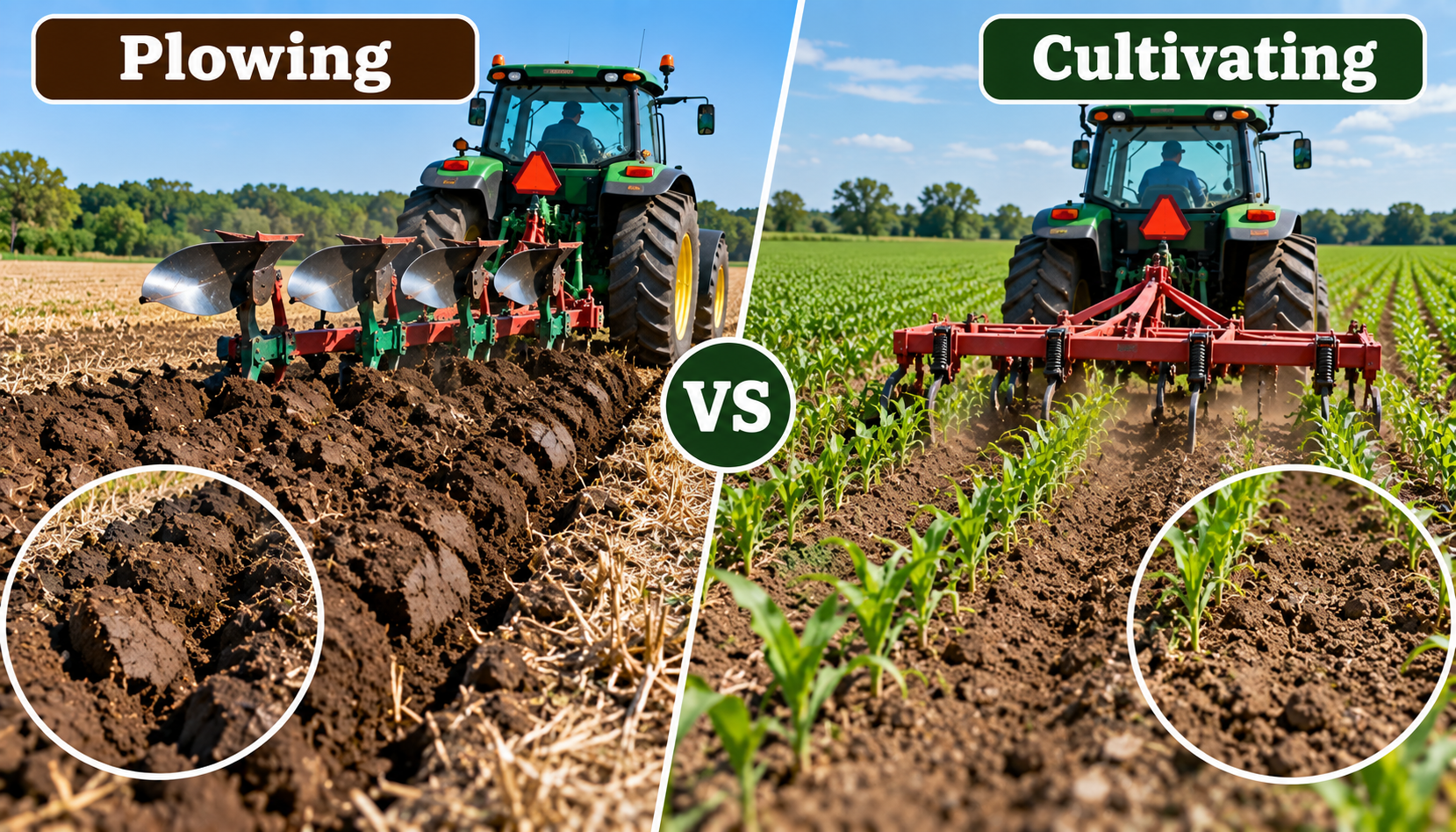
Plowing vs cultivating is a comparison every gardener, farmer, and homesteader eventually faces when preparing soil for planting. Plowing turns over the soil deeply, burying residue and loosening compacted ground. Cultivating works the top few inches, controlling weeds and smoothing the seedbed. The two tools do different jobs at different times.
The choice between plowing and cultivating depends on soil condition, crop type, season, and long-term goals. Plowing is a primary tillage pass done before planting, while cultivating is a secondary or in-season pass that fine-tunes the seedbed and manages weeds. Each has a place in traditional and modern systems.
Both methods affect soil structure, organic matter, and erosion risk. Plowing can break up hardpan and incorporate amendments, but it also disturbs soil life and can cause compaction if done when soil is wet. Cultivating is shallower and less disruptive but still affects soil biology with repeated passes.
In this guide, we break down plowing vs cultivating by examining their purpose, depth, timing, tools, benefits, drawbacks, and best uses to help you choose the right method for your land.
Plowing vs Cultivating: 10 Key Differences To Know
1. Depth Of Soil Disturbance – Primary Difference
Depth of soil disturbance is the primary difference between plowing and cultivating. Plowing turns over the top 6 to 12 inches of soil, lifting and inverting it to bury crop residue and loosen compacted layers. Cultivating works only the top 2 to 4 inches, stirring the surface without inverting it.
Plowing is considered primary tillage because it makes the first deep pass on undisturbed ground. Cultivating is secondary tillage because it follows plowing or another primary pass to refine the seedbed. The depth difference determines which nutrients, weed seeds, and soil organisms are affected.
Plowing brings deeper soil to the surface, which can help incorporate lime, compost, or fertilizer. Cultivating keeps residue on or near the surface, protecting soil from erosion and feeding soil life.
2. Purpose And Timing – Different Jobs In The Field
Purpose and timing differ sharply between plowing and cultivating. Plowing is done before the growing season, usually in fall or early spring, to break up compacted soil and bury residue from the previous crop. Cultivating is done before planting and during the growing season to smooth the seedbed and control weeds.
Plowing is a single deep pass that sets up the field for winter weathering or spring planting. Cultivating may be repeated multiple times, often after each rain or before each crop stage. The two work together in traditional systems: plow first, then cultivate.
In no-till and reduced-till systems, plowing may be skipped entirely, and cultivating is replaced by cover crops, mulches, or targeted herbicide. This shows that the two methods are not locked together; each can be used on its own depending on the system.
3. Tools And Equipment – Different Implements For Each Job
Tools and equipment differ significantly between plowing and cultivating. Plows include moldboard plows, chisel plows, and disc plows, each designed to lift and invert soil at depth. Cultivators include field cultivators, row cultivators, harrows, and rotary tillers, designed to stir the surface.
A moldboard plow is the classic plowing tool, cutting a furrow and flipping the soil slice. A chisel plow shatters compacted layers without inverting them. A field cultivator loosens and smooths the top few inches, while a row cultivator weeds between crop rows.
Rotary tillers are often grouped with cultivators but work soil more aggressively, mixing it rather than just stirring it. Choosing the right tool depends on soil type, residue load, and the depth of work needed.
4. Effect On Soil Structure – Deep Breakup Versus Surface Stirring
Effect on soil structure differs between plowing and cultivating. Plowing can break up a hardpan and improve water infiltration in compacted soils. However, repeated plowing at the same depth can create a new plow pan just below the working depth, which restricts roots.
Cultivating stirs the topsoil without inverting it, preserving soil aggregates and pore structure in the upper layer. Repeated cultivating, though, can pulverize soil into fine particles that crust over after rain and seal the surface.
The best approach in most systems is to plow rarely and only when needed, then rely on shallow cultivation, cover crops, and organic matter to maintain structure. Over-plowing and over-cultivating both degrade soil over time.
5. Weed Control – Burying Versus Uprooting
Weed control works differently with each method. Plowing buries weed seeds and existing weeds deep enough that many cannot germinate, but it also brings new seeds to the surface where they can sprout. Cultivating uproots or cuts weeds at the surface, killing them without bringing up new seeds from depth.
Plowing is a one-time weed reset that works best before a new crop. Cultivating is a repeated tool used through the season, especially between rows and around crop plants. In organic systems, cultivation is the primary weed control method.
Repeated cultivation can cause a flush of new weeds each time it stirs the soil. Combining shallow cultivation with mulches, cover crops, and hand-weeding reduces the cycle of weed germination.
6. Effect On Organic Matter – Oxidation Versus Preservation
Effect on organic matter is one of the biggest differences. Plowing introduces oxygen deep into the soil, which speeds the breakdown of organic matter and releases carbon into the atmosphere. Cultivating affects only the top layer, so it preserves more organic matter in the subsoil.
Repeated plowing over many years reduces soil carbon, weakens soil structure, and lowers water-holding capacity. Shallow cultivation, used sparingly, slows this loss and keeps more residue on the surface where it feeds soil life.
No-till and reduced-till systems avoid both plowing and aggressive cultivation for this reason, relying instead on cover crops and organic inputs to build soil carbon over time.
7. Erosion Risk – Higher With Plowing, Lower With Cultivating
Erosion risk is higher with plowing because it leaves soil bare and loosened across the whole field. Rain and wind can carry that soil away before a crop establishes. Cultivating leaves more residue on the surface and disturbs less soil, reducing erosion risk.
On slopes, plowing up and down the slope can create channels that carry water and soil off the field quickly. Cultivating on the contour or leaving strips of residue helps slow water and trap soil.
Cover crops, mulches, and reduced tillage are the best defenses against erosion. Plowing should be limited on erodible land and paired with residue management and contour farming where possible.
8. Fuel, Labor, And Cost – Plowing Costs More
Fuel, labor, and cost are typically higher for plowing. A deep pass with a moldboard or chisel plow requires more horsepower, more fuel per acre, and more time than a shallow cultivating pass. Cultivating is faster and cheaper per pass but may need to be repeated multiple times.
For a full season, plowing plus several cultivations can add up to more fuel and labor than a single no-till pass. Reduced-till systems save fuel and labor by skipping the plow and limiting cultivation.
Cost also includes equipment wear, repairs, and depreciation. Plows and heavy cultivators are expensive to buy and maintain, while smaller cultivating tools and no-till drills may cost less overall.
9. Best Uses – When Each Method Shines
Best uses vary by situation. Plowing works well when breaking new ground, incorporating large amounts of organic matter, or correcting severe compaction. It is also useful for burying heavy residue that would otherwise block a seed drill.
Cultivating works well for seedbed preparation, weed control between crop rows, and light aeration of the topsoil. It is essential in organic systems where herbicides are not used.
In most modern systems, plowing is used rarely or not at all, while cultivating is used selectively and shallowly. The trend is toward less disturbance, not more, across nearly every crop and region.
10. Modern Alternatives – Reduced Tillage And No-Till
Modern alternatives to both plowing and cultivating include no-till, strip-till, and reduced-till systems. These methods disturb as little soil as possible, keeping residue on the surface and preserving soil structure and carbon.
No-till relies on cover crops, crop rotation, and targeted herbicide or cultivation to manage weeds and prepare the seedbed. Strip-till loosens only the planting row, leaving the rest of the field undisturbed.
These systems save fuel, reduce erosion, and build soil health over time. Many farmers combine no-till with occasional deep tillage only when compaction or residue makes it necessary.
7 Tips For Choosing Between Plowing And Cultivating
- Match the method to the goal: Use plowing for deep compaction, new ground, or heavy residue. Use cultivating for seedbed prep, weed control, and light aeration.
- Plow only when necessary: Deep tillage should be a rare corrective tool, not an annual habit. Over-plowing degrades soil structure and organic matter.
- Cultivate shallowly and often: Shallow passes disturb less soil and control weeds without bringing up new weed seeds from depth.
- Time tillage to soil moisture: Never plow or cultivate wet soil, which causes smearing and compaction. Work when soil crumbles rather than clumps.
- Keep residue on the surface: Leave crop residue or cover crops on top to protect soil from erosion and feed soil life.
- Consider reduced-till alternatives: No-till and strip-till can replace both plowing and cultivating in many systems, saving fuel and improving soil health.
- Monitor soil health over time: Watch for compaction layers, declining organic matter, and erosion. Adjust your tillage program based on what the soil tells you.
Plowing vs Cultivating (FAQs)
1. What is the difference between plowing and cultivating?
Plowing turns over the top 6 to 12 inches of soil to bury residue and break up compaction, while cultivating stirs only the top 2 to 4 inches to smooth the seedbed and control weeds. Plowing is primary tillage; cultivating is secondary.
2. Which is better, plowing or cultivating?
Neither is universally better. Plowing is best for new ground, heavy residue, or deep compaction, while cultivating is best for seedbed prep and weed control. Modern systems favor minimal disturbance from either method.
3. Can I cultivate without plowing first?
Yes, cultivating without plowing works well in many gardens and reduced-till systems. Shallow cultivation preserves soil structure and residue while still preparing the seedbed and controlling weeds.
4. Does plowing damage soil?
Repeated plowing can degrade soil structure, reduce organic matter, and create a plow pan just below the working depth. Occasional plowing for specific problems is less harmful than annual plowing.
5. When should I plow my field?
Plow in fall or early spring when soil is dry enough to crumble rather than clump. Fall plowing allows frost to break up clods, while spring plowing must be timed carefully to avoid compaction.
6. Is cultivating the same as tilling?
Cultivating is one form of tilling. Tilling includes any mechanical soil disturbance, from deep plowing to shallow cultivating. Cultivating specifically refers to shallow stirring of the topsoil.
7. What are no-till alternatives to plowing and cultivating?
No-till, strip-till, and reduced-till systems avoid both plowing and aggressive cultivation, relying instead on cover crops, crop rotation, and targeted weed control. These methods build soil health and reduce erosion.
Conclusion
Plowing turns over the top 6 to 12 inches of soil to bury residue and break up compaction, while cultivating stirs only the top 2 to 4 inches to smooth the seedbed and control weeds. The two methods serve different purposes and are often used together in traditional systems.
Plowing is primary tillage best suited to new ground, heavy residue, or deep compaction, but it costs more fuel and labor and can degrade soil structure over time. Cultivating is secondary tillage best suited to seedbed prep and weed control, but repeated passes can cause weed flushes and surface crusting.
Modern systems increasingly favor reduced-till and no-till approaches that skip the plow and limit cultivation. These methods save fuel, reduce erosion, and build soil carbon, making them the preferred choice on most farms and gardens today.
Match the method to the goal, time tillage to soil moisture, keep residue on the surface, and monitor soil health over time. The best tillage program is the one that disturbs soil as little as possible while still getting the job done.