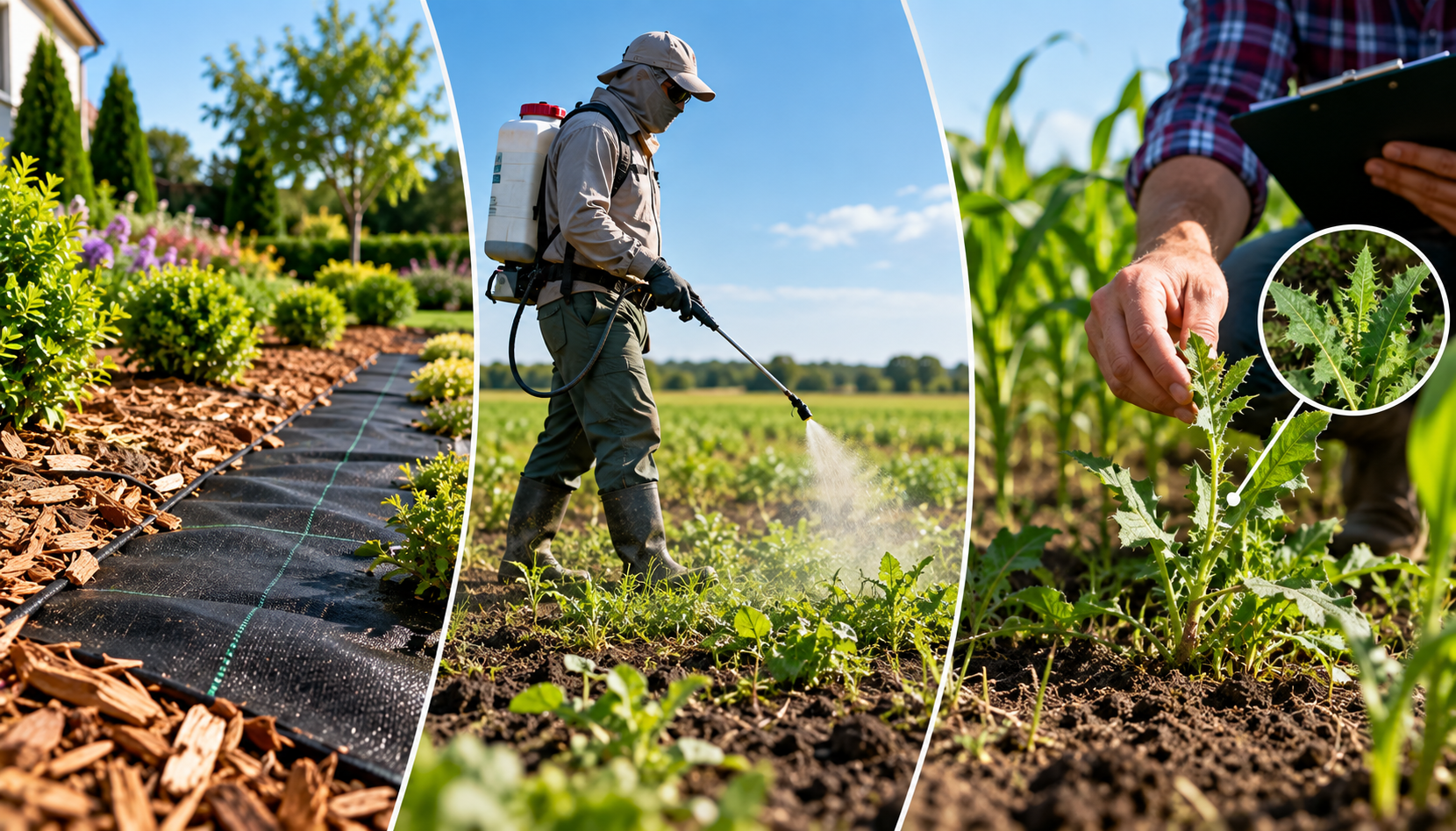
Herbicide resistance has become one of the most serious threats to modern crop production, reducing yields and increasing costs across millions of acres. More than 500 weed species worldwide have developed resistance to at least one herbicide group, and the number continues to grow each year. Once resistance develops in a field, it cannot be reversed.
Delaying resistance requires a deliberate, multi-season strategy that combines chemical, cultural, mechanical, and biological tactics. Farmers who rotate modes of action, diversify crops, and integrate non-chemical methods preserve herbicide effectiveness far longer than those relying on a single product. Prevention costs less than managing resistant populations later.
Resistance develops when the same herbicide is applied repeatedly, allowing naturally resistant individuals to survive and reproduce. Over several seasons, those survivors dominate the weed population, and the product no longer works. Understanding this process helps farmers make better decisions before resistance appears.
In this guide, we examine how farmers can delay herbicide resistance by reviewing the most effective strategies for preserving herbicide effectiveness and protecting long-term profitability.
How Can Farmers Delay Herbicide Resistance? 10 Proven Strategies
1. Rotate Herbicide Modes Of Action – Most Effective Strategy
Rotating herbicide modes of action is the most effective strategy for delaying resistance because it prevents any single selection pressure from dominating the weed population. Farmers should alternate between herbicide groups with different modes of action across applications and seasons, never relying on one product year after year.
Effective rotation requires understanding herbicide group numbers and how each product works. For example, alternating between Group 1 grass herbicides and Group 2 broadleaf herbicides reduces the chance that resistant individuals survive repeated exposure to the same mechanism. Records of past applications help plan rotations that avoid repeating the same group.
Rotation works best when combined with other tactics, including tank mixes, crop rotation, and mechanical control. No single strategy delays resistance indefinitely, but consistent rotation significantly extends the useful life of every herbicide in the program.
2. Use Full Labeled Rates – Most Overlooked Strategy
Using full labeled rates is the most overlooked strategy for delaying resistance because reduced rates allow partially resistant weeds to survive and reproduce. Sub-lethal doses kill only the most susceptible individuals, leaving those with intermediate resistance to pass their traits to the next generation.
Farmers sometimes reduce rates to save money or avoid crop injury, but this practice accelerates resistance development. Following label rates ensures that susceptible weeds are controlled completely, reducing the number of survivors that contribute to the next generation.
Full rates must be paired with proper application timing, correct nozzle selection, and adequate spray coverage. Cutting corners on any of these factors reduces effectiveness and undermines the benefits of using full rates.
3. Apply Multiple Effective Modes Of Action – Best Tank-Mix Strategy
Applying multiple effective modes of action in a single tank mix is the best way to reduce the chance that resistant individuals survive treatment. When two herbicides with different mechanisms target the same weed, a plant would need resistance to both to survive, which is far less likely than resistance to one.
Tank mixes must include products that are each effective against the target weeds at the rates used. Adding a product that does not control the weed provides no benefit and increases cost without improving resistance management. Checking label compatibility and application restrictions is essential before mixing.
This strategy works best when rotated across seasons so that no single combination is used repeatedly. Alternating tank mixes and rotation partners keeps selection pressure varied and unpredictable for weed populations.
4. Diversify Crop Rotation – Most Powerful Cultural Tool
Diversifying crop rotation is the most powerful cultural tool for delaying resistance because different crops allow different herbicides and management practices. A rotation that includes corn, soybeans, small grains, and forages creates varied selection pressure and disrupts weed life cycles that depend on a single crop environment.
Rotating crops also allows farmers to use different herbicide groups, plant at different times, and adopt different tillage practices. These variations prevent any single weed species from adapting to one consistent management system. Diverse rotations reduce the buildup of resistant populations over time.
Including forages and cover crops in the rotation further improves weed control by providing competition and reducing the window for weed establishment. Fields with diverse rotations consistently show slower resistance development than continuous monocultures.
5. Integrate Mechanical And Cultural Control – Best Non-Chemical Approach
Integrating mechanical and cultural control is the best non-chemical approach for delaying resistance because it reduces reliance on herbicides and addresses weeds that survive chemical treatment. Tillage, mowing, cultivation, and hand-weeding remove survivors before they set seed and contribute to the resistant population.
Mechanical methods must be timed correctly to be effective. Cultivating when weeds are small and soil conditions are right maximizes control and minimizes the risk of spreading rhizomes or root fragments. Delaying operations until weeds are large reduces effectiveness and can spread resistant seed.
Cultural practices like planting competitive varieties, adjusting row spacing, and managing fertility also reduce weed pressure. Combining these methods with herbicide programs lowers the total number of applications required and slows resistance development.
6. Manage The Weed Seedbank – Most Important Long-Term Tactic
Managing the weed seedbank is the most important long-term tactic for delaying resistance because seeds in the soil determine future weed populations. Every resistant weed that sets seed adds to the seedbank, and those seeds can remain viable for years or decades, complicating control for future seasons.
Farmers should prevent seed production by removing escapes before they mature, cleaning equipment between fields, and managing field edges and ditches. Hand-rogueing resistant weeds before they flower is one of the most cost-effective actions available, even though it requires labor.
Reducing the seedbank takes years of consistent effort, but the payoff is significant. Lower weed populations mean fewer herbicide applications, less selection pressure, and slower resistance development across the entire operation.
7. Scout Fields Regularly – Best Early Detection Tool
Scouting fields regularly is the best early detection tool for resistance because it identifies survivors before they spread. Farmers should walk fields 7 to 14 days after each herbicide application and look for patches of weeds that survived treatment, especially species that should have been controlled.
Early detection allows targeted action before resistant weeds set seed. If survivors are found, farmers can remove them by hand, spot-spray with a different mode of action, or adjust the management plan for the following season. Delaying action allows resistant populations to expand rapidly.
Recording scouting observations year by year reveals patterns that indicate developing resistance. Fields with repeated escapes of the same species after the same herbicide treatment are strong candidates for resistance testing and program changes.
8. Rotate Tillage Practices – Most Effective Soil Disturbance Strategy
Rotating tillage practices is the most effective soil disturbance strategy for delaying resistance because it prevents weeds from adapting to one consistent system. No-till, minimum-till, and conventional tillage each create different selection pressures that favor different weed species and life cycles.
Alternating tillage systems disrupts weed establishment and reduces reliance on herbicides in any single season. For example, a no-till year followed by a tillage year prevents perennial weeds from building up while disturbing the seedbank of annual species in different ways.
Tillage must be used carefully to avoid soil erosion, moisture loss, and degradation of soil structure. Combining strategic tillage with cover crops and reduced tillage in other years balances weed control with soil health.
9. Test For Resistance – Most Important Diagnostic Step
Testing for resistance is the most important diagnostic step because it confirms whether weed populations are truly resistant or simply survived due to application error. Farmers can submit seed or plant samples to university labs and commercial testing services that screen for resistance to specific herbicide groups.
Test results guide future decisions by identifying which products still work and which should be avoided. Without testing, farmers may waste money on ineffective herbicides or apply unnecessary products that increase costs and selection pressure. Accurate diagnosis saves time and resources.
Testing also documents resistance patterns across a region, helping extension services and researchers develop better management recommendations. Participation in resistance monitoring programs benefits individual farms and the broader agricultural community.
10. Educate And Plan Ahead – Most Sustainable Long-Term Approach
Educating yourself and planning ahead is the most sustainable long-term approach to delaying resistance because it ensures every decision is informed by current science. Attending extension meetings, reading research updates, and consulting with agronomists keeps farmers aware of new resistance threats and management options.
Written weed management plans that cover multiple seasons help farmers stay consistent and adapt to changing conditions. Plans should include herbicide rotations, crop sequences, mechanical practices, and monitoring schedules, with flexibility to adjust as new information becomes available.
Planning ahead also means budgeting for non-chemical control methods, resistance testing, and follow-up treatments. Farms that treat resistance management as a long-term investment consistently outperform those that react only after problems appear.
7 Tips For Delaying Herbicide Resistance On Your Farm
- Never rely on a single herbicide: Rotate modes of action across applications and seasons, and always combine at least two effective products when possible.
- Apply full labeled rates: Reduced rates allow partially resistant weeds to survive and reproduce, accelerating resistance development. Follow label rates consistently.
- Prevent seed production: Remove escapes before they flower and set seed. Hand-rogueing resistant weeds is one of the most cost-effective resistance management tools available.
- Diversify crop rotations: Include corn, soybeans, small grains, and forages to create varied selection pressure and disrupt weed life cycles that depend on a single crop.
- Integrate mechanical control: Tillage, cultivation, mowing, and hand-weeding reduce reliance on herbicides and address survivors that chemicals miss.
- Scout after every application: Walk fields 7 to 14 days after spraying to identify survivors and take action before resistant weeds set seed.
- Keep detailed records: Track products, rates, dates, and weed responses year by year to identify resistance patterns and guide future decisions.
How Can Farmers Delay Herbicide Resistance (FAQs)
1. How can farmers delay herbicide resistance?
Farmers can delay herbicide resistance by rotating modes of action, applying full labeled rates, using multiple effective products in tank mixes, diversifying crop rotations, integrating mechanical control, and managing the weed seedbank through consistent scouting and record-keeping.
2. What is the most effective way to prevent herbicide resistance?
Rotating herbicide modes of action is the most effective single strategy, but it works best when combined with crop rotation, tank mixes, full rates, and mechanical control. Integrated programs delay resistance far longer than any single tactic.
3. How fast does herbicide resistance develop?
Herbicide resistance can develop in as few as three to five years of repeated use of the same mode of action, depending on weed species, application frequency, and other management practices. Some species develop resistance faster than others.
4. Should farmers reduce herbicide rates to save money?
No, reducing herbicide rates below label recommendations accelerates resistance by allowing partially resistant weeds to survive and reproduce. Full labeled rates are essential for effective control and long-term resistance management.
5. What is the role of crop rotation in resistance management?
Crop rotation creates varied selection pressure by allowing different herbicides, planting dates, and management practices. Diverse rotations disrupt weed life cycles and prevent any single species from adapting to one consistent system.
6. How do I know if I have herbicide-resistant weeds?
Signs of resistance include weeds that survive applications that previously controlled them, patches of uncontrolled weeds in treated areas, and declining control over successive seasons. Testing suspected populations confirms the diagnosis.
7. Where can farmers get help with resistance management?
Farmers can contact their local extension office, university weed science programs, crop consultants, and industry agronomists for help with resistance testing, management planning, and product selection. Many extension services offer free diagnostic testing.
Conclusion
Rotating herbicide modes of action is the most effective strategy for delaying resistance because it prevents any single selection pressure from dominating weed populations. Combining rotation with full labeled rates, tank mixes, and crop diversity extends the useful life of every herbicide in the program.
Cultural and mechanical practices, including diverse crop rotations, strategic tillage, and timely cultivation, reduce reliance on chemicals and address survivors that herbicides miss. Managing the weed seedbank through scouting and removing escapes before they set seed is essential for long-term control.
Testing for resistance, keeping detailed records, and planning ahead ensure that every decision is informed by current science and field observations. Farms that treat resistance management as a long-term investment consistently outperform those that react only after problems appear.
Start building your resistance management plan this season, rotate modes of action, scout fields after every application, and adjust your program as conditions change. Consistent effort over multiple seasons protects yields, reduces costs, and preserves effective herbicides for the future.