Virginia creeper is a native North American vine that many homeowners treat as a weed once it climbs trees, fences, and siding. Because it is a broadleaf woody vine, controlling it requires herbicides that reach the roots, not just burn the leaves. The right product depends on where the vine is growing and what surrounding plants you need to protect.
Effective Virginia creeper control combines the right herbicide with the right application method. Foliar sprays work on low-growing vines and ground cover, while cut-stump and basal bark treatments are needed for established vines climbing trees. Timing applications for late summer and early fall improves control by targeting the plant when it moves energy to its roots.
Because Virginia creeper often grows alongside desirable trees, shrubs, and garden plants, drift control and careful targeting matter more than with many other weeds. Some products also have soil residual activity that can affect nearby plants for months, so product selection should account for what will be planted in the area afterward.
In this guide, we review the best herbicides for Virginia creeper by examining foliar, cut-stump, and basal bark options, application methods, and safe-use practices for long-term control.
Best Herbicide For Virginia Creeper: Top 15 Options
1. Glyphosate – Best Overall Herbicide For Virginia Creeper
Glyphosate is the best overall herbicide for Virginia creeper because it is non-selective, systemic, and translocates to the roots after foliar absorption. It kills both top growth and the underground crown, which is essential because Virginia creeper regrows readily from surviving roots. It has no soil residual activity.

- Powerful Weed Control:Effectively kills over 130 types of weeds and grasses, reaching down to the roots to prevent regrowth. Perfect for driveways, sidewalks, fences, and garden areas.
- Covers Up To 26,000 Square Feet
Glyphosate is widely used for fence line clearing, ground cover control, and cut-stump treatments on woody vines. It works best when applied to actively growing foliage in late summer or early fall, when Virginia creeper is moving energy to its roots. It is not selective, so it kills desirable plants on contact.
Resistance to glyphosate has developed in many weed species, so rotating to other modes of action helps preserve its effectiveness. It requires careful application to avoid drift onto desirable vegetation.
✓ Kills roots and top growth
✓ Systemic translocation
✓ No soil residual
✓ Effective on woody vines
✓ Works in cut-stump treatments
✓ Affordable price
✓ Trusted by land managers
⊘ Non-selective
⊘ Kills desirable plants
⊘ Widespread resistance
2. Triclopyr – Best For Cut-Stump And Basal Bark Treatments
Triclopyr is the best herbicide for cut-stump and basal bark treatments on Virginia creeper because it targets woody vines and brush while leaving most grasses unharmed. It is absorbed through bark, cut surfaces, and leaves and translocated to the roots, killing the entire plant. It is available in ester and amine formulations.

- REVIVE FORESTS AND PASTURES: Triclopyr 4 Herbicide targets & controls woody plants, broadleaf weeds, & brush, making it ideal for restoring pastures and managing unwanted vegetation in forests, rangelands, and industrial sites without harming grasses
- YEAR-ROUND APPLICATION FLEXIBILITY: With flexible application options throughout the year, this broadleaf herbicide offers versatility for a wide range of conditions. Its ester formulation allows for effective absorption through leaves and roots
Triclopyr is used on fence rows, rights-of-way, forestry, and non-crop areas. It is highly effective on Virginia creeper, poison ivy, and other woody vines when applied as a foliar spray, cut-stump treatment, or basal bark treatment in late summer or early fall. It works best when applied to actively growing vines.
This product has moderate soil residual activity in some formulations. It can injure desirable broadleaf plants if applied carelessly, so careful targeting is essential around gardens and ornamentals.
✓ Controls woody vines
✓ Safe for grasses
✓ Multiple formulations
✓ Effective on cut-stump treatments
✓ Basal bark options
✓ Widely used in rights-of-way
✓ Trusted by land managers
⊘ Can injure desirable broadleaf plants
⊘ Some soil residual
⊘ Higher cost than glyphosate
3. Crossbow – Best Ready-Mixed Brush Herbicide
Crossbow is a ready-mixed herbicide combining 2,4-D and triclopyr for broad-spectrum brush and woody vine control. It is absorbed through leaves and roots and translocated throughout the plant. It is widely used in rights-of-way, pastures, and non-crop areas for Virginia creeper and similar vines.
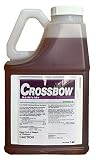
Crossbow is labeled for fence rows, rights-of-way, pastures, and industrial sites. It controls brush, vines, and tough broadleaf weeds like Virginia creeper, blackberry, and poison ivy. It works best when applied to actively growing vegetation in late summer or early fall.
This product has moderate soil residual activity that contributes to its long-lasting control. It can injure desirable broadleaf plants if applied carelessly, so careful targeting is essential in mixed landscapes.
✓ Ready-mixed formulation
✓ Controls vines and brush
✓ Safe for grasses
✓ Convenient single product
✓ Works in fence rows and rights-of-way
✓ Long-lasting control
✓ Trusted by land managers
⊘ Can injure desirable broadleaf plants
⊘ Some soil residual
⊘ Restricted in some areas
4. Remedy Ultra – Best For Cut-Stump And Basal Bark On Thick Vines
Remedy Ultra is a triclopyr ester formulation designed for cut-stump and basal bark applications on woody vines like Virginia creeper. It is absorbed through bark and cut surfaces and translocated to the roots, killing the entire plant. It is highly effective on thick, established vines.

Remedy Ultra is labeled for fence rows, rights-of-way, pastures, and forestry. It controls Virginia creeper, mesquite, huisache, blackberry, and other woody species. It works best when applied as a basal bark or cut-stump treatment in late summer or early fall.
This product requires an oil carrier for basal bark applications and careful targeting to avoid damage to desirable trees and shrubs. It is not suitable for use near water without an approved aquatic formulation.
✓ Effective on thick vines
✓ Cut-stump and basal bark options
✓ Safe for grasses
✓ Absorbed through bark
✓ Works in fence rows and rights-of-way
✓ Long-lasting control
✓ Trusted by land managers
⊘ Requires oil carrier
⊘ Not for aquatic use
⊘ Higher cost
5. Garlon 4 Ultra – Best For Basal Bark On Climbing Vines
Garlon 4 Ultra is a triclopyr ester formulation designed for basal bark and cut-stump treatments on woody vines climbing trees and structures. It is absorbed through bark and translocated to the roots, killing the entire plant. It is widely used in fence rows, rights-of-way, and forestry.


- Target Pests: 55 woody plants and more than 25 tough-to-control annual and perennial broadleaf weeds in noncrop areas - High-anxiety woody species - Cherry, loblolly pine, mesquite, red oak, sweetgum and Scotch broom. See Product label for all listed pests.
- For use In: Roadsides, railroads, pipelines, industrial sites, forests, grazing areas, and rights-of-way such as power lines - establishment and maintenance of wildlife openings and can be used on sites that include grazed areas. See Product label for complete list.
Garlon 4 Ultra is labeled for fence rows, rights-of-way, pastures, and industrial sites. It controls Virginia creeper, poison ivy, tree of heaven, and ailanthus. It works best when applied as a basal bark treatment in late summer or early fall.
This product requires an oil carrier for basal bark applications and careful targeting to avoid damage to desirable trees and shrubs. It is not suitable for use near water without an approved aquatic formulation.
✓ Effective on climbing vines
✓ Basal bark and cut-stump options
✓ Safe for grasses
✓ Absorbed through bark
✓ Works in rights-of-way and fence rows
✓ Long-lasting control
✓ Trusted by land managers
⊘ Requires oil carrier
⊘ Not for aquatic use
⊘ Higher cost
6. 2,4-D – Best For Broadleaf Ground Cover Control
2,4-D is a selective broadleaf herbicide that controls Virginia creeper when it grows as ground cover, without harming most grasses. It is a synthetic auxin that causes uncontrolled cell division and twisting. It is absorbed through leaves and translocated throughout the plant.

- Low, economical use rate of 1 to 4 pints per acre
- Controls many broadleaf weeds & woody plants
2,4-D is used in fence rows, pastures, and roadsides to control broadleaf weeds and low-growing vines. It works best when applied to actively growing vines in spring or fall. It does not control established woody vines on its own and works better as part of a tank mix.
Resistance to 2,4-D is increasing in some weed species. It is a restricted-use product in some formulations, and drift to sensitive broadleaf crops can cause serious damage.
✓ Selective for broadleaf vines
✓ Safe for most grasses
✓ Absorbed and translocated
✓ Affordable
✓ Widely available
✓ Works in fence rows and pastures
✓ Trusted by land managers
⊘ Drift risk to sensitive crops
⊘ Does not control grasses
⊘ Weak on established vines
7. Dicamba – Best For Broadleaf Vines In Pastures
Dicamba is a selective broadleaf herbicide that controls Virginia creeper and other tough broadleaf vines in pastures and fence rows. It is absorbed through leaves, roots, and stems, making it effective under a wide range of conditions. It is often tank-mixed with 2,4-D for broader spectrum control.

- CROP-SAFE WEED KILLER: This herbicide weed killer targets broadleaf weeds in a variety of crops, including corn, soybean, cotton, sugarcane, and turf. Its fast-acting formula ensures long-lasting results, keeping your fields and pastures clean
- FLEXIBLE FIELD COVERAGE: Compatible with both ground and aerial application equipment, this broadleaf herbicide is easy to apply regardless of your farming setup. Whether treating dense vegetation or large-acreage fields, you can depend on consistent coverage
Dicamba is used in fence rows, pastures, and non-crop areas. It has some soil residual activity that extends control of germinating broadleaf weeds. It works best when applied to actively growing vines in spring or fall.
Dicamba is volatile and can drift long distances, damaging sensitive crops and garden plants. It is regulated in many states, with restrictions on timing and buffer zones.
✓ Broad-spectrum broadleaf control
✓ Some soil residual
✓ Works with 2,4-D
✓ Effective on tough vines
✓ Widely available
✓ Affordable
✓ Trusted by land managers
⊘ Highly volatile
⊘ Long-distance drift risk
⊘ State-regulated use
8. Imazapyr – Best For Long-Term Residual Control
Imazapyr is a non-selective herbicide with long soil residual activity that controls Virginia creeper and other woody vines in fence rows and non-crop areas. It is absorbed through leaves and roots and translocated throughout the plant. It is highly effective on tough perennial species.

- BROAD-SPECTRUM WEED CONTROL: The weed and grass killer concentrate is effective at controlling a wide range of weeds, including vines and hardwood brush. Ideal for forestry and rangeland, it provides lasting protection and eliminates tough vegetation
- VERSATILE APPLICATION METHODS: This weed and grass killer can be applied using multiple methods: broadcast, targeted handgun, low volume, cut stump, or basal application. It offers a flexible application for both large areas and specific vegetation
Imazapyr is labeled for fence rows, rights-of-way, and non-crop areas. It controls deep-rooted perennials like Virginia creeper, Johnsongrass, Bermuda grass, and tree of heaven. It works best when applied to actively growing vegetation in late summer or early fall.
This product has significant soil residual activity that can affect desirable plants for months or years. It is not suitable for use where sensitive plants will be planted soon after application.
✓ Long soil residual
✓ Controls tough vines
✓ Effective on woody plants
✓ Reduces repeat applications
✓ Works in non-crop areas
✓ Long-lasting control
✓ Trusted by land managers
⊘ Long soil residual
⊘ Can affect desirable plants
⊘ Not for use near gardens
9. Picloram – Best For Deep-Rooted Perennials And Vines
Picloram is a selective broadleaf herbicide with long soil residual activity that controls deep-rooted perennials like Virginia creeper and Canada thistle. It is absorbed through leaves and roots and translocated throughout the plant. It is highly effective on tough broadleaf species.

- Effective: Kills cut stumps on fence lines&non-cropland areas. Control unwanted trees by cut surface treatments in forest&non-crop areas such as fence rows, roadsides&rights-of-way
Picloram is labeled for fence rows, rights-of-way, pastures, and non-crop areas. It controls a broad spectrum of broadleaf weeds without harming established grasses. It works best when applied to actively growing vegetation in spring or fall.
This product has long soil residual activity that can affect sensitive broadleaf plants for months or years. It is not suitable for use where legumes or sensitive crops will be planted soon after application.
✓ Long soil residual
✓ Controls deep-rooted perennials
✓ Safe for established grasses
✓ Effective on tough vines
✓ Reduces repeat applications
✓ Works in pastures
✓ Trusted by land managers
⊘ Long soil residual
⊘ Can affect sensitive plants
⊘ Not for use near gardens
10. Aminopyralid – Best For Pasture Edges And Fence Rows
Aminopyralid is a selective broadleaf herbicide that controls deep-rooted perennials and vines in fence rows and pasture edges. It is absorbed through leaves and roots and translocated throughout the plant. It is highly effective on tough broadleaf species including Virginia creeper.

- Target Pests: . See Product label for all listed pests.
- For use In: Rangeland, permanent grass pastures, CRP Acres, non-cropland areas, non-irrigation ditch banks, natural areas, and grazed areas in and around these sites. See Product label for complete list.
Aminopyralid is labeled for fence rows, pastures, rangeland, and non-crop areas. It controls a broad spectrum of broadleaf weeds without harming established grasses. It works best when applied to actively growing vegetation in spring or fall.
This product has significant soil residual activity that can affect sensitive broadleaf plants for months or years. It is not suitable for use where legumes or sensitive crops will be planted soon after application.
✓ Broad-spectrum broadleaf control
✓ Safe for established grasses
✓ Labeled for pastures
✓ Long soil residual
✓ Reduces repeat applications
✓ Works in fence rows
✓ Trusted by land managers
⊘ Long soil residual
⊘ Can affect sensitive plants
⊘ Grazing and replanting restrictions
11. Glufosinate – Best Non-Selective Alternative To Glyphosate
Glufosinate is a non-selective herbicide that controls Virginia creeper and other vegetation through contact action. It is absorbed through leaves and acts on contact, with symptoms appearing within hours. It is often used as an alternative to glyphosate where resistance is a concern.

- NON-SELECTIVE BROAD-SPECTRUM CONTROL Provides post-emergence control of a wide range of broadleaf and grassy weeds, including tough and resistant species such as marestail (horseweed).
- EFFECTIVE ON RESISTANT WEEDS Ideal for managing weeds resistant to glyphosate and multiple herbicide modes of action, making it a powerful rotational or rescue treatment.
Glufosinate is labeled for fence rows, rights-of-way, and non-crop areas. It has no soil residual activity, so it does not prevent new weeds from germinating. It works best when applied to small, actively growing vegetation with good spray coverage.
This product requires good spray coverage for effective control and works best on small vines. It is less effective on large, established Virginia creeper because it does not translocate to the roots as strongly as systemic herbicides.
✓ Fast contact action
✓ Broad-spectrum control
✓ Alternative to glyphosate
✓ No soil residual
✓ Works in burndown programs
✓ Effective on resistant weeds
✓ Trusted by land managers
⊘ Non-selective
⊘ Requires good coverage
⊘ Weak on established vines
12. Diquat – Best For Fast Burndown Of Vine Foliage
Diquat is a non-selective contact herbicide that rapidly desiccates Virginia creeper foliage. It is absorbed through leaves and disrupts cell membranes, causing wilting and browning within hours. It has no soil residual activity and does not translocate to the roots.

- INSTANT WEED CONTROL: Expect visible results within hours, as hydrilla killer starts working immediately on contact with green plant tissue, making it an ideal solution when fast, effective weed control is needed with minimal downtime
- GLYPHOSATE-FREE POWER: This non-selective aquatic herbicide for ponds provides broad-spectrum control without using glyphosate. It works quickly to kill a wide range of weeds and is ideal for those looking for an efficient and fast-acting substitute
Diquat is labeled for fence rows, driveways, and non-crop areas. It controls small vines and provides fast burndown where quick top-kill is needed. It works best when applied to small, actively growing vegetation with good spray coverage.
This product requires good spray coverage for effective control and works best on small vines. It is less effective on perennial vines like Virginia creeper because it does not move into the roots, meaning regrowth is likely.
✓ Fast burndown action
✓ No soil residual
✓ Effective on small vines
✓ Works in fence rows and driveways
✓ Widely available
✓ Affordable
✓ Trusted by land managers
⊘ Non-selective
⊘ No root kill
⊘ Requires good coverage
13. Diuron – Best For Long-Term Soil Residual Control
Diuron is a non-selective herbicide with long soil residual activity that controls Virginia creeper seedlings and other vegetation in fence rows. It is absorbed through roots and inhibits photosynthesis in susceptible plants. It is highly effective on annual vines and some perennials.

- FULL-CYCLE WEED PROTECTION: Tackle weeds before and after they sprout with Diuron herbicide weed killer’s dual-action formula. It is ideal for long-term control of annual grasses and broadleaf weeds in non-crop areas where consistent results matter most
- BUILT FOR HARSH ENVIRONMENTS: Built for demanding environments like highways, airports, and industrial zones, this weed killer delivers proven weed control where other herbicides fall short, keeping large-scale areas clear and low-maintenance
Diuron is labeled for fence rows, rights-of-way, and industrial sites. It controls annual grasses and broadleaf weeds when applied before or after germination. It works best when applied to bare soil or small, actively growing vegetation.
This product has significant soil residual activity that can affect desirable plants for months or years. It is not suitable for use where sensitive plants will be planted soon after application.
✓ Long soil residual
✓ Pre and post-emergent activity
✓ Controls annual weeds
✓ Reduces repeat applications
✓ Works in fence rows and rights-of-way
✓ Affordable
✓ Trusted by land managers
⊘ Long soil residual
⊘ Can affect desirable plants
⊘ Not for use near gardens
14. Bromacil – Best For Total Vegetation Control
Bromacil is a non-selective herbicide with long soil residual activity that controls Virginia creeper and other vegetation in fence rows. It is absorbed through roots and inhibits photosynthesis in susceptible plants. It is highly effective on tough perennial species.

- ALL-SEASON WEED GUARD: Bromacil weed and grass killer provides consistent suppression of tough annual and perennial grasses and broadleaf weeds for up to 360 days, reducing the need for repeated applications and keeping your site weed-free
- SELECTIVE AND VERSATILE APPLICATION: Formulated for use in various non-crop areas, this pre-emergent weed prevention controls weeds without harming desirable plants, making it ideal for utility sites, railroads, pipelines, and industrial zones
Bromacil is labeled for fence rows, rights-of-way, and industrial sites. It controls a broad spectrum of vegetation when applied to bare soil or actively growing plants. It works best when applied in late summer or early fall before soil freezes.
This product has significant soil residual activity that can affect desirable plants for months or years. It is not suitable for use where sensitive plants will be planted soon after application.
✓ Long soil residual
✓ Total vegetation control
✓ Controls woody vines
✓ Reduces repeat applications
✓ Works in rights-of-way
✓ Effective on tough species
✓ Trusted by land managers
⊘ Long soil residual
⊘ Can affect desirable plants
⊘ Not for use near gardens
15. Hexazinone – Best For Total Fence Line Clearing
Hexazinone is a non-selective herbicide with long soil residual activity that controls Virginia creeper and other vegetation in fence rows. It is absorbed primarily through roots and inhibits photosynthesis in susceptible plants. It is highly effective on tough perennial vines.

- Visible Results in One Hour - Spruce dehydrates to kill roots, showing visible results in just 1 hour, dead weeds in 1 day. The hardworking weed sprayer can kill all types of broadleaf and grassy weeds including dandelions, large crabgrass, white clover, dollarweed and morning glory vines.
- Ready to Use Worry-Free Formula - Spruce grass and weed killer is safe to use around people, pets, and bees when used as directed, and one bottle can treat up to 400 weeds. This versatile weed killer spray is made with water, essential oils and surfactant.
Hexazinone is labeled for fence rows, rights-of-way, and non-crop areas. It controls a broad spectrum of vegetation when applied to bare soil around the base of established woody plants. It works best when applied in late summer or early fall before soil freezes.
This product has significant soil residual activity that can affect desirable plants for months or years. It is not suitable for use where sensitive plants will be planted soon after application.
✓ Long soil residual
✓ Total vegetation control
✓ Controls woody vines
✓ Reduces repeat applications
✓ Works in rights-of-way
✓ Effective on tough species
✓ Trusted by land managers
⊘ Long soil residual
⊘ Can affect desirable plants
⊘ Not for use near gardens
Tips For Controlling Virginia Creeper With Herbicides
- Identify the vine first: Confirm that the vine is Virginia creeper and not poison ivy or another species, since control timing and products vary by species.
- Choose the right application method: Use foliar sprays for low-growing vines, and cut-stump or basal bark treatments for established vines climbing trees.
- Time applications for late summer or early fall: Virginia creeper moves energy to its roots in late summer and fall, improving herbicide absorption and long-term control.
- Protect desirable plants: Virginia creeper often grows alongside trees and shrubs. Use shields, careful targeting, and drift-reducing nozzles to avoid damage.
- Remove vines from tree trunks by hand: Cut vines at the base and let them die back. Do not pull vines off bark, which can damage the tree.
- Rotate modes of action: Using the same herbicide group repeatedly selects for resistant weeds. Rotate between glyphosate, triclopyr, and other groups.
- Monitor and re-treat: Virginia creeper regrows from roots and seeds. Scout treated areas several times per season and re-treat regrowth while it is small.
Frequently Asked Questions
1. What is the best herbicide for Virginia creeper?
Glyphosate is the best overall herbicide for Virginia creeper because it is systemic and kills the roots. Triclopyr and Crossbow are best for cut-stump and basal bark treatments on thick, established vines.
2. Will vinegar kill Virginia creeper?
Vinegar burns Virginia creeper foliage but does not kill the roots. It works best as part of an integrated program combining hand-pulling, cutting, and systemic herbicides.
3. How do I kill Virginia creeper without killing my tree?
Cut the vine near the base of the tree and immediately apply concentrated glyphosate or triclopyr to the cut surface. Do not spray the vine on the tree, and do not pull vines off the bark, which can damage it.
4. When is the best time to spray Virginia creeper?
Late summer and early fall are the best times to spray Virginia creeper because the plant is moving energy to its roots, improving herbicide absorption and long-term control.
5. Does Virginia creeper come back after spraying?
Virginia creeper can regrow from roots and seeds after a single treatment. Repeated applications over two to three seasons are usually needed for complete control.
6. Is Virginia creeper poisonous?
Virginia creeper berries contain oxalate crystals that are toxic to humans and pets if eaten. The sap can also cause skin irritation in sensitive people. Wear gloves when handling it.
7. What is the difference between Virginia creeper and poison ivy?
Virginia creeper has five leaflets per leaf, while poison ivy has three. Virginia creeper is native and less allergenic, but both can cause skin irritation in sensitive people.
Conclusion
Glyphosate is the best overall herbicide for Virginia creeper because it is systemic and kills the roots. Triclopyr, Crossbow, and Remedy Ultra follow closely as the best options for cut-stump and basal bark treatments on thick, established vines climbing trees and fences.
For long-term residual control, imazapyr, picloram, aminopyralid, diuron, bromacil, and hexazinone prevent new vines from germinating and reduce the need for repeat applications. These products are best used where total vegetation control is acceptable and where sensitive plants are not nearby.
Effective Virginia creeper control requires matching the product to the vine’s location, timing applications for late summer or early fall, using the right application method, and protecting surrounding vegetation. Rotating modes of action prevents resistance and keeps products effective over time.
Start your Virginia creeper control program this season, choose the right product for your site, and plan for follow-up treatments each year. Consistent effort over two to three seasons delivers a clean fence line, healthy trees, and long-term control.