Anyone who has stood in a lawn centre, staring at two rows of turf and wondering which is better, Kikuyu or Buffalo grass, knows the choice is not as simple as the price tag suggests. Both grasses shrug off heat and sun, yet they behave like distant cousins once they settle into the soil.
Comparing the two depends on your region, how the lawn is used, how much water you can supply, and whether you prefer a soft fine-bladed turf or a tougher broad-leaved lawn. Kikuyu spreads aggressively and repairs quickly, while Buffalo grass offers denser growth with lower water needs and better shade tolerance in some cultivars. Soil type, mowing habits, and shade also shift the balance.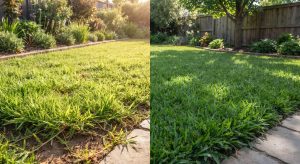
Understanding each grass before planting prevents expensive mistakes. Kikuyu invades garden beds and demands frequent mowing, while Buffalo grass recovers more slowly from heavy wear and needs careful cultivar selection. Get those wrong and the result is a lawn that either takes over the yard or thins out within a season.
In this guide, we explore 15 key comparisons between Kikuyu and Buffalo grass, including wear tolerance, water requirements, shade performance, maintenance demands, and suitability for different climates and lifestyles. We examine their growth habits, advantages, limitations, and overall fit for Australian and warm-climate lawns.
Which Is Better, Kikuyu Or Buffalo Grass?
1. Wear Tolerance – Best Comparison For Kikuyu Vs Buffalo Grass On Active Lawns
Wear tolerance is the best comparison for Kikuyu vs Buffalo grass on active lawns because Kikuyu handles heavy foot traffic and pet play far better. To begin with, Kikuyu’s vigorous rhizomes and stolons regrow quickly after damage. This makes it the stronger choice for busy family yards.


- A grass seed for lawns that grows thick blades of grass that stand up to hot summers and heavy rains
- Sun and shade grass seed for use in full sun to medium-shaded areas

Buffalo grass tolerates moderate traffic but thins under constant wear and recovers slowly. One standout feature of Kikuyu is that it repairs bare patches within weeks. For households with dogs and children, this resilience matters greatly.
If the lawn takes heavy daily use, Kikuyu wins on wear tolerance. Another advantage is that it maintains density even after rough play. Without question, it remains the tougher option for high-traffic areas.
- Handles heavy traffic
- Regrows quickly after damage
- Repairs bare patches fast
- Dense under pressure
- Good for pets and kids
- Vigorous growth
- Widely available
- Spreads aggressively
- Needs frequent mowing
- Invades garden beds
2. Water Requirements – Best Comparison For Drought-Prone Regions
Water requirements are the best comparison for drought-prone regions because Buffalo grass uses significantly less water than Kikuyu. Right from the start, Buffalo grass has deeper roots and thicker leaves that lose less moisture. As such, it stays green with less irrigation.

- HIGH QUALITY TURF: The most advanced turf-type buffalo grass available, Sundancer buffalograss offers accelerated establishment and superior turf quality, making it ideal for diverse environments. It does not require much turf builder as it outperformed the other entries for turfgrass quality, color, spring green-up and canopy density.
- VERSATILE USAGE: This drought tolerant grass seed has dark green color, enhanced density, fine leaf texture and low plant height of 6 inches, making them the perfect buffalo grass seeds for lawn, natural-looking golf course roughs, roadside plantings, airport landscaping, and parklands.
Kikuyu needs regular watering to stay lush and recovers poorly from drought stress. An added benefit of Buffalo grass is that it tolerates extended dry spells. Because of this, it suits water-restricted areas.
If water conservation is a priority, Buffalo grass wins clearly. Even better, many modern Buffalo cultivars stay green through summer with minimal watering. Taken together, it offers an excellent option for dry climates.
- Lower water needs
- Deeper roots
- Thicker leaves
- Stays green in drought
- Water-restriction friendly
- Lower bills
- Modern cultivars available
- Slower to green in spring
- Higher upfront cost
- Recovers slowly from stress
3. Shade Tolerance – Best Comparison For Shaded Yards
Shade tolerance is the best comparison for shaded yards because modern Buffalo cultivars perform far better under trees than Kikuyu. From the outset, Buffalo grass holds color and density in partial shade where Kikuyu thins out. This makes it the practical choice for established gardens.
- HIGH QUALITY TURF: The most advanced turf-type buffalo grass available, Sundancer buffalograss offers accelerated establishment and superior turf quality, making it ideal for diverse environments. It does not require much turf builder as it outperformed the other entries for turfgrass quality, color, spring green-up and canopy density.
- VERSATILE USAGE: This drought tolerant grass seed has dark green color, enhanced density, fine leaf texture and low plant height of 6 inches, making them the perfect buffalo grass seeds for lawn, natural-looking golf course roughs, roadside plantings, airport landscaping, and parklands.
Kikuyu loves full sun and fades quickly under heavy canopy. One impressive feature of Buffalo grass is that it maintains ground cover under trees. With careful mowing, it stays healthy in shadier spots.
If the lawn sits under mature trees, Buffalo grass wins. Just as important, the best shade-tolerant cultivars like Sapphire and Palmetto perform well. For mixed light, it offers an excellent combination of performance and appearance.
- Better shade tolerance
- Holds color under trees
- Maintains density
- Cultivars bred for shade
- Works in mixed light
- Lower thinning
- Good for established gardens
- Still needs some sun
- Slow growth in deep shade
- Limited cultivar availability
4. Texture And Appearance – Best Comparison For Visual Preference
Texture and appearance are the best comparison for visual preference because Kikuyu offers a fine-bladed, uniform lawn while Buffalo grass has a broader leaf and softer feel. Right from the start, Kikuyu resembles a classic manicured turf. As such, it suits formal gardens and sports fields.
- A grass seed for lawns that grows thick blades of grass that stand up to hot summers and heavy rains
- Sun and shade grass seed for use in full sun to medium-shaded areas
Buffalo grass has a softer, thicker leaf that looks more relaxed. One impressive feature of modern Buffalo cultivars is that they have narrower blades than older types. With regular mowing, the difference in appearance narrows.
If a manicured look matters most, Kikuyu wins on texture. Just as important, Buffalo grass suits natural-style gardens better. Taken together, the choice depends on whether you prefer classic fine turf or softer, natural-looking grass.
- Fine-bladed texture
- Uniform appearance
- Manicured look
- Suits sports fields
- Good for formal gardens
- Dense canopy
- Classic turf appearance
- Requires frequent mowing
- Can look patchy when dry
- Aggressive growth spoils edges
5. Mowing Frequency – Best Comparison For Low-Maintenance Lawns
Mowing frequency is the best comparison for low-maintenance lawns because Buffalo grass grows more slowly and needs mowing far less often than Kikuyu. From the outset, Kikuyu’s rapid growth means weekly mowing in summer. This demands time and equipment.
- HIGH QUALITY TURF: The most advanced turf-type buffalo grass available, Sundancer buffalograss offers accelerated establishment and superior turf quality, making it ideal for diverse environments. It does not require much turf builder as it outperformed the other entries for turfgrass quality, color, spring green-up and canopy density.
- VERSATILE USAGE: This drought tolerant grass seed has dark green color, enhanced density, fine leaf texture and low plant height of 6 inches, making them the perfect buffalo grass seeds for lawn, natural-looking golf course roughs, roadside plantings, airport landscaping, and parklands.
Buffalo grass can go two to three weeks between cuts. One impressive feature is that the slower growth keeps the lawn looking neat for longer. With proper mowing height, it stays healthy without constant attention.
If time is limited, Buffalo grass wins on mowing frequency. Just as important, the slower growth saves fuel and equipment wear. Taken together, it offers an excellent option for busy households.
- Slower growth
- Less mowing
- Saves time
- Lower fuel cost
- Less equipment wear
- Neat appearance longer
- Good for busy owners
- Slower recovery
- Less dense under wear
- Higher upfront cost
6. Invasion Into Garden Beds – Best Comparison For Landscaped Yards
Invasion into garden beds is the best comparison for landscaped yards because Kikuyu spreads aggressively through rhizomes and can choke out flowers and shrubs. Right from the start, the runners travel across paths and into beds within a season. As such, it demands edging and constant control.

- SIZE:Landscape edging is 33ft/10m length & 4in/10cm height; with 50pcs 8-inch spiral spikes.
- FLEXIBLE AND DURABLE: Garden edging border made of durable PE material, soft material can be cut to fit your exact need. spiral spikes Made of tough nylon, won’t rust, reusable, longer service life.
Buffalo grass spreads more slowly and stays within defined boundaries with basic edging. An added benefit is that it requires far less trimming around garden beds. Because of this, it suits intricate landscapes.
If the yard has extensive garden beds, Buffalo grass wins on containment. Even better, the slower spread means less time spent pulling runners. Taken together, it offers an excellent option for landscaped properties.
- Slower spread
- Stays in boundaries
- Less edging needed
- Fewer runners
- Good for landscaped yards
- Lower maintenance
- Easier control
- Still needs edging
- Slower to fill bare patches
- Higher cost
7. Shade And Sun Adaptation – Best Comparison For Variable Light Conditions
Shade and sun adaptation is the best comparison for variable light conditions because Buffalo grass handles dappled shade while Kikuyu needs strong sun. From the outset, Buffalo grass maintains density where sunlight is inconsistent. This makes it the practical choice for yards with shifting shade patterns.
- HIGH QUALITY TURF: The most advanced turf-type buffalo grass available, Sundancer buffalograss offers accelerated establishment and superior turf quality, making it ideal for diverse environments. It does not require much turf builder as it outperformed the other entries for turfgrass quality, color, spring green-up and canopy density.
- VERSATILE USAGE: This drought tolerant grass seed has dark green color, enhanced density, fine leaf texture and low plant height of 6 inches, making them the perfect buffalo grass seeds for lawn, natural-looking golf course roughs, roadside plantings, airport landscaping, and parklands.
Kikuyu thins quickly in shade and fails under dense canopy. One impressive feature of Buffalo grass is that the best cultivars perform under both light and moderate shade. With careful mowing, it stays healthy in changing light.
If the yard has trees or shifting shade, Buffalo grass wins. Just as important, its slower growth means less maintenance in shaded areas. Taken together, it handles variable light better than Kikuyu.
- Handles dappled shade
- Stays dense in variable light
- Cultivars bred for shade
- Good under trees
- Slower growth in shade
- Maintains color
- Fewer bare patches
- Needs some sun
- Slower spread
- Recovers slowly from damage
8. Repair Speed After Damage – Best Comparison For Quick Recovery
Repair speed after damage is the best comparison for quick recovery because Kikuyu fills bare spots far faster than Buffalo grass. Right from the start, the rapid runners repair pet damage and sports wear within weeks. As such, it suits lawns that take hard knocks.
- A grass seed for lawns that grows thick blades of grass that stand up to hot summers and heavy rains
- Sun and shade grass seed for use in full sun to medium-shaded areas
Buffalo grass recovers slowly and may need overseeding after heavy wear. One impressive feature of Kikuyu is that a small patch fills in without reseeding. With proper watering, the repair happens quickly.
If the lawn takes heavy damage, Kikuyu wins on repair speed. Just as important, the vigorous regrowth keeps the surface even. Taken together, it handles wear better than Buffalo grass.
- Fast repair
- Fills bare spots quickly
- Handles pet damage
- Handles sports wear
- No reseeding needed
- Keeps surface even
- Vigorous regrowth
- Spreads aggressively
- Needs frequent mowing
- Can spread into beds
9. Fertilizer Needs – Best Comparison For Low-Input Lawns
Fertilizer needs are the best comparison for low-input lawns because Buffalo grass thrives with minimal feeding while Kikuyu demands regular nitrogen. From the outset, Buffalo grass stays healthy with two light feeds per year. This reduces cost and runoff risk.

- Enhance Natural Green Color & Lawn Appearance – Boosts color vibrancy to keep buffalo grass looking healthy and visually appealing.
- Strengthen Roots for Drought Resilience – Supports deep root development to improve tolerance to heat, drought, and foot traffic.
Kikuyu needs more nitrogen to maintain color and growth. One impressive feature of Buffalo grass is that the slower growth means less nutrient demand. With careful timing, the lawn stays healthy with minimal inputs.
If low inputs matter, Buffalo grass wins on fertilizer needs. Just as important, the reduced feeding helps prevent runoff into waterways. Taken together, it offers an excellent option for environmentally conscious gardeners.
- Low nutrient needs
- Two feeds per year
- Lower cost
- Less runoff
- Slower growth
- Environmentally friendly
- Good for low-input lawns
- Slower green-up in spring
- Higher upfront cost
- Recovers slowly from stress
10. Salt And Pet Urine Tolerance – Best Comparison For Homes With Pets
Salt and pet urine tolerance is the best comparison for homes with pets because Buffalo grass handles salt and urine far better than Kikuyu. Right from the start, the thicker leaf and deeper root system buffer against burn damage. As such, it suits dog owners well.

- Ideal for overseeding southern lawns for green winter grass
- For areas getting 6 to 8 hours of full sun
Kikuyu burns more easily under concentrated urine and takes longer to recover. One impressive feature of Buffalo grass is that many cultivars resist salt damage from coastal winds. With proper watering, the damage is minimal.
If dogs share the yard, Buffalo grass wins on urine tolerance. Just as important, its slower growth means the damage is less visible. Taken together, it offers an excellent option for pet-owning households.
- Handles pet urine
- Tolerates salt
- Coastal-friendly
- Thicker leaves
- Deeper roots
- Less burn damage
- Slower visible damage
- Slower recovery
- Higher cost
- Needs careful watering
11. Cost Of Installation – Best Comparison For Budget-Conscious Buyers
Cost of installation is the best comparison for budget-conscious buyers because Kikuyu seed and turf are generally cheaper than Buffalo grass. From the outset, Kikuyu is widely available and economical to establish. This makes it attractive for large areas on a budget.
- A grass seed for lawns that grows thick blades of grass that stand up to hot summers and heavy rains
- Sun and shade grass seed for use in full sun to medium-shaded areas
Buffalo grass costs more upfront but requires less ongoing maintenance. One impressive feature of Kikuyu is that seed is readily available and inexpensive. With proper care, the lawn establishes quickly.
If initial cost drives the decision, Kikuyu wins. Just as important, the savings on installation may offset higher maintenance later. Taken together, it offers a budget-friendly entry point.
- Lower upfront cost
- Seed widely available
- Fast establishment
- Economical for large areas
- Budget-friendly
- Quick results
- Widely stocked
- Higher long-term maintenance
- Frequent mowing
- Water-hungry
12. Weed Resistance – Best Comparison For Low-Weed Lawns
Weed resistance is the best comparison for low-weed lawns because Kikuyu’s dense growth smothers weeds better than Buffalo grass. Right from the start, the aggressive runners crowd out competition. As such, it keeps a thick lawn with fewer weeds.
- A grass seed for lawns that grows thick blades of grass that stand up to hot summers and heavy rains
- Sun and shade grass seed for use in full sun to medium-shaded areas
Buffalo grass is more open and can allow weeds to establish. One impressive feature of Kikuyu is that its density leaves weeds nowhere to grow. With proper mowing, the lawn stays nearly weed-free.
If weed control matters, Kikuyu wins on density. Just as important, the thick growth reduces the need for herbicides. Taken together, it offers an excellent natural weed barrier.
- Dense growth
- Smothers weeds
- Fewer herbicides
- Fast spread
- Reliable cover
- Reduces weed pressure
- Widely available
- Aggressive runners
- Invades beds
- Frequent mowing
13. Winter Color Retention – Best Comparison For Year-Round Appearance
Winter color retention is the best comparison for year-round appearance because Buffalo grass holds color better in cool weather than Kikuyu. From the outset, modern Buffalo cultivars stay greener through winter in mild climates. This reduces the dormant brown period.
- HIGH QUALITY TURF: The most advanced turf-type buffalo grass available, Sundancer buffalograss offers accelerated establishment and superior turf quality, making it ideal for diverse environments. It does not require much turf builder as it outperformed the other entries for turfgrass quality, color, spring green-up and canopy density.
- VERSATILE USAGE: This drought tolerant grass seed has dark green color, enhanced density, fine leaf texture and low plant height of 6 inches, making them the perfect buffalo grass seeds for lawn, natural-looking golf course roughs, roadside plantings, airport landscaping, and parklands.
Kikuyu goes dormant and browns off in cold weather. One impressive feature of Buffalo grass is that cultivars like Palmetto retain color to lower temperatures. With careful watering, the color holds longer.
If winter appearance matters, Buffalo grass wins on color retention. Just as important, the greener lawn lifts the garden’s winter appearance. Taken together, it offers a more attractive year-round option.
- Better winter color
- Holds green longer
- Cultivars bred for retention
- Reduces dormant brown
- Attractive in cool months
- Works in mild climates
- Widely available
- Still browns in cold
- Higher cost
- Slow green-up
14. Suitability For Coastal Areas – Best Comparison For Salt-Spray Gardens
Suitability for coastal areas is the best comparison for salt-spray gardens because Buffalo grass tolerates salt-laden winds and sandy soils better than Kikuyu. Right from the start, its deeper roots and thicker leaves buffer against salt burn. As such, it suits beachside properties.
- HIGH QUALITY TURF: The most advanced turf-type buffalo grass available, Sundancer buffalograss offers accelerated establishment and superior turf quality, making it ideal for diverse environments. It does not require much turf builder as it outperformed the other entries for turfgrass quality, color, spring green-up and canopy density.
- VERSATILE USAGE: This drought tolerant grass seed has dark green color, enhanced density, fine leaf texture and low plant height of 6 inches, making them the perfect buffalo grass seeds for lawn, natural-looking golf course roughs, roadside plantings, airport landscaping, and parklands.
Kikuyu struggles in coastal conditions and shows salt burn quickly. One impressive feature of Buffalo grass is that many cultivars resist wind and salt. With proper irrigation, the lawn stays green year-round.
If the property sits near the coast, Buffalo grass wins on salt tolerance. Just as important, it holds up in sandy soil with minimal amendments. Taken together, it offers an excellent option for coastal gardens.
- Tolerates salt spray
- Handles wind
- Works in sandy soil
- Deeper roots
- Thicker leaves
- Coastal-friendly
- Holds color
- Slower growth
- Higher cost
- Needs careful watering
15. Best Overall Fit For Different Lifestyles – Best Comparison Summary
Best overall fit for different lifestyles is the best comparison summary because each grass suits a different kind of household. From the outset, Kikuyu fits busy families who need a tough, fast-repairing lawn and can mow often. Buffalo grass fits those who prefer lower maintenance and lower water use.
- HIGH QUALITY TURF: The most advanced turf-type buffalo grass available, Sundancer buffalograss offers accelerated establishment and superior turf quality, making it ideal for diverse environments. It does not require much turf builder as it outperformed the other entries for turfgrass quality, color, spring green-up and canopy density.
- VERSATILE USAGE: This drought tolerant grass seed has dark green color, enhanced density, fine leaf texture and low plant height of 6 inches, making them the perfect buffalo grass seeds for lawn, natural-looking golf course roughs, roadside plantings, airport landscaping, and parklands.
Buffalo grass suits pet owners, coastal properties, and shade gardens. One impressive feature is that the choice comes down to lifestyle more than winners and losers. With a clear plan, either grass can thrive.
If wear and repair matter most, choose Kikuyu. Just as important, if water and mowing savings matter, choose Buffalo grass. Taken together, the decision depends entirely on the household’s needs.
- Clear lifestyle fit
- Kikuyu for high traffic
- Buffalo for low water
- Buffalo for shade
- Kikuyu for fast repair
- Each suits different needs
- Widely available
- Requires honest assessment
- Both need some care
- No single best choice
Which Is Better, Kikuyu Or Buffalo Grass? FAQs
1. Which is better, Kikuyu or Buffalo grass?
Kikuyu is better for high-traffic lawns that need fast repair, while Buffalo grass is better for low water use, shade, and coastal conditions.
2. Is Kikuyu or Buffalo grass softer?
Buffalo grass has a softer, broader leaf that feels gentler underfoot. Kikuyu has a finer blade but a coarser feel.
3. Which grass needs less mowing?
Buffalo grass needs less mowing because it grows more slowly. Kikuyu needs weekly mowing in summer.
4. Which grass uses less water?
Buffalo grass uses significantly less water than Kikuyu and stays green through dry spells better.
5. Can Buffalo grass handle dogs?
Yes. Buffalo grass tolerates pet urine better than Kikuyu, though neither grass is immune to damage.
6. Which grass is better in shade?
Buffalo grass performs better in shade, especially modern cultivars like Sapphire and Palmetto.
7. Which grass is cheaper to install?
Kikuyu is generally cheaper upfront, while Buffalo grass costs more but requires less ongoing maintenance.
Conclusion
In conclusion, Kikuyu is the best overall choice for which is better, Kikuyu or Buffalo grass on high-traffic family lawns because it repairs damage quickly and stands up to heavy use. Its low installation cost and dense growth make it the toughest option for active households.
Buffalo grass is a deserving runner-up thanks to its lower water needs and better shade tolerance. It provides dependable performance for coastal, shaded, and low-maintenance properties.
Every comparison featured in this guide offers reliable guidance, practical insights, and long-term value for which is better, Kikuyu or Buffalo grass. Selecting the correct grass for your lifestyle will help ensure lasting results and a healthier lawn.
Before choosing, test your soil, assess your climate, and match the grass to your maintenance habits. Choosing the right grass today will provide lasting value, dependable results, and a greener lawn for years to come.