The best fertilizer for tree root growth is the one that feeds the soil around the roots rather than dumping nutrients at the trunk. Tree roots spread far beyond the canopy, and they absorb nutrients best in the top foot of soil where oxygen, water, and organic matter meet.
Choosing the best fertilizer for tree root growth depends on your soil test, the tree species and age, whether the tree is newly planted or established, and how compacted the surrounding soil has become. A new transplant needs phosphorus for root initiation, while a mature tree usually needs nitrogen and improved soil structure.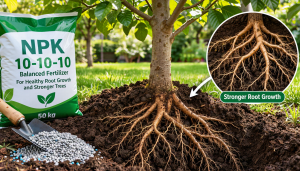
Fertilizer for tree root growth is applied at planting, in early spring, and sometimes in fall, so selection must account for release rate, root depth, and how easily the product moves through soil. The wrong product can burn roots or feed weeds instead of trees.
In this guide, we review 15 of the best fertilizers for tree root growth by examining nutrient balance, application timing, and what each product needs to perform.
Best Fertilizer For Tree Root Growth: 15 Best Options
1. Root Stimulator With Phosphorus – Best Overall Fertilizer For New Tree Roots
Root stimulator with phosphorus is the best overall fertilizer for new tree roots because it delivers phosphorus and a light hormone charge that encourages rapid root initiation after transplant. Newly planted trees need roots before they need top growth.

- IDEAL PLANTS - Perfect for transplants, houseplants, vegetables, fruit trees, berries, flowers, trees, shrubs, and ornamentals.
- ROOTING HORMONES - Use Root and Grow anytime you are seeding or transplanting to stimulate early root formation and stronger root development, to help reduce transplant shock, and to promote more vigorous plant growth.

Dilute the root stimulator per the label and water it into the backfill soil immediately after planting, then repeat two to three times in the first season. Apply to the root ball and surrounding soil, not the trunk.
Root stimulator fertilizer from a reputable supplier is backed by quality guarantees and works well for gardeners establishing new trees.
- Encourages root initiation
- Formulated for transplants
- Easy to dilute
- Reduces transplant shock
- Works on most species
- Good for bare-root trees
- Fast response
- Not for mature trees
- Needs repeat applications
- Can burn if overmixed
2. Bone Meal – Best Slow-Release Phosphorus Fertilizer For Tree Roots
Bone meal is the best slow-release phosphorus fertilizer for tree roots because it feeds steadily through the first seasons and adds calcium that supports strong root cell walls. It is a classic amendment for planting holes.


- STRONGER ROOT DEVELOPMENT: Bone Meal is a natural source of vital, readily available organic nitrogen, phosphorus and calcium that promotes strong plant roots, vibrant blooms and more delicious vegetables. Helps to enhance your plants throughout the growing season!
- ADD TO SOIL: Add to soil or potting mix during seed starting or at any time prior to harvest to fuel strong roots and early, healthy plant growth. Bone meal fertilizer breaks down slowly, releasing nitrogen for robust growth throughout the season. Follow packaging instructions for the amount to use.
Mix bone meal into the backfill soil at planting and scratch a handful into the soil around the root zone each spring. Apply early so phosphorus begins breaking down before roots need it.
Bone meal fertilizer from a reputable supplier is backed by quality guarantees and works well for gardeners building long-term soil fertility.
- Slow release
- Supports root development
- Adds calcium
- Low burn risk
- Good at planting
- Organic input
- Improves soil over time
- Slow to become available
- Can attract animals
- Needs soil contact
3. Mycorrhizal Inoculant – Best Biological Fertilizer For Root Establishment
Mycorrhizal inoculant is the best biological fertilizer for root establishment because it introduces beneficial fungi that extend the root system and improve nutrient and water uptake. New trees establish faster with healthy mycorrhizae.

- POWERFUL MYCORRHIZAL ROOT SUPPORT: Our mycorrhizal rooting hormone for cuttings contains beneficial mycorrhizal fungi that colonize roots, helping plants absorb water and nutrients more efficiently while promoting stronger root development and healthier growth.
- IMPROVES NUTRIENT & WATER UPTAKE: Expands the effective root zone with our mycorrhizal plant food to increase access to essential nutrients and moisture, supporting vigorous plant growth, improved resilience, and stronger overall plant performance.
Apply the inoculant directly to the roots at planting, following the label for bare-root, container, or balled-and-burlapped trees. Keep the soil moist but not saturated, since fungi need oxygen to colonize.
Mycorrhizal inoculant from a reputable supplier is backed by quality guarantees and works well for gardeners establishing trees in poor soil.
- Extends root reach
- Improves nutrient uptake
- Improves water uptake
- Reduces transplant shock
- Works with organic programs
- Good in poor soil
- Long-lasting benefit
- Needs direct root contact
- Variable results
- Higher upfront cost
4. Balanced Tree And Shrub Fertilizer 10-10-10 – Best All-Purpose Fertilizer For Established Trees
Balanced tree and shrub fertilizer 10-10-10 is the best all-purpose fertilizer for established trees because it supplies equal nitrogen, phosphorus, and potassium that support root and canopy growth together. It suits trees of most ages.

- Contains natural ingredients to feed microbes in the soil
- For use on all flowering trees, shrubs and other acid-loving plants
Broadcast granules over the root zone out to the drip line in early spring, scratching them lightly into the soil and watering deeply. Keep the product well away from the trunk.
Tree and shrub fertilizer from a reputable supplier is backed by quality guarantees and works well for gardeners who want a simple annual feeding.
- Balanced nutrients
- Supports roots and canopy
- Easy to spread
- Works on many species
- Widely available
- Predictable results
- Good annual program
- Can burn if overapplied
- Needs repeat applications
- Does not build soil
5. Slow-Release Tree Fertilizer Spikes – Best Low-Effort Fertilizer For Root Zones
Slow-release tree fertilizer spikes are the best low-effort fertilizer for root zones because they feed for months with no measuring or mixing. They suit homeowners who want a simple feeding routine for established trees.

- LASTING COLOR: Miracle-Gro Tree & Shrub Plant Food Spikes are fertilizer spikes for trees and shrubs; they promote vibrant color and foliage for trees and shrubs in your yard
- PROVIDES NUTRITION: These easy-to-use outdoor tree food spikes provide slow release nutrients directly to your trees and shrubs' roots, where they need it most
Drive spikes into moist soil around the drip line, following the label count for trunk diameter. Space them evenly around the tree and water thoroughly so nutrients begin dispersing.
Tree fertilizer spikes from a reputable supplier are backed by quality guarantees and work well for homeowners who want minimal handling.
- No mixing or measuring
- Feeds for months
- Simple application
- Good for beginners
- Predictable dosing
- Low mess
- Works on established trees
- Concentrates nutrients locally
- Not adjustable
- Limited root coverage
6. Organic Compost – Best Soil-Building Fertilizer For Tree Root Zones
Organic compost is the best soil-building fertilizer for tree root zones because it improves structure, water retention, and soil life around expanding roots. Healthy soil feeds trees far better than any single nutrient product.

- 100% Organic & Peat-Free: Our compost mix is 100% organic & peat-free. Peat is one of Mother Nature’s most important stores of carbon. Instead of imported peat, the base of our soils is made from upcycled plant matter or wood fines from the United States!
- Intended for use in Compost Mix: Our unique soil blend is ideal for nurturing herbs, vegetables, and fruits planted in a raised bed. Its nutrient-rich composition provides the essential elements for promoting robust growth, vibrant flavors, and bountiful harvests. It’s also proudly made in the USA.
Spread a two-inch layer of compost out to the drip line each spring and let earthworms and watering work it in. Keep compost a few inches from the trunk so the flare stays dry and visible.
Organic compost from a reputable supplier is backed by quality guarantees and works well for homeowners who want long-term soil improvement.
- Improves soil structure
- Feeds soil life
- Low burn risk
- Improves water retention
- Supports steady growth
- Good for sandy and clay soils
- Renewable input
- Slow nutrient release
- Needs annual reapplication
- Can bury the root flare if piled high
7. Mulch Layer – Best Indirect Fertilizer For Tree Roots
Mulch is the best indirect fertilizer for tree roots because it breaks down into organic matter, moderates soil temperature, and holds moisture that roots need. A proper mulch ring is the single best root investment.

- Includes 10lb block of Back to the Roots compressed Coconut Husk Mulch that expands to over 2 cubic feet of mulch. Use it for gardens, raised beds, pet bedding and more
- Expands to over 2 cubic feet
Spread a three- to four-inch layer of bark or wood mulch out to the drip line, keeping it a few inches away from the trunk. Refresh the ring every year or two as the mulch breaks down.
Tree mulch from a reputable supplier is backed by quality guarantees and works well for homeowners who want a simple, ongoing root program.
- Improves soil as it decays
- Holds moisture
- Moderates soil temperature
- Suppresses weeds
- Low cost
- Easy to apply
- Protects shallow roots
- Not a direct nutrient source
- Needs annual top-up
- Can smother roots if piled against trunk
8. Nitrogen-Only Fertilizer 30-0-0 – Best Fertilizer For Canopy And Root Expansion
Nitrogen-only fertilizer 30-0-0 is the best fertilizer for canopy and root expansion because nitrogen drives growth throughout the tree, including fine root production. It suits established trees with adequate phosphorus and potassium.

- High Nitrogen Formula – Promotes lush green foliage and vigorous plant growth.
- Essential Macronutrient Support – Helps maintain balanced plant nutrition and vitality.
Apply in early spring before bud break, broadcast over the root zone, and water in deeply. Avoid applying near the trunk or during drought stress, since concentrated nitrogen can burn feeder roots.
High nitrogen tree fertilizer from a reputable supplier is backed by quality guarantees and works well for homeowners with nitrogen-poor soil.
- Drives fast growth
- Supports fine root production
- Good for nitrogen-poor soil
- Works on established trees
- Easy to spread
- Visible response
- Widely available
- Can burn roots if overapplied
- Needs soil test first
- Not for young trees
9. Root-Growth Liquid Concentrate – Best Drench Fertilizer For Transplanted Trees
Root-growth liquid concentrate is the best drench fertilizer for transplanted trees because it delivers water-soluble nutrients and hormones straight to the root ball during the critical first season. It reduces transplant stress.

- THE ULTIMATE ROOTING BOOSTER: Specially formulated with all-natural rooting hormone and vitamins, our propagation drops dramatically speed up root development and strengthen plants at every stage, from delicate cuttings to mature houseplants.
- FASTER RESULTS, HEALTHIER PLANTS: Unlike messy rooting powder and gel, our liquid formula works effectively for water propagation, soil transplants, and specialized substrates like leca, pon, or sphagnum moss - growing faster, stronger, and thicker roots.
Mix the concentrate per label directions and pour it slowly over the root ball immediately after planting, then repeat every two to three weeks through the first summer. Water deeply before and after each application.
Root growth liquid fertilizer from a reputable supplier is backed by quality guarantees and works well for gardeners establishing new trees in hot climates.
- Fast nutrient delivery
- Reduces transplant shock
- Formulated for roots
- Easy to apply
- Good in containers
- Works with watering schedule
- Quick response
- Needs repeat applications
- Can burn if overmixed
- Not for mature trees
10. Seaweed Extract – Best Hormone-Rich Fertilizer For Root Initiation
Seaweed extract is the best hormone-rich fertilizer for root initiation because it supplies natural growth compounds that stimulate root tips and help trees recover from stress. It works well alongside phosphorus products.

- Organic Seaweed & Kelp Fertilizer – Seaweed fertilizer for plants made from clean kelp seaweed fertilizer sources for natural plant nutrition.
- Supports Root Growth & Plant Health – Kelp fertilizer helps promote strong roots, improved nutrient uptake, and overall plant resilience.
Dilute seaweed extract and apply as a soil drench or foliar spray every two to three weeks during the first growing season. Spray in the cooler part of the day to avoid leaf burn.
Seaweed extract fertilizer from a reputable supplier is backed by quality guarantees and works well for gardeners who want gentle stress support.
- Stimulates root tips
- Provides micronutrients
- Supports stress recovery
- Gentle organic input
- Works as drench or spray
- Safe for young trees
- Easy to dilute
- Needs frequent application
- Lower NPK content
- Can clog sprayers
11. Humic Acid Granules – Best Soil-Activating Fertilizer For Deep Roots
Humic acid granules are the best soil-activating fertilizer for deep roots because they improve soil structure and chelate nutrients so roots can absorb them more easily. They help trees in compacted or poor soil.
- Carbon soil amendment – increases soil carbon and soil organic matter
- Highly concentrated 70% humic content (A&L method). Feeds beneficial soil microbes by providing a key food source, carbon. Chelates nutrients to increase nutrient and fertilizer efficiency; increases nutrient absorption
Broadcast humic acid granules over the root zone in early spring, then water deeply to move them into the soil. Apply annually or whenever the soil feels compacted and lifeless.
Humic acid granules from a reputable supplier are backed by quality guarantees and work well for homeowners improving tough soils.
- Improves soil structure
- Chelates nutrients
- Supports root growth
- Good in compacted soil
- Low burn risk
- Easy to apply
- Works with compost
- Slow effect
- Needs moisture to activate
- Not a direct nutrient source
12. Liquid Fish And Kelp Blend – Best Gentle Fertilizer For Young Tree Roots
Liquid fish and kelp blend is the best gentle fertilizer for young tree roots because it delivers mild nitrogen, trace minerals, and growth hormones without burning tender new roots. It suits first-year trees.

- ORGANIC MATERIALS REVIEW INSTITUTE LISTED FOR TRUSTED GARDEN CARE Certified by OMRI for use in organic growing, GS Plant Foods Liquid Fish & Kelp Fertilizer delivers reliable, natural nutrition for vegetables, flowers, and shrubs.
- SEA-AND-SOIL BASED NUTRITION Made from North Atlantic seaweed (Ascophyllum nodosum) and fresh fish hydrolysate, this liquid concentrate delivers natural plant nutrition and beneficial organic compounds that help maintain healthy soil and support productive plants.
Dilute the blend per the label and apply as a soil drench every two to three weeks during the first season. Water the root zone before applying to prevent nutrient shock on new roots.
Fish and kelp fertilizer from a reputable supplier is backed by quality guarantees and works well for gardeners who want gentle organic feeding.
- Gentle on new roots
- Provides micronutrients
- Supports root growth
- Organic input
- Easy to dilute
- Safe for young trees
- Good with compost
- Strong odor
- Needs frequent application
- Lower NPK content
13. Gypsum – Best Calcium And Sulfur Fertilizer For Clay And Compacted Soil
Gypsum is the best calcium and sulfur fertilizer for clay and compacted soil because it improves soil structure and helps roots push through tight layers. It works without raising pH.

- OMRI Listed - Cz Gypsum Calcium Sulfate Dihydrate is an All-Natural mineral fertilizer listed by the Organic Materials Review Institute (OMRI). It may be used in certified organic production or food processing and handling according to the USDA National Organic Program regulations.
- Supplies essential nutrients calcium and sulfur to improve plant growth and maximize fertilizer performance.
Broadcast gypsum over the root zone in spring or fall at label rates and water it in thoroughly. It works slowly, improving clay structure over months as calcium displaces sodium.
Garden gypsum from a reputable supplier is backed by quality guarantees and works well for homeowners with heavy clay or compacted soil.
- Improves clay structure
- Adds calcium and sulfur
- Does not raise pH
- Helps roots penetrate
- Low cost
- Easy to spread
- Works with compost
- Slow effect
- Not a nutrient substitute
- Needs soil test first
14. Rock Phosphate – Best Long-Term Phosphorus Fertilizer For Root Systems
Rock phosphate is the best long-term phosphorus fertilizer for root systems because it releases slowly over years and supplies calcium alongside phosphorus. It suits gardeners building permanent soil fertility around trees.

- ORGANIC PLANT POWER - This high phosphorus fertilizer is a natural and organic source of phosphorus that helps correct phosphorus deficient soils
- ALL NATURAL - This phosphate fertilizer is derived from phosphorus-rich natural deposits, ensuring a premium and authentic source of this essential nutrient for your garden.
Apply rock phosphate around the root zone at planting and again every few years, scratching it into the topsoil and watering it in. Pair it with compost, since soil microbes are needed to release the phosphorus.
Rock phosphate fertilizer from a reputable supplier is backed by quality guarantees and works well for gardeners who want a slow, steady phosphorus source.
- Slow long-term release
- Supports root growth
- Adds calcium
- Organic input
- Works with compost
- Good for permanent plantings
- Low burn risk
- Very slow to act
- Needs microbial activity
- Limited in alkaline soil
15. Compost Tea – Best Microbial Fertilizer For Root Zone Health
Compost tea is the best microbial fertilizer for root zone health because it delivers beneficial organisms that improve nutrient cycling and suppress root pathogens. Healthy soil biology is the foundation of long-term root growth.

- Brew compost tea and worm casting tea for organic gardening
- Designed to be used with a standard 5-gallon bucket
Brew compost tea with dechlorinated water and quality compost, aerating for 24 to 36 hours before use. Apply as a soil drench around the root zone at dawn and use it within hours, since organisms decline quickly.
Compost tea brewers from a reputable supplier are backed by quality guarantees and work well for gardeners who want to support soil biology around trees.
- Supports soil microbes
- Improves nutrient cycling
- Suppresses root pathogens
- Gentle on roots
- Good with organic programs
- Works with compost
- Improves soil over time
- Needs brewing equipment
- Short shelf life
- Low direct NPK
Tips For Fertilizing For Tree Root Growth
- Feed the root zone, not the trunk: Tree roots extend far beyond the canopy. Broadcast fertilizer out to the drip line, never against the trunk.
- Prioritize phosphorus at planting: New trees need phosphorus for root initiation. Root stimulators, bone meal, and rock phosphate all support establishment.
- Water deeply and infrequently: Roots grow toward moisture. Deep watering encourages deep roots, while shallow watering encourages surface roots.
- Mulch the root zone: A proper mulch ring holds moisture, moderates temperature, and slowly feeds the soil as it decays.
- Test soil before feeding: Established trees rarely need heavy fertilizer. A soil test prevents overfeeding and nutrient imbalance.
- Skip nitrogen on new transplants: Nitrogen pushes top growth before roots can support it. Wait until the second season for high-nitrogen products.
- Support soil biology: Compost, humic acid, mycorrhizae, and compost tea improve the soil ecosystem that feeds tree roots over decades.
Frequently Asked Questions
1. What is the best fertilizer for tree root growth?
Root stimulator with phosphorus is the best choice for new trees because it encourages root initiation. Bone meal and mycorrhizal inoculant support establishment, while balanced fertilizer suits established trees.
2. How do I encourage tree roots to grow deeper?
Water deeply and infrequently, mulch the root zone, and avoid frequent shallow watering. Roots follow moisture, so deep watering trains roots to grow downward.
3. Should I fertilize a newly planted tree?
Yes, but with a root-focused product rather than high nitrogen. Phosphorus and mycorrhizae support root establishment, while nitrogen should wait until the second season.
4. Where should I apply fertilizer around a tree?
Broadcast fertilizer over the root zone out to the drip line, keeping it well away from the trunk. Tree roots spread far beyond the canopy.
5. Is bone meal good for tree roots?
Yes. Bone meal supplies slow-release phosphorus and calcium that support root development, especially at planting. It is one of the classic root-growth amendments.
6. What is the best fertilizer for mature trees?
Balanced tree and shrub fertilizer applied in early spring works well for most mature trees. A soil test should guide whether nitrogen, phosphorus, or potassium is actually needed.
7. Can fertilizer burn tree roots?
Yes. Overapplied or concentrated fertilizer can burn feeder roots, especially near the trunk. Follow label rates, water deeply, and keep products away from the trunk.
Conclusion
Root stimulator with phosphorus is the best overall fertilizer for new tree roots because it encourages rapid root initiation after transplant. Bone meal and mycorrhizal inoculant follow closely for steady establishment.
Balanced fertilizer, fertilizer spikes, compost, mulch, nitrogen products, root-growth drenches, seaweed extract, humic acid, fish and kelp blend, gypsum, rock phosphate, and compost tea each support tree roots in different ways and at different stages.
Effective root feeding depends on applying nutrients over the root zone, watering deeply, mulching well, and testing soil before adding fertilizer. No single product builds a root system alone.
Start with a root-focused feed at planting, build soil with compost and mulch, and adjust as the tree matures. Thoughtful care delivers deep roots and a healthy tree for decades.