Cool-season lawns need a balanced nutrition program to maintain dense growth, rich green color, and strong root development throughout the growing season.
Choosing the best fertilizer for cool season grass requires understanding how nitrogen, phosphorus, and potassium influence Kentucky bluegrass, tall fescue, perennial ryegrass, and fine fescue. 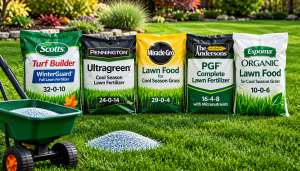
These grasses grow most actively during spring and fall, while high summer temperatures can slow their development and increase stress. A suitable fertilizer should provide the nutrients required for healthy growth without encouraging excessive leaf production.
In this guide, best fertilizer for cool season grass options are assessed according to nutrient composition, release characteristics, application flexibility, and suitability for different lawn-care objectives.
15 Best Fertilizers For Cool Season Grass
1. Scotts Turf Builder Lawn Food – Best Overall Fertilizer for Cool Season Grass
Scotts Turf Builder Lawn Food is a widely used granular fertilizer that provides nitrogen and potassium for maintaining attractive, actively growing turf, making it a practical option for homeowners seeking the best overall fertilizer for cool season grass. Its commonly marketed 32-0-4 formulation supplies a substantial nitrogen concentration to encourage green foliage and support recovery from routine mowing and moderate environmental stress. The relatively high nitrogen content makes accurate application particularly important when treating established lawns.


- WHERE TO USE: Lawn fertilizer for grass can be used on any grass type
- GRASS FERTILIZER FOR LAWNS: Scotts Turf Builder Lawn Food feeds and strengthens your grass to help protect against future problems

The 32-0-4 analysis supplies 32% nitrogen, no phosphate, and 4% soluble potash, making it more suitable for lawns that do not require additional phosphorus. Its granular formulation is convenient for spreading across established Kentucky bluegrass, tall fescue, and perennial ryegrass lawns with a calibrated broadcast spreader. Homeowners should follow the specific product label because application rates and directions can vary between packaging versions.
Scotts Turf Builder is particularly useful when the objective is to improve lawn color and encourage consistent shoot development during active growth. It should not be treated as a substitute for a soil test, especially where potassium deficiencies or other nutrient limitations are suspected. For routine maintenance, it offers a straightforward nitrogen-focused option for established cool-season turf.
- High nitrogen concentration
- Supports green foliage
- Supplies supplemental potassium
- Suitable for established lawns
- Granular application is convenient
- Contains no unnecessary phosphorus
- Works with common spreaders
- Requires accurate application
- Not a complete NPK fertilizer
- Excess nitrogen can encourage excessive growth
2. Jonathan Green Winter Survival Fall Fertilizer – Best Fall Fertilizer for Cool Season Grass
Jonathan Green Winter Survival Fall Fertilizer is formulated for autumn lawn feeding, when cool-season grasses can direct nutrients toward recovery and preparation for winter. Its commonly marketed 10-0-20 analysis makes it a useful option for homeowners searching for the best fall fertilizer for cool season grass. The combination of nitrogen and a relatively high potassium concentration supports foliage development and provides an important nutrient involved in plant stress tolerance.

- WINTER LAWN CARE: Designed as a winterizer lawn fertilizer to prepare grass for colder months and promote strong root growth for a healthy spring lawn.
- FALL FERTILIZER BENEFITS: Ideal as a fall lawn fertilizer to help grass recover from summer stress and store nutrients for winter survival.
The 10-0-20 formulation provides a lower nitrogen concentration than many conventional lawn foods, making it suitable for a more moderate feeding approach. Potassium contributes to several physiological processes, including water regulation and enzyme activity, although additional potassium is most beneficial when soil conditions indicate a need. The absence of phosphate also makes it an option for lawns where soil tests do not recommend phosphorus additions.
Apply this fertilizer during the appropriate autumn growth period rather than waiting until the lawn has stopped growing. It can complement proper mowing, irrigation, and leaf management as the grass recovers from summer stress. Homeowners should use the product label to determine the correct rate for their particular lawn and regional conditions.
- Designed for autumn feeding
- Supplies nitrogen and potassium
- Moderate nitrogen concentration
- Suitable for established cool-season lawns
- Supports seasonal lawn maintenance
- Contains no added phosphate
- Useful for fall nutrition programs
- Not a complete NPK fertilizer
- Less suitable when phosphorus is deficient
- Regional availability varies
3. Milorganite Organic Nitrogen Fertilizer – Best Organic Fertilizer for Cool Season Grass
Milorganite is an organic nitrogen fertilizer commonly used by homeowners who prefer a gradual nutrient-release approach for established turf. Its familiar 6-4-0 analysis provides nitrogen and phosphorus, making it a candidate for gardeners looking for the best organic fertilizer for cool season grass. The relatively low nitrogen concentration offers a different feeding profile from concentrated synthetic lawn fertilizers.

- Bundle of 2 items: One 32 lb bag of Milorganite 6-4-0 fertilizer and one printed feeding and spreader tips brochure with seasonal application guidance
- Low-salt formula: Milorganite contains virtually no salts, helping avoid streaks, stripes, and fertilizer burn, even in hot or dry conditions
The 6-4-0 formulation contains 6% nitrogen, 4% phosphate, and no listed potash, so its nutrient contribution should be evaluated against the lawn’s soil-test requirements. Its organic nutrient sources release nitrogen through biological processes, with the speed of availability influenced by soil temperature, moisture, and microbial activity. Because it contains phosphorus, repeated applications should be avoided where soil tests already indicate excessive phosphorus.
Milorganite can be incorporated into a broader lawn-maintenance program when its nutrient analysis suits the site’s requirements. It is not a complete fertilizer because it does not supply potassium, and its slower nutrient-release behavior may not provide the immediate response associated with some soluble nitrogen products. Follow the current label for application rates, watering guidance, and local restrictions.
- Organic nutrient source
- Gradual nitrogen availability
- Contains phosphorus
- Lower nitrogen concentration
- Suitable for established lawns
- Provides an alternative to conventional lawn food
- Useful in planned fertility programs
- Does not supply listed potassium
- Contains phosphorus that may be unnecessary
- Response depends on soil conditions
4. The Andersons Professional Turf Fertilizer – Best Professional-Style Fertilizer for Cool Season Grass
The Andersons manufactures granular turf fertilizers for residential and professional lawn-management programs, with different formulations designed to meet different nutritional requirements. Its lawn fertilizer range includes products with nitrogen and potassium, making suitable formulations worth considering when selecting the best professional fertilizer for cool season grass. Buyers should compare the exact analysis on the bag because the brand sells multiple products rather than one universal formulation.

- Application 4 of The Andersons Lawn Program
- Helps feed and prepare your lawn for winter
A formulation such as 24-0-10 provides a concentrated nitrogen supply alongside potassium, without adding phosphate. This nutrient balance can suit established lawns where soil testing indicates adequate phosphorus but continued nitrogen feeding is required. Granular products are particularly convenient for treating larger lawn areas with a calibrated spreader.
The Andersons range is useful for homeowners who want to select a fertilizer according to a specific NPK requirement rather than relying exclusively on a general-purpose lawn food. Its suitability depends on the exact formulation, nitrogen-release characteristics, and recommended application rate. Always check the current bag analysis before purchasing because product names and formulations can differ by market.
- Multiple turf fertilizer formulations
- Options with nitrogen and potassium
- Suitable for established lawns
- Granular application
- Useful for planned nutrient programs
- Some options omit phosphorus
- Suitable for larger lawn areas
- Formulations vary considerably
- Some products target professional users
- Exact product analysis must be checked
5. Espoma Organic Lawn Food – Best Natural Fertilizer for Cool Season Grass
Espoma Organic Lawn Food is a granular organic fertilizer designed for homeowners interested in using organic nutrient sources in their lawn-maintenance programs. Its commonly listed 9-0-0 analysis supplies nitrogen without adding phosphate or potash, making it a possible choice for those seeking the best natural fertilizer for cool season grass. The product is particularly relevant when nitrogen is the primary nutrient required by an established lawn.

- CONTAINS: Espoma Organic Lawn Food is a rich blend of the finest natural & organic ingredients enhanced with our exclusive Bio-tone formula; 9-0-0 Fertilizer analysis. Adds Long Lasting Nitrogen for Deep Green Color. Environmentally Safe - No sludges or toxic ingredients.
- FOR USE ON: Use for all lawns both cool and warm season grasses. Ideal for fescues, bluegrass, rye grass, St. Augustine and zoysia. Won’t Burn Lawns or Leach Out of Soil
Its nitrogen contribution supports chlorophyll production, leaf development, and the maintenance of green turf when moisture and temperature conditions support active growth. As an organic fertilizer, its nitrogen availability depends partly on microbial activity, so the response may be less immediate than with readily soluble synthetic products. The absence of listed phosphorus and potassium means that separate nutrient amendments may be necessary if soil testing identifies deficiencies.
Espoma is worth considering for homeowners who prefer organic lawn inputs and want to avoid automatically adding phosphorus to the soil. It should be applied according to the current product label, with attention to the lawn’s seasonal growth pattern. Organic fertilizers still require appropriate handling and should not be applied in excessive quantities.
- Organic nitrogen source
- Supplies nitrogen for foliage growth
- Does not add listed phosphate
- Suitable for established lawns
- Granular application
- Useful in organic lawn programs
- Lower risk of sudden nutrient release than many soluble feeds
- Does not supply listed phosphorus or potassium
- Slower response than soluble nitrogen
- Availability depends on soil conditions
6. GreenView Fairway Formula Lawn Fertilizer – Best Slow-Release Fertilizer for Cool Season Grass
GreenView Fairway Formula is a lawn fertilizer range that includes products designed to provide nitrogen over an extended period. Suitable formulations can be considered by homeowners looking for the best slow-release fertilizer for cool season grass, particularly when they want to reduce the need for frequent feeding. The exact NPK analysis and percentage of slow-release nitrogen depend on the particular product.

- Formula - GreenView lawn food is a high nitrogen fertilizer with 63% slow release nitrogen that continuously feeds your grass for up to 12 weeks, promoting thick green grass growth without surge patterns for consistent lawn care results
- Coverage - This 33 lb bag of GreenView fertilizer grass food covers 10,000 sq ft of yard area, making it perfect for medium to large lawns that need comprehensive spring fertilizer treatment and ongoing nutrition
Slow-release nitrogen can provide a more gradual supply of this essential nutrient, helping maintain turf growth without the sharp growth response associated with some quick-release fertilizers. A formulation containing nitrogen and potassium can be useful when both nutrients are required by the soil and grass. Homeowners should inspect the guaranteed analysis and slow-release nitrogen statement instead of assuming every GreenView product has identical characteristics.
This fertilizer is most useful when its release characteristics match the lawn’s growing conditions and the intended application schedule. Slow-release nitrogen does not eliminate the risk of overfertilization, and the product should still be applied at the recommended rate. It is particularly worth comparing with conventional lawn foods when planning a longer-term maintenance program.
- Slow-release options available
- Supports gradual nitrogen delivery
- Suitable for established turf
- Can reduce feeding frequency
- Granular application
- Useful for seasonal maintenance
- Multiple lawn-care formulations
- Product analyses vary
- Some formulations may cost more
- Release depends on product characteristics and conditions
7. Pennington UltraGreen Lawn Fertilizer – Best Fertilizer for Greening Cool Season Grass
Pennington UltraGreen is a lawn fertilizer range designed to provide nutrients that support green foliage and turf development. Formulations such as 30-0-4 offer substantial nitrogen alongside potassium, making them relevant to homeowners searching for the best fertilizer for greening cool season grass. The high nitrogen concentration is particularly important to consider when planning application rates.

- This spring lawn fertilizer is one application and done for a season
- Contains natural beneficial microorganisms for lawn care that revitalize soil
Nitrogen is a central component of chlorophyll and several plant proteins, which explains its importance in maintaining green grass. A 30-0-4 analysis supplies nitrogen and potassium but does not provide phosphate, so it is not intended to correct phosphorus deficiency. The product should be used when the lawn is actively growing and can use the supplied nutrients.
Pennington UltraGreen can be useful for established Kentucky bluegrass and tall fescue lawns that need nitrogen-based maintenance feeding. However, excessive nitrogen can create unnecessary shoot growth, increase mowing requirements, and make turf more vulnerable to stress when conditions are unfavorable. Follow the label rather than applying fertilizer solely according to the lawn’s color.
- High nitrogen concentration
- Supports green foliage
- Supplies potassium
- Granular application
- Suitable for established turf
- Useful for routine lawn feeding
- No listed phosphate in 30-0-4 formulations
- High nitrogen requires careful dosing
- Not a complete NPK fertilizer
- Not suitable for every seasonal condition
8. Simple Lawn Solutions Advanced 16-4-8 – Best Liquid Fertilizer for Cool Season Grass
Simple Lawn Solutions Advanced 16-4-8 is a liquid lawn fertilizer that provides nitrogen, phosphate, and potash in one formulation. Its balanced nutrient profile makes it an option for homeowners seeking the best liquid fertilizer for cool season grass, especially when all three primary nutrients are required. Unlike granular fertilizers, liquid products are applied using the manufacturer’s recommended dilution and spraying instructions.
No products found.
The 16-4-8 analysis contains 16% nitrogen, 4% phosphate, and 8% potash, supplying nutrients involved in leaf development, root establishment, and plant metabolism. Its liquid format allows the product to be distributed using suitable spraying equipment, although even coverage depends on correct dilution and application technique. Because it contains phosphorus, it should not automatically be applied to lawns where soil tests show sufficient or excessive phosphate.
This product can be considered for established cool-season lawns when a complete nutrient formulation is appropriate. Liquid fertilizers may provide a relatively rapid response, but their application still needs to match the lawn’s growth stage and environmental conditions. Avoid spraying during extreme heat or drought stress, and follow all label precautions.
- Supplies all three primary nutrients
- Convenient liquid formulation
- Contains nitrogen for leaf growth
- Provides phosphate and potash
- Suitable for targeted feeding
- Can be applied with compatible sprayers
- Useful where soil tests support complete feeding
- Contains phosphorus that may be unnecessary
- Requires correct dilution
- Coverage depends on spraying technique
9. Lesco Professional Turf Fertilizer – Best Commercial Fertilizer for Cool Season Grass
Lesco Professional Turf Fertilizer is a range of granular products used in professional lawn and turf management. Its various formulations make it possible to select nitrogen-focused or more complete nutrient combinations, which is useful for homeowners seeking the best commercial fertilizer for cool season grass. The correct product should be chosen according to the lawn’s species, soil-test results, and maintenance requirements.

Some Lesco formulations provide concentrated nitrogen with potassium, while other products may include phosphorus or different nutrient ratios. Controlled-release nitrogen options can be particularly useful when a lawn requires a gradual nutrient supply during active growth. The guaranteed analysis should be checked carefully because a brand name alone does not establish the nutrient composition or release characteristics.
Lesco is worth considering for larger properties and users who already understand fertilizer calculations and spreader calibration. Applying the wrong analysis or excessive nitrogen can produce undesirable growth and nutrient losses. Use the exact product label to establish application rates and seasonal suitability.
- Professional turf product range
- Multiple nutrient formulations
- Options with controlled-release nitrogen
- Suitable for larger lawn areas
- Granular application
- Useful for planned maintenance
- Allows selection based on soil needs
- Product analyses vary
- Some formulations may be harder to find
- Requires careful spreader calibration
10. Scotts Turf Builder WinterGuard Fall Lawn Food – Best Winter Preparation Fertilizer for Cool Season Grass
Scotts Turf Builder WinterGuard Fall Lawn Food is designed for autumn lawn maintenance, when cool-season grasses are recovering from summer conditions and preparing for colder weather. It is a useful candidate for homeowners searching for the best winter preparation fertilizer for cool season grass. Its intended seasonal role makes application timing particularly important.

- FALL LAWN FERTILIZER: Scotts Turf Builder WinterGuard Fall Lawn Food is a fertilizer that builds strong, deep grass roots for a better lawn next spring
- SUMMER LAWN RECOVERY: Our fertilizer provides nutrients lawns need to help recover from summer heat, drought, and regular activity while preparing roots to take on harsh winter conditions
Fall fertilization supplies nutrients during a period when many cool-season grasses can actively develop roots and shoots. The product’s exact NPK formulation should be confirmed from the current bag, since WinterGuard products can differ by market and product version. A suitable fall fertilizer should provide an appropriate nitrogen contribution without encouraging excessive late-season growth.
This product is best considered as part of an autumn lawn-care program rather than a replacement for soil testing or proper cultural management. Apply it while the grass is still actively growing and follow the instructions for the relevant regional formulation. Do not apply additional fertilizer simply because the lawn looks less green as temperatures decline.
- Designed for fall lawn care
- Suitable for seasonal feeding
- Supports active cool-season turf
- Convenient granular application
- Useful after summer stress
- Fits into autumn maintenance programs
- Widely recognized lawn-care brand
- Exact analysis varies by product
- Not a substitute for soil testing
- Timing is important
11. Scotts Turf Builder Triple Action – Best Multi-Action Fertilizer for Cool Season Grass
Scotts Turf Builder Triple Action combines lawn fertilizer with additional lawn-care ingredients, depending on the specific product version. It is an option for homeowners looking for a multi-action fertilizer for cool season grass while also addressing selected weed or weed-and-feed management needs. Its suitability depends on whether the accompanying herbicide is labeled for the grass species and weeds present.

- 3-IN-1 FORMULA: Scotts Turf Builder Triple Action1 is a three-in-one lawn fertilizer and weed control formula that kills listed lawn weeds, prevents crabgrass, and feeds grass to build thick, green lawns
- WHERE TO USE: This grass fertilizer, crabgrass preventer, and clover and dandelion killer for lawns is for use on Bahiagrass, Centipedegrass, Kentucky Bluegrass, Perennial Ryegrass, Bermudagrass, Tall Fescue, Fine Fescue, and Zoysiagrass
The fertilizer component supplies nutrients that support green foliage and active turf growth, while the additional ingredients are intended for the specific weed-control claims on the package. Some versions are designed for particular grass types and application periods, so the label must be checked before use. A product containing herbicides should never be treated as an ordinary fertilizer that can be spread at any time.
This option is most appropriate when a lawn has both a legitimate fertilizer requirement and a weed-control problem that the product is labeled to address. Homeowners with fine fescue, newly seeded grass, or sensitive turf varieties should be particularly careful about restrictions. If weed control is unnecessary, a fertilizer-only product is usually the more straightforward choice.
- Combines lawn feeding with other lawn-care functions
- Convenient granular application
- Supports green turf growth
- Can address selected weed problems
- Reduces the need for separate products in some programs
- Established lawn-care brand
- Product-specific options available
- Herbicide restrictions apply
- Not suitable for every grass species
- Unnecessary when weeds are absent
12. LebanonTurf ProScape Fertilizer – Best Turf Management Fertilizer for Cool Season Grass
LebanonTurf ProScape is a professional turf nutrition range that offers different fertilizer formulations for lawn and landscape management. Its range can suit property managers and homeowners searching for the best turf management fertilizer for cool season grass because it allows selection according to the required nutrient ratio. Product-specific nitrogen-release characteristics should be checked before choosing a formulation.

- Roots Fertilizer for Trees is a water-dispersible chemical and biological fertility product with NPK of 11-22-22 SRN (slow release nitrogen) for the fertilization of trees
- This lower nitrogen fertilizer provides both macro- and micro-nutrients to replenish seasonal (short-term) fertility requirements; provides essential mineral nutrients that promote growth, health and
A suitable ProScape formulation can provide nitrogen for shoot development and may include potassium for additional nutritional support. Some professional fertilizers use controlled-release nitrogen sources to extend nutrient availability and reduce the need for frequent applications. However, the exact benefits depend on the formulation, nitrogen source, soil moisture, and temperature.
ProScape is particularly relevant when maintaining larger turf areas that require a planned fertilizer schedule. It is important to distinguish between products designed for quick green-up and those intended for longer-term feeding. Select the exact analysis according to a soil test and the grass species rather than purchasing solely by brand.
- Professional turf fertilizer range
- Multiple nutrient ratios
- Options for controlled-release feeding
- Suitable for established turf
- Useful for larger properties
- Supports planned fertilizer programs
- Allows species-specific nutrient selection
- Exact formulation must be selected
- Availability varies by retailer
- May be more than small lawns require
13. Sta-Green Lawn Fertilizer – Best Budget-Friendly Fertilizer for Cool Season Grass
Sta-Green lawn fertilizers provide homeowners with a range of granular products for routine turf maintenance. Selected formulations containing nitrogen and potassium can be useful for those seeking the best budget-friendly fertilizer for cool season grass. The product’s value should be judged by its guaranteed analysis, bag size, and cost per pound of actual nitrogen rather than its retail price alone.

- Feeds for deep greening in just 3 days
- Dual-action, 2-in-1 formula feeds and supplements with iron
A nitrogen-rich formulation can support foliage development and help maintain lawn color during active growth. Some products in this category include potassium, while others may have different nutrient ratios, so the label should be checked before purchase. A lower-priced fertilizer is not necessarily more economical if its nutrient concentration requires a much larger application.
Sta-Green is worth comparing with other conventional lawn fertilizers when maintaining an established lawn on a budget. Use a calibrated spreader and calculate the quantity needed from the percentage of nitrogen in the product. Avoid applying it to drought-stressed, dormant, or heat-stressed grass unless the label and local recommendations support the application.
- Conventional lawn fertilizer options
- Often competitively priced
- Granular application
- Nitrogen supports foliage growth
- Suitable formulations for established turf
- Convenient for routine maintenance
- Available through lawn-care retailers
- Nutrient ratios vary
- Slow-release content is product-dependent
- Not every formulation suits every lawn
14. Sunday Green Machine Lawn Fertilizer – Best Lawn Fertilizer for Convenient Application
Sunday Green Machine is part of a lawn-care product range designed to make routine lawn maintenance more convenient for homeowners. Its fertilizer formulation can be considered when selecting the best convenient fertilizer for cool season grass, particularly for users who prefer straightforward application systems. The exact nutrient analysis and application method should be confirmed from the product currently available.

- SUNDAY IS OFFICIALLY ON AMAZON: Sunday Lawn Care, the premium lawn care brand now available on Amazon! Say goodbye to harsh ingredients and hello to a healthier, greener lawn with Sunday.
- NUTRIENTS YOUR LAWN NEEDS: Our 22-0-3 cutting-edge liquid formulation helps fortify your grass by encouraging deep rooting with ingredients like nitrogen, seaweed, iron, and potassium.
A fertilizer’s effectiveness depends on whether its nutrient composition meets the requirements of the turf and soil. Nitrogen is particularly important for cool-season grasses because it supports chlorophyll production and the development of new leaves. If the product contains additional nutrients, those should be considered in relation to the lawn’s soil-test results.
Sunday products are most useful when their application format fits the homeowner’s equipment and maintenance routine. The correct seasonal timing remains important, regardless of whether the fertilizer is delivered in liquid or granular form. Follow the manufacturer’s dilution, application, and watering instructions to prevent uneven feeding.
- Designed for convenient lawn care
- Suitable for planned feeding
- Nitrogen supports green foliage
- Product range offers different lawn-care options
- Useful for residential lawns
- Can fit routine maintenance schedules
- Alternative to conventional granular products
- Exact nutrient analysis must be checked
- Availability varies by region
- Application system may limit flexibility
15. Fertilome Lawn Food – Best General-Purpose Fertilizer for Cool Season Grass
Fertilome Lawn Food is a general lawn nutrition option for homeowners who want to maintain established turf through regular fertilizer applications. Depending on the selected formulation, it can provide nitrogen and other nutrients needed by cool-season grasses. It is worth considering when comparing the best general-purpose fertilizer for cool season grass products available through garden centers.

- Fast and Lasting: Features both fast and slow-release nitrogen to get immediate greening and long-term stable growth to promote thick, dense lawns.
- Deep-Green Coloration: Contains chelated iron to promote a beautiful, healthy coloration in your lawn.
The exact nutrient analysis determines whether a Fertilome product is appropriate for Kentucky bluegrass, tall fescue, perennial ryegrass, or fine fescue. A nitrogen-rich formulation may be suitable for routine foliage maintenance, while a complete fertilizer may be more appropriate where soil tests identify phosphorus or potassium deficiencies. The product label should also be checked for application timing and any restrictions.
Fertilome can be incorporated into a lawn program when its formulation meets the site’s nutritional requirements. It should not be applied automatically at every seasonal transition because cool-season grasses have changing nutrient demands throughout the year. A soil test, appropriate mowing height, and consistent irrigation will help determine whether additional fertilizer is necessary.
- General lawn nutrition option
- Multiple formulations may be available
- Suitable for established turf when correctly selected
- Nitrogen supports green growth
- Convenient garden-center product range
- Can fit seasonal maintenance programs
- Useful for comparing nutrient ratios
- Exact formulation varies
- Not every product is designed for cool-season turf
- Soil testing is still necessary
7 Important Factors to Consider When Buying Fertilizer for Cool Season Grass
1. Nitrogen Percentage
Nitrogen is the primary nutrient responsible for promoting green foliage and supporting the development of new grass leaves. Cool-season grasses such as Kentucky bluegrass, tall fescue, and perennial ryegrass generally respond strongly to nitrogen when temperatures and moisture conditions support active growth.
Look at the first number in the NPK analysis when comparing fertilizers. A 30-0-4 product contains 30% nitrogen by weight, whereas a 10-0-20 fertilizer contains 10% nitrogen. A higher nitrogen percentage does not automatically make a fertilizer better because the correct application rate depends on the quantity of actual nitrogen required per unit of lawn area.
2. Nitrogen Release Characteristics
Fertilizers may contain quick-release nitrogen, slow-release nitrogen, or a combination of both. Quick-release sources can produce a faster response, but they require careful application and may create excessive growth if applied in large quantities.
Slow-release nitrogen supplies nutrients more gradually and can extend the feeding period. Purdue Extension explains that slow-release products can reduce rapid growth surges and lower the risk of nutrient losses under suitable conditions. Check the guaranteed analysis for the percentage and type of slow-release nitrogen rather than relying solely on marketing descriptions.
3. Grass Species
Different cool-season grasses have different annual nitrogen requirements. Fine fescues generally require less nitrogen than Kentucky bluegrass, while tall fescue and perennial ryegrass commonly benefit from moderate annual feeding.
Kentucky bluegrass can require a relatively substantial nitrogen supply to maintain dense growth, whereas fine fescues often perform well under lower-input maintenance programs. Identifying the grass species before selecting a fertilizer helps prevent overapplication and unnecessary expenditure.
4. Soil Phosphorus and Potassium Levels
Phosphorus and potassium are important nutrients, but their application should be based on actual soil requirements. Phosphorus supports energy transfer and root development, while potassium contributes to water regulation, enzyme activation, and stress tolerance.
A fertilizer with an NPK ratio of 32-0-4 supplies nitrogen and potassium without phosphate. A 16-4-8 fertilizer supplies all three primary nutrients. Neither is automatically superior; the appropriate choice depends on the existing nutrient status of the soil.
5. Seasonal Application Timing
Cool-season grasses grow most actively during cooler periods, especially in late summer and autumn. Fall nitrogen applications can encourage recovery from summer stress, increase turf density, and support root development before winter.
Spring feeding can help restore green color, but excessive spring nitrogen may produce rapid shoot growth and increase mowing requirements. Summer feeding should generally be reduced or avoided when turf is heat-stressed, drought-stressed, or dormant.
6. Fertilizer Formulation
Granular fertilizers are popular because they are relatively easy to distribute across larger lawns using a broadcast or drop spreader. Liquid fertilizers can be convenient for smaller areas and targeted applications, although proper dilution and even spraying are essential.
Organic fertilizers provide nutrients through organic materials and often release nitrogen gradually as soil organisms break them down. Synthetic fertilizers can offer more predictable nutrient concentrations and may provide a quicker response, depending on their nitrogen sources. Choose the formulation that fits the lawn’s requirements, equipment, and maintenance schedule.
7. Application Rate and Cost Per Pound of Nitrogen
The price of a fertilizer bag does not tell you how much nitrogen it supplies. Calculate the quantity of actual nitrogen in the bag before comparing products, particularly when evaluating fertilizers with different NPK ratios.
For example, a 50-pound bag of 20-0-5 fertilizer contains 10 pounds of nitrogen. A 50-pound bag of 10-0-20 fertilizer contains only 5 pounds of nitrogen. However, the second product supplies twice as much potash by weight, which may be useful if the soil requires additional potassium.
Best Fertilizer For Cool Season Grass Frequently Asked Questions
1. What is the best fertilizer for cool season grass?
A nitrogen-focused fertilizer with an appropriate release pattern is generally a strong choice for established cool-season lawns. Products such as Scotts Turf Builder Lawn Food and suitable slow-release GreenView or Andersons formulations can be considered, depending on their exact nutrient analyses. The best selection depends on grass species, soil fertility, season, and the lawn’s maintenance requirements.
2. What NPK ratio is best for cool season grass?
There is no single NPK ratio that is best for every cool-season lawn. Nitrogen is usually the most important nutrient for maintaining turf growth, while phosphorus and potassium should be applied according to soil-test recommendations. Ratios such as 30-0-4, 24-0-10, or 16-4-8 may be appropriate in different circumstances, but their suitability depends on the soil’s nutrient status.
3. When should I fertilize cool season grass?
Late summer and autumn are generally the most important periods for fertilizing cool-season lawns. These grasses can recover from summer stress and develop dense growth while temperatures are more favorable. A lighter spring application may be useful, but excessive summer fertilization should be avoided.
4. Is slow-release fertilizer better for cool season grass?
Slow-release fertilizer can be beneficial because it supplies nitrogen over an extended period rather than releasing the entire nutrient quantity rapidly. This can help maintain more consistent growth and reduce the risk of sudden growth surges. However, quick-release fertilizers can also be effective when applied at suitable rates and during appropriate growing conditions.
5. Can I use 10-10-10 fertilizer on cool season grass?
Yes, 10-10-10 fertilizer can be used when the lawn requires nitrogen, phosphorus, and potassium. However, it should not be applied automatically because many established lawns already contain adequate phosphorus and potassium. A soil test can determine whether a complete fertilizer is necessary or whether a nitrogen-focused product would be more appropriate.
6. Should I fertilize cool season grass during summer?
Cool-season grasses generally experience reduced growth and increased stress during hot summer conditions. Heavy nitrogen applications during this period can encourage vulnerable shoot growth and increase maintenance requirements. Fertilize during summer only when local recommendations, irrigation practices, and the lawn’s condition support the application.
7. How much fertilizer should I apply to cool season grass?
The correct quantity depends on the fertilizer’s nitrogen percentage and the recommended actual nitrogen rate per 1,000 square feet. For example, applying 1 pound of actual nitrogen from a 20% nitrogen fertilizer requires 5 pounds of product per 1,000 square feet. Always use the product label and local Extension recommendations to determine the correct rate for the particular lawn.
Conclusion
In conclusion, Scotts Turf Builder Lawn Food is a strong overall option for homeowners who need a concentrated nitrogen fertilizer for established cool-season turf, while Jonathan Green Winter Survival Fall Fertilizer is a useful runner-up for autumn feeding where its nitrogen and potassium formulation matches soil requirements. Both offer different nutritional approaches, so the right choice depends on the lawn’s seasonal needs and existing soil fertility.
Milorganite and Espoma Organic Lawn Food are worth considering for homeowners who prefer organic nutrient sources, while Simple Lawn Solutions Advanced 16-4-8 provides a liquid option containing all three primary nutrients. GreenView Fairway Formula, The Andersons, Lesco, and LebanonTurf ProScape offer additional formulations for homeowners seeking different nitrogen-release characteristics and turf-management approaches.
Pennington UltraGreen, Sta-Green, and suitable Fertilome products can also fit routine maintenance programs when their guaranteed analyses match the lawn’s requirements. Scotts WinterGuard Fall Lawn Food is another seasonal option, while Scotts Triple Action is relevant only when its additional weed-control ingredients are appropriate for the grass species and target weeds. Comparing nutrient composition is more important than choosing a fertilizer solely by brand reputation.
Choose a fertilizer according to the grass species, soil-test results, nitrogen requirement, and season of application. For most established cool-season lawns, a well-timed autumn nitrogen program combined with suitable mowing, irrigation, and soil management will provide a stronger foundation for healthy turf than repeatedly applying high-nitrogen fertilizer throughout the year.